
The three native peoples inhabiting the 500-kilometre-long Wadden Sea coast since the Early Middle Ages are the Jutes, the Frisians, and the Saxons. This blog post focuses on the latter, the Saxons. These were adventurous types who often lived off piracy. Many migrated from the Weser–Elbe Triangle to Frisia and on to England after the fall of the Western Roman Empire, where they also left something of a mark. However, not all of them left their Stedt. North of the River Elbe lived the Saxons known as the Nordalbingi, which translates as ‘the people north of the River Elbe.’ More specifically, among these northerners were the Dithmarsians, who lived where the sandy geest soils bordered the clay tidal marshlands. Below their medieval history of switching between free and not (so) free.
The history of the Dithmarschians has evident parallels with that of the Frisians. Both peoples lived on the narrow edge between sea and land. They were organised in Germanic tribal structures until they were incorporated into the Frankish Empire in the Early Middle Ages, around 800, and both were more or less simultaneously Christianised, either willingly or by force: Taufe oder Tod (‘baptism or death’), as the adage of the Roman Catholic Church was at the time. The conversion process was far from smooth, and missionaries, even prominent ones, not seldomly achieved martyrdom. Bonifatius was killed in 754, somewhere near the town of Dokkum in Frisia. Atrebanus was killed in 782, at the town of Meldorf in Thiatmaresgaho (i.e. Dithmarschen).
In the High Middle Ages, around the turn of the twelfth century, however, both peoples broke free from feudal and ecclesiastical authority, or at least managed to achieve a special autonomous status; either de jure or de facto. The entire Wadden Sea coast became a belt of small, self-governing communities. One slightly larger than the other. They lived off the fertile salt marsh soils, the sea, trade, and, at times, piracy. Something they found hard to give up. It marked the age of the so-called free peasant republics, which lasted roughly until the first half of the sixteenth century.
In other words, the Frisians and Saxons — including the Saxons of Land Hadeln more to the west who also governed themselves — belonged to a shared material culture, largely shaped by the same natural and political environments in which they lived. These conditions provided both similar opportunities and constraints. Also the manner of warfare showed strong similarities. Indeed, even the Franks made little distinction between the two groups in the Early Middle Ages, viewing them as broadly comparable populations.
Likewise, the Frisians and Saxons probably considered themselves as akin tribes during the Early Middle Ages. In Rome, for example, Frisian pilgrims initially stayed at the schola of their neighbours, the Saxons. Later, they did establish their own schola. They also at times joined forces both in fighting against the Franks and in fighting for them elsewhere in the kingdom.
However, there were also important differences between the two regions. For example, the Dithmarsians developed a more strongly clan-based social structure (Urban 2024), while simultaneously establishing a less fragmented political system. Unlike the Frisian lands, Dithmarschen did not fragment into numerous territories ruled by rival headmen or warlords, each controlling its own, small stone donjon, called a stins or Steinhaus, or later borg or state. Consequently, no fortified structures of stone are found in Dithmarschen (Kienitz 2024). Whereas in Frisia headmen — and even monasteries — became increasingly embroiled in protracted feuds with one another, Dithmarschen witnessed the growing influence of a governing regent class.
The rich farmers organised themselves in the so-called XLVIII or Achtundvierziger, the council of forty-eight representatives. In fact, the governing body of rich farmers (Kienitz 2024). But it has many other names in German like Kollegium der 48er and Rat der Bauern. The parallels with the regent class and the Heeren XVII (Lords Seventeen) of the Dutch Republic appear more than coincidental. The institution of the Achtundvierziger was first codified in the Landrecht (‘land law’) of Dithmarschen in the year 1447. To choose one’s own laws was, at the time, regarded as the very essence of communal freedom.
This more centralized organisation of the Dithmarsians enabled them, among other things, to reclaim land along the Wadden Sea coast on a much larger scale than the Frisians, who lived to the east and north of them, and to construct and maintain the necessary dykes, ditches, and sluices. Whereas the Frisians tended to build more isolated, island-like embankment systems, the Dithmarsians developed long, continuous dyke lines that often extended across multiple parishes. A process in which the early influence of the counts of Stade also appears to have played a role (Bünz & Missfeldt 2025). The House of Stade are also known as the dynasty of the Udonids.
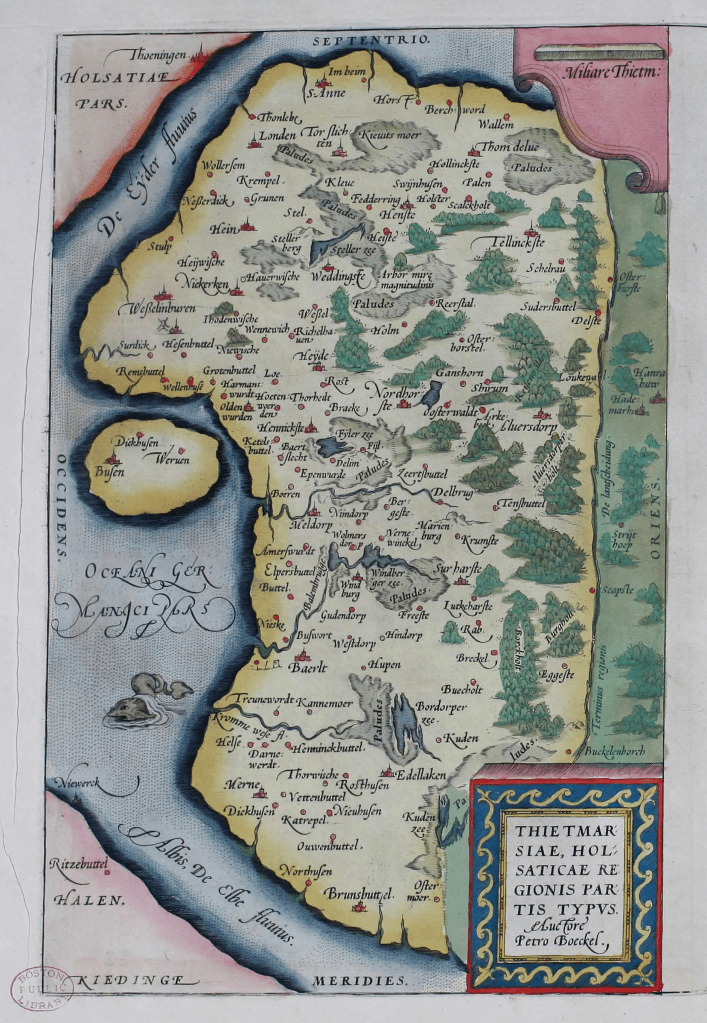
The more developed political institutions likewise enabled the region of Dithmarschen to pursue a more effective ‘foreign’ trade policy, including relations with the Hanseatic League, than would otherwise have been possible. The Dithmarsians were also able to raise considerable armies — essentially popular militias — and succeeded in preserving their freedom as the last autonomous peasant republic along the southern North Sea coast, a status they ultimately lost in 1559.
Prophecy of a new freedom
De Wunnerboom vun Süderhastedt
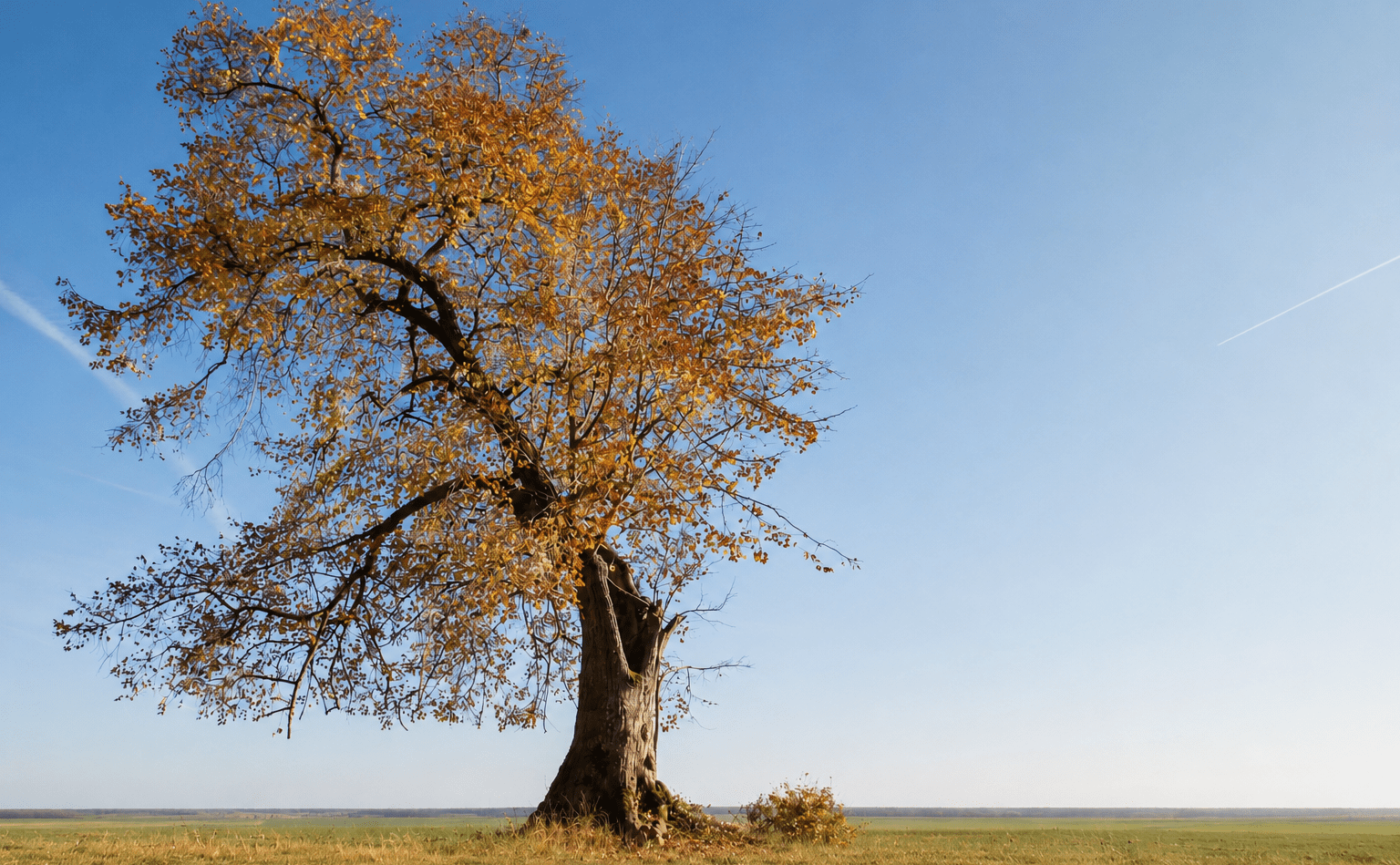
In the days of Dithmarschen’s freedom, near the village of Süderhastedt in the parish of Henstedt — where in earlier times an important fortress once stood, surrounded by a moat — there grew, in the days of the freedom, an ancient linden tree known throughout the marshlands as the Wunnerboom (‘miracle tree’). It towered above all other trees in the surrounding landscape; its branches grew in a crosswise pattern, unlike anything else in the region, and it remained green and vigorous year after year despite its great age.
It was said that as long as the freedom of the land flourished and the land remained green, the wonder tree would also continue to thrive. And so it came to pass: when the freedom of the Dithmarsians was finally broken in the year 1559, the miracle linden tree withered and died.
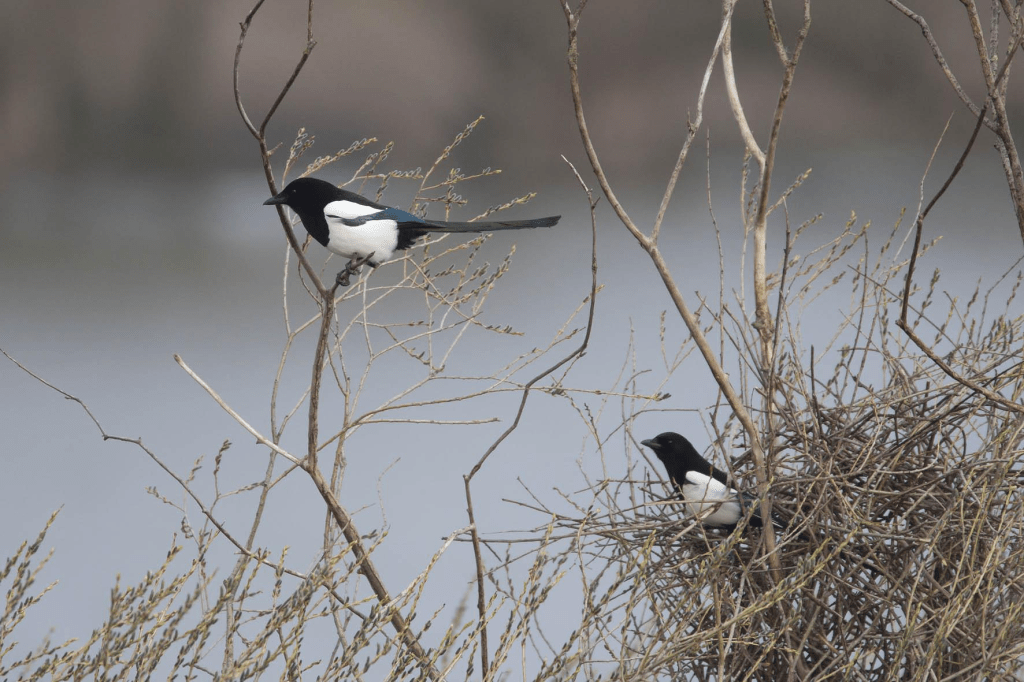
Yet the legend lives on. One day, so it is told, a magpie will build its nest in the dry linden tree and hatch five white young. That will be the sign that the people of Dithmarschen will regain their freedom, and the old linden tree will return to life, sprouting once more and turning green.
* * *
This legend was recorded by the pastor and chronicler Johannum Neocorus, the somewhat infantiel pseudonym — meaning ‘new church sexton’ — used by Johann Adolph ‘Köster’ (ca. 1550–1630), in the years before 1598 (Müllenhoff 1845, Kienitz 2024). The motifs of a dead tree returning to life as a form of rebirth, and the magpie as a symbol of change announcing this renewal, are therefore not from the Romantic period, a time in which many sagas and legends of this kind were recorded and popularised. Instead, this tale has older roots. One is almost tempted to think that the Weirwood tree in the television series Game of Thrones were inspired by this legend.
In addition, the supernational qualities of the linden tree represents a very old tradition. The Germanic assembly, the thing, was usually held in the open air under court linden trees (Gerichtslinden in German). In some areas, court sites were said to be surrounded by seven linden trees. Rulings were sometimes recorded with the Latin phrase sub tilia dictum est (‘given under the linden tree’). These trees were regarded holy and as trees of freedom. The linden tree was also believed to support the pursuit and revelation of truth and justice during thing assemblies. Such trees were typically located at prominent places in the landscape, such as near castles, churches, or on hills (Georg-August-Universität Göttingen website).
The former pan-Frisia thing site called Upstalsboom near the town of Aurich in the region of Ostfriesland is covered with linden trees, too. Concerning the functioning of the medieval thing, see our blog post Well, the Thing Is… Speaking From the Moral High Ground of Old.
The region of Ostfriesland is also home to Europe’s oldest and largest linden tree, which stands in Emsland, the region surrounding the River Ems. Affectionately, the tree is also called Dicke Linde. It stands in the town of Heede, in Burgstiege Park, there where once the late-medieval castle Scharpenburg stood. The circumference of this tree is a staggering 17 metres, and its age is estimated at between 800 and 1,000 years, with some even claiming up to 1,400 years. The earliest recorded mention of the tree dates from the year 1677. As is often the case with ancient linden trees, the inner core dies off while new shoots emerge from the trunk. This is also the case with the Heede linden tree.
When the linden tree is in bloom, it spreads a light, sweet fragrance. According to folklore, this was believed to contribute to more lenient punishments. The tree blossoms in late June or early July, so one would have to hope for court proceedings to take place at that time of year.
The oldest and biggest linden tree to be found in the region of Dithmarschen today stands in the fields between the villages of Tellingstedt and Schalkholz. Its age is estimated 250 years and its circumference is 5.5 metres (Kienitz 2024).
From free to unfree — Twice over
1. From free to unfree — until 804
At the end of the eighth century, the very energetic Charlemagne created the Frankish kingdom. What the Romans had never succeeded in doing, Charlemagne did achieve: the conquest of the territories north of the River Rhine, where the free Saxon (and Frisian) tribes lived. As mentioned, this was no walkover. The military campaigns began in 772, and the sacred tree, or wooden pillar, the Irminsul, was destroyed. A long and bitter struggle followed. In the end, the Saxons were finally forced to submit in 804.
The northern tribal grouping of the Saxons was, as mentioned, referred to by the Franks as the Nordalbingi, meaning ‘those north of the River Elbe River.’ In addition to this term, the northern Saxons were also described as the Nordliudi, literally ‘the people of the north.’ This confederation, if you can call it that, consisted of the regions of Dithmarschen, Holstein, Stormarn, and Wagria, the latter of which was later settled by Slavic groups. Geographically, this area broadly corresponds to the core of modern southern Schleswig-Holstein and the eastern coastal zone of the North German Plain, bounded by the North Sea to the west, the Baltic Sea to the east, and the River Elbe forming its southern frontier.
Alongside the northern Saxons, the Frankish sources distinguish other major Saxon groups: the Angarii (Engern), the Westfalai (Westphalians) associated with the region of Wigmodia, and the Ostfalai (Eastphalians).
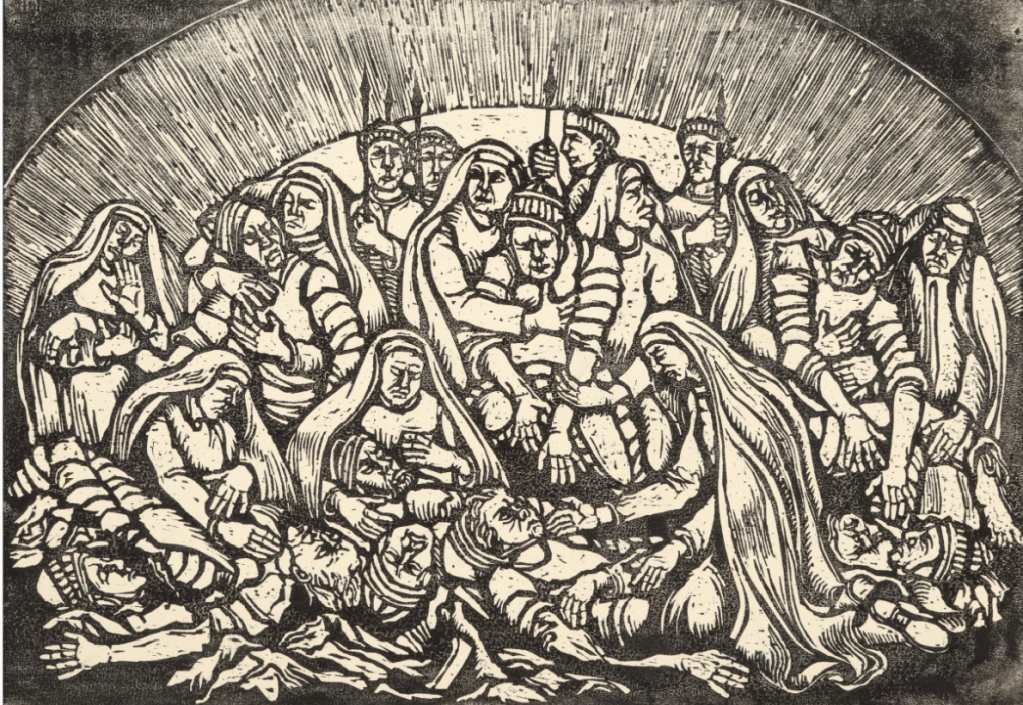
There are many battles that could be mentioned, but that would make this blog post even longer than it already is. One of the most infamous was the Battle of Verden in the region of the Eastphalians in the year 782. During this military campaign, the Franks showed little regard for the conventions of warfare — conventions that, luckily, today are observed to the letter with great precision — and, after their victory, are said to have executed approximately 4,500 Saxons. All this according to the Frankish annals, the Annales regni Francorum of the mid-eighth century. It remains unclear whether this execution included women and children, as the sources do not specify. The reader can draw her or his own conclusions. As a tip, do not be too lenient in your assessment of the Frankish rulers.
In the year 798, the Battle of Sventanafeld, not too far from the modern village of Bornhöved, took place between, on the one side, the Franks and their Slavic allies, the Obodrites, and, on the other side, the northern Saxons. The Saxons were defeated. To quote the Annales regni Francorum: “Nordliudi contra Thrasuconem ducem Abodritorum et Eburisum legatum nostrum commisso proelio acie victi sunt. Caesa sunt ex eis in loco proelii quattuor milia.” (‘The Nordalbingian Saxons, having engaged in battle against Thrasuco, duke of the Obodrites, and Eburisus, our [Frankish] envoy, were defeated in battle. About 4,000 of them were slain on the battlefield’).
Bornhöved apparently was a popular battleground. Maybe because of its idyllic lanscape with many bodies of water, streams, gently rolling hills, forests, and fields. In 1227, namely, another battle took place at the village of Bornhöved, in which the Dithmarschers were involved. This time with a more favourable outcome for them. We shall return to this battle later.
The definitive submission of the last Saxon tribes, and thus also of the Frisians in the wider sphere of Frankish expansion, is commonly dated to 804. In that year, Charlemagne is reported to have deported and dispersed many of the Saxons north of the River Elbe. Evidence from later sources suggests that some Saxon identities persisted in exile. The diocese of Würzburg, all the way to the south in the State of Bavaria, in the tenth century still refers to “Saxones qui Northelbinga vocantur,” which translates as ‘Saxons who are called Nordelbingers’ (Bünz & Missfeldt 2025). Probably, this act of war would fall under the term ethnic cleansing today.
But the cruelty did not end here. The Franks introduced strict legislation known as the Capitulatio de partibus Saxoniae (‘the capitularies for the Saxon lands’), imposed on the Saxons in the year 782 — a year that also, incidentally, saw the path of the aforementioned priest Atrebanus prematurely rerouted to either heaven, purgatory, or hell, depending on the outcome of the iudicium particulare, of course. That this Frankish legislation had little to do with justice and civil liberties, such as freedom of conscience, becomes clear from the following provisions:
“Anyone who breaks the fast before Easter and eats meat shall die; anyone who kills a bishop, a priest, or a deacon shall die; anyone who turns to the devil and lives according to pagan custom shall die; anyone who sacrifices human beings to the devil shall die — a provision that perhaps merits some sympathy; anyone who casts heathen tendrils against a Christian shall die; anyone who buries the dead according to pagan customs shall die; and so on.”
The expanision-driven Danish kingdom became the next challenge for the Franks. However, here Charlemagne had to accept the boundary of his empire. To quote the famous words of the Danish King Neffe Hemming: “Eidora Romani Terminus Imperii,” which means ‘at the River Eider ends the Roman Empire.’ At the point where the Cimbrian Peninsula is at its narrowest, the two realms were separated in the west by, indeed, the River Eider. From the east, from the sea inlet Schlei, the Danevirke more or less connected to this natural border. This ‘works of the Danes’ was a defensive earthwork constructed in the Early Middle Ages and significantly strengthened during the wars with the Franks in the early ninth century.
Not long before his death, Charlemagne ordered the establishment of his own defensive system, the Limes Saxoniae, which was completed under his successor Louis the Pious. The Limes Saxoniae ran from the town of Lauenburg on the River Elbe in the south to the town of Kiel on the Baltic Sea in the northeast. It was not a wall, but rather a frontier zone consisting of fortifications, natural barriers, and strategic strongpoints designed to secure the border between the Saxons and the Slaves.
As a result, the region of Dithmarschen came to lie at the true edge of the Frankish realm, a frontier march. In the north even. Standing at the intersection of overlapping spheres of influence — the Frankish, the Danish, and the Slavic, as well as competing local counts and the Hanseatic League — Dithmarschen’s history would be shaped by these rival powers for centuries to come. In time, and contrary to the quoted words of King Neffe Hemming, the Danish kingdom would even attempt to incorporate Dithmarschen into its realm. We shall return to this later, too.
Moreover, the Danish rulers had been warned not to take such ventures against these autonomous marshland republics lightly. In 1252, the Danish king Abel Valdemarsen attempted to subdue the Eiderstedt Peninsula and enforce the proper payment of tribute there (Pajung 2025), a region belonging to Nordfriesland bordering in the south with Dithmarschen. But the Eiderfriesen, led by Sicko Sjaerdema, offered strong resistance.
The campaign cost King Abel of Denmark his life. Dying in his mid 30s and he still had a long life of conquests, killing, plundering, and warfare ahead of him. Such a waste. According to later tradition, a simple wheelwright, a Frisian named Henner, struck the king down with an axe from an ambush near the town of Husum. Indeed, what was Henner thinking? Or, as the contemporary Annales Ryenses put it more succinctly: Rex Abel ivit ad Ejdersted et ibi cecidit (‘King Abel went to Eiderstedt and fell there’). And yes, using axes was the modus operandi of Frisians when slaying famous, pushy men.
2. From unfree to free again — 804 until 1404
Over the four centuries that followed, the region of Dithmarschen fell under the feudal authority of the Franks, with counts acting as representatives of the king. The first royal representative, annex count, of Dithmarschen was Egbert, a Saxon loyal to the Franks. His rule began in 814, and his stronghold Esesfeld stood somewhere near the town of Itzehoe. A later royal representative, Hermann, ruling around 936, held the prestigious title of margrave. Ecclesiastically, Dithmarschen belonged to the Archiepiscopatus Bremensis et Hamburgensis ‘archdiocese of Bremen and Hamburg.’ The Dithmarsians never fully alienated themselves from the bishopric and maintained, throughout the Middle Ages, a certain balance between formal recognition of clerical authority and autonomy.
Both the counts of Holstein and those of Stade (Udonids) exercised influence over the region of Dithmarschen, while it fell under the archbisshopric. In particular, the House of Stade does not get many positive reviews from the Dithmarsians, at least not in folklore. According to legend, the farmers of Dithmarschen were forced to wear a rope (Klawen) around their necks — a rope normally used to tie cattle in the stable. This humiliation was more specifically attributed to Count Rudolf of Bökelnborg. In 1144, the rule of Count Rudolf II came to an end, together with the House of Stade as a ruling dynasty. It is even possible that Rudolf met his end in Dithmarschen (Alberts 2020).
Notably, this legend of neck ropes resembles Frisian legends about their period of subjugation under the Vikings, when they were said to have been forced to wear a noose around their necks, as well as the saga about Magnus, in which the Frisians were required to wear wooden collars as a sign of their subordination. For the legend about the unfree necks of the Frisians, see our blog post With a Noose Through the Norsemen’s Door. In any way, ropes tie the Frisians and northern Saxons together as well.
Kinship was an important feature of Saxon society in the region of Dithmarschen. Clan structures were strong and highly influential. These kinship groups originated on the salt marshes and gradually spread eastwards into Dithmarschen, reaching the higher sandy geest lands (Bünz & Missfeldt 2025). As noted earlier, these close social bonds made it possible, among other things, to undertake large-scale land reclamation for that time. As in the Frisian regions, dyke construction began around the end of the first millennium.
Like in the surrounding regions along the Wadden Sea, both secular and ecclesiastical authority steadily lost influence at the beginning of the second millennium, say from the twelfth and thirteenth centuries onward. A first notable armed clash with the counts of Holstein-Rendsburg took place in 1319, called the Battle of Wöhrden, in which the Dithmarsians were victorious, invoking the Virgin Mary. In 1404, the Buren ‘peasants’ of Dithmarschen once again defeated the Holsteiners at the Battle of the Hamme. This occurred on the eve of the feast day of Saint Oswald, who, alongside Virgin Mary, was also venerated in connection with the victory. As long as the Dithmarsians were ‘free republicans,’ the battle was commemorated annually on the feast day of Saint Oswald.
De stelle sick wol thor Wehre, Ditmerschen, dat schölen Buren sin? It mögen wol wesen Heren.
Whoever wants to go to war, Dithmarsians, who supposedly are peasants? They may well be lords.
Incidentally, Marian devotion in relation to freedom was not unique to the region of Dithmarschen. The Frisians also explicitly associated Virgin Mary with their freedom (Mulder-Bakker & Van Beek 2021). The seal of the alliance of the Seven Sealands of the Upstalsboom also depicts Virgin Mary, seated among barefoot Frisian warriors armed with kletsies (i.e. spears annex leaping poles), swords, and small shields. These details of warfare are not mentioned randomly. We will encounter them again later in relation to the Dithmarsian fighters.
In 1227, the long-awaited turning point finally arrived, opening the path toward freedom. First, Danish expansion in northern Germany was decisively halted. In the summer of that year, it came to a confrontation between the kingdom of Denmark on one side and a coalition consisting of the count of Holstein, the archbishop of Bremen, and local elites from Holstein and the surrounding regions on the other. The Dithmarsians also took part in the fighting. The Danes were defeated, and as a result Denmark’s role as a major northern European power was permanently diminished.
Subsequently, the counts of Holstein attempted to bring the region of Dithmarschen under their control. The Dithmarsians did not agree and resisted.
In 1288, the count of Holstein suffered an initial defeat in a clash known in tradition as the Hasenkrieg, or Hare War. According to legend, when both armies stood facing each other, waiting for the signal to begin the battle, a hare suddenly sprang up in the field. Some of the front-line Holstein soldiers saw the animal, laughed, and let out a hunting cry, which the rear ranks misinterpreted as the signal to attack. This misunderstanding spread confusion and panic throughout the Holstein lines, causing parts of the army to waver and retreat. The Dithmarsian peasants seized the opportunity, launched their attack, and ultimately drove back and defeated the Holstein forces.
Something we would call a butterfly effect nowadays. Always be prepared!
The climax then comes in 1404, once more in the summer. Once again, it comes to a confrontation between the counts of Holstein and the people of Dithmarschen. The Holstein army is defeated, following many skirmishes and military incursions from Holstein involving plunder and arson of Dithmarsian villages. This is the famous Battle of Hamme. After this battle, Dithmarschen yet again fell under the authority of the archbishopric of Bremen, but its power would rapidly decline. In practice, namely, “the archbishops did not carry out their executive powers; the legal and religious administration of Dithmarschen was instead managed by the peasants themselves” (Lorenz 2024). The Battle of Hamme is seen as the attainment of freedom and the beginning of the free peasant republic of Dithmarschen, of the Großbauerntum.
3. From free to unfree again — 1404 until 1559
Not to spoil the fun, but some nuance regarding the freedom of Dithmarsians is in order. The region of Dithmarschen continued to recognize the archbishop of Bremen as its formal lord, although his actual influence was very limited. In practice, the archbishop’s rights were largely confined to the homagium, also Huldigung or Willkomm— essentially a symbolic acknowledgment of lordship accompanied by an annual payment of 50 Mark.
This quasi-subordination to the archbishop of Bremen also proved to be useful now and then. In 1473, the cheeky Danish king manages to persuade the Holy Roman Emperor Frederick III to grant him Dithmarschen as a fief. The people of Dithmarschen rushed to Rome to plead before Pope Sixtus IV that this was unlawful, because the archbishop was their rightful lord. The Pope informed the Danish king that if he dares to appropriate Dithmarschen, he will be excommunicated (Kühl 2025). The Danish king chose to cut his loses — he preferred heaven over hell.
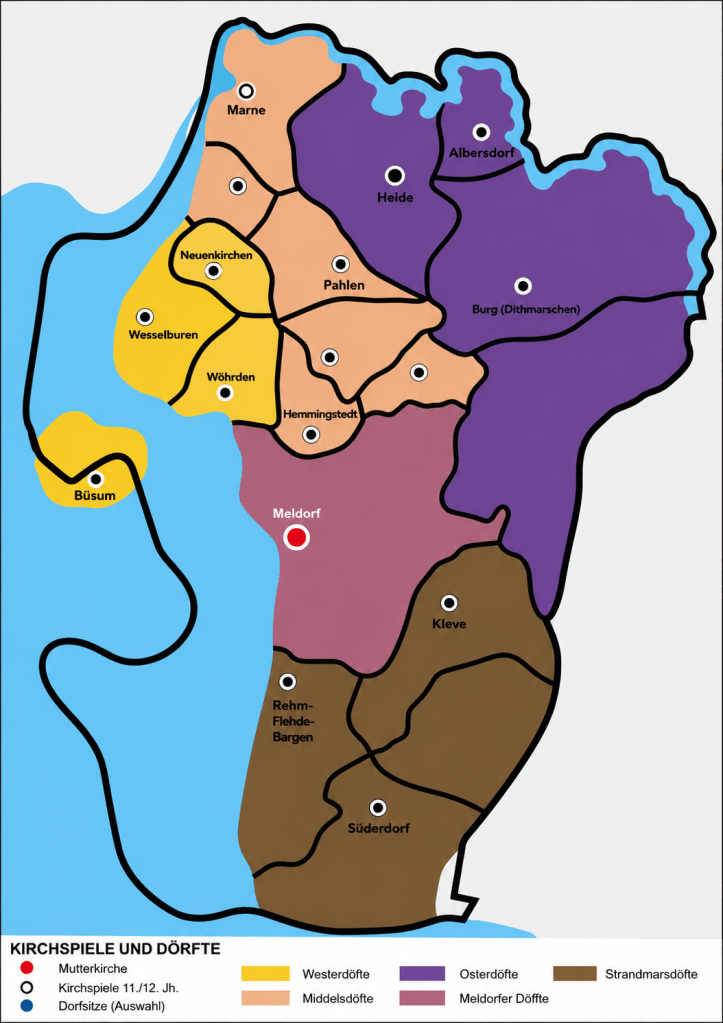
Initially, the republic was classically divided into quarters. These were the so-called Döfften, or ‘districts,’ each with its own thing assembly that gathered at Pentecost. The names of the four original Döfften were the Mitteldöfft (also written Middelsdöfte), the Osterdöfft, the Meldorfer Döfft, and the Strandmannsdöfft (also written Strandmarsdöfte). Later, sometime before the mid-thirteenth century at the latest, a fifth Döfft was added: the Westerdöfft. This Döfft owed its existence to large-scale land reclamation, including the incorporation of the remnants of the Wadden Sea island of Büsum into the mainland.
In the earlier period, when Dithmarschen still functioned within the feudal system, each Döfft had its own Vögt or reeve, a representative accountable to the count. However, this office lost much of its importance and had disappeared around 1300 altogether. Each Döfft comprised several Kirchspiele (parishes), and Dithmarschen as a whole had roughly fifteen Kirchspiele. De oldest Kirchspiele were Meldorf, Süderhastedt, Tellingstedt, and Weddingstedt.
Several times a year, the Kirchspiele sent delegates to the Landesgemeinde, the large national assembly or thing that met in Meldorf. In addition, each Döfft sent members to what was effectively the republic’s day-to-day governing council — a council of regents. Each Döfft was expected to send twelve representatives, except for the Strandmanndöfft, which refused to do so. This Döfft in the southwest preferred not to be tightly bound to Meldorf and instead kept its hands free to profit from the lucrative shipping traffic at the mouth of the River Elbe. On occasion, this also meant plundering the cargo of shipwrecks or grounded ships so-called on the basis of the Strandrecht or ‘law of wreck’. The Landrecht ‘land law’ of Dithmarschen therefore did not explicitly called the area of the Strandmannen a Döfft (Kolster 1873).
As a result, the central governing body consisted of (four times twelve) forty-eight members, known as the Achtundvierziger (‘the forty-eighters’). The Achtundvierziger met every week in the town of Meldorf at the marketplace. Later, with the continued land reclamation along the Wadden Sea coast, and the growing strategic position within the road network leading to the hinterland, the administrative center was shifted to the village of Heide.
Within the republic, the clans, were highly influential. These local elite lineages included the Woldermannen, Vogdemannen, Wurtmannen, Vorhebkemannen, Ebbingmannen, and the Holm. Over time, these clans gained increasing influence within the Achtundvierziger, gradually eclipsing the political role of the Kirchspiele, militias, nobility, and local farmer communities. These clans replaced more or less the Vögte (Bünz & Missfeldt 2025). But also on personal level, living outside a clan was simply not possible. One, for example, would not enjoy any (legal) protection.
And so, the Dithmarsians flourished, sustained by their fertile soils and by their strategic position between the sea and the overland routes to Lübeck and the Heerweg or Ochsenweg. The Oxen Way was an age-old network of land and coastal routes running from Jutland in the north southwards and westwards, reaching as far as Amsterdam, along which young cattle were driven for trade. The marshlands of the Eiderstedt Peninsula and Dithmarschen provided high-quality grazing land ideally suited for fattening young livestock, and ultimately fattening the sellers as well.
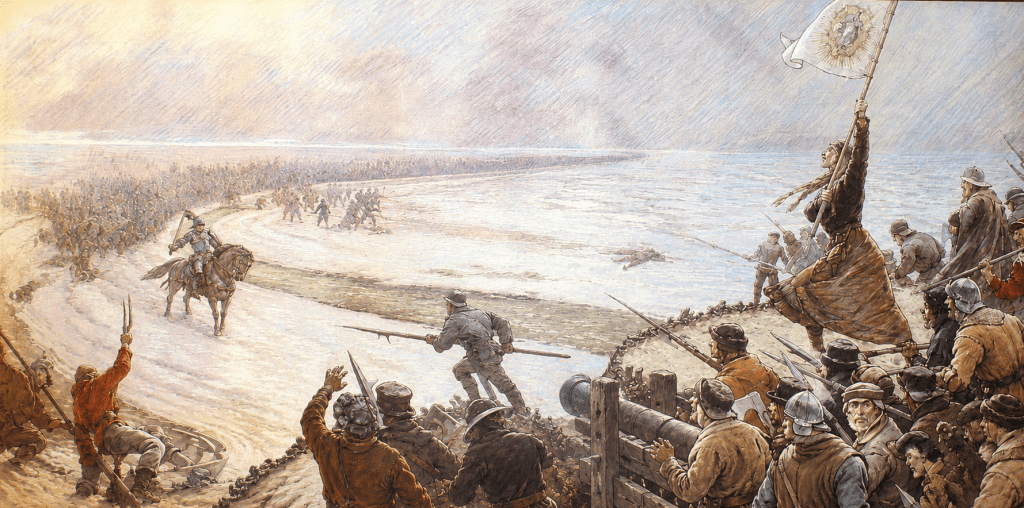
Who would not desire such a green, rolling Teletubby-like land of milk and honey? The counts of Holstein and the Kingdom of Denmark certainly did. In the year 1500, under the command of Danish King John I, or Kong Hans in Danish, they invaded Dithmarschen with a massive army of approximately 12,000 men, including the feared Landsknecht mercenaries known as the Black Guard or Schwarze Garde, numbering around 2,700 strong. Some already battle-hardened in the decennium before in the Low Countries. A battle that would be remembered as the Battle of Hemmingstedt or die Schlacht am Dusendduvelswarft.
Opposing them was the army of the Dithmarsians, with only about 6,000 men. They were armed with, among other, long spears and halberds, which they also could use as leaping pole (Springstock) — known as kletsies, as the Frisians likewise used in battle at the time. The fighters were barefoot and half-naked so they could easily wade through water and the purposedly inundated lands. This made their forces highly manoeuvrable in the marshy, ditch-filled landscape. Moving through water like many captain Willards on their move to kill Colonel Kurtz.
The Holstein–Danish army was soundly defeated by the peasants. According to most legends, this was due to the tactical leadership of a man named Wulf Isebrand, often described as a Dutchman. Among other things, he is said to have ensured that the land was flooded at precisely the right moment, turning the terrain against the invading army. In addition, the Dithmarsians were aided by snow and heavy rainfall, which further worsened conditions for the attackers. Also, the campaign suffered from insufficient funding to sustain the mercenary troops over a prolonged military operation, and, as some accounts suggest, a degree of sheer luck (Urban 2024).
Or was it the heroic girl carrying the Holy Cross during the battle who ensured that the Dithmarsians were victorious?
There is no consensus on the exact location where the battle took place. Five kilometres north of the town of Meldorf stands the memorial to the battle. The battle most likely took place about 800 metres further north, on a slight elevation in the landscape, a remnant of an ancient Pleistocene beach ridge. It lies along the old road between the towns of Meldorf and Heide. During excavations in 1949, remains of field fortifications (Schanzen) were found there (Kienitz 2024).
INTERMEZZO
Standard Bearer Telsche vun Kampen — Like the young woman Tjede Peckes from Land Wursten, another well-known female standard-bearer from the same region and period was Telsche vun Kampen, also known as Telse Kampen. She was from the peasants republic Dithmarschen.
Telsche was engaged to Reimer vun Wiemerstedt, but before they could marry, the region of Dithmarschen was threatened in 1500 by the Black Guard — an army of Landsknechts sent by the King of Denmark and the Duke of Holstein. Before the Dithmarsians went into battle, the council of the Achtundvierziger decided that a maiden should carry the banner into combat. To ensure victory, this role was assigned to a young woman who had vowed eternal chastity. This way the Dithmarsians would have God on their side. The choice fell on the twenty-year-old Telsche.
After Telsche had taken her vow of perpetual virginity, priests dressed her in gleaming armour and entrusted her with the Holy Cross. Throughout the battle, she held the Cross aloft, strengthening the morale of the peasant forces and thereby playing a significant role in securing victory against the vastly superior army. A battle that became known as the Battle of Dusenddüwelswarf, or the Battle of Hemmingstedt.
Sages tell that King John I only narrowly survived the war. At one point he was surrounded. In the house where he had taken refuge, a maiden named Mette was in service. She helped the king escape at night by tearing fabric from her skirt and wrapping it around the hooves of his horse so that it could move silently, like a thief in the night — and indeed, with his attempt to seize the land from the Dithmarsians, that is what he was, of course — allowing him to flee from the bloodthirsty peasants.
As thanks, Mette was granted a piece of land in the marsh region of Nordfriesland, in the Bordelumer Koog (a koog or kaag is a polder), by the king. In addition, she was permitted to claim land on the adjacent geest soils up to as much as she could plough in a single day. She held this land free of feudal obligations and taxes. The settlement in the Bordelumer Koog is therefore said to be called Mettenwarf (Müllenhoff 1845). It should be noted that Nordfriesland formed part of the Duchy of Schleswig, which was part of the Kingdom of Denmark throughout much of the High and Late Middle Ages until the mid-nineteenth century.
The victory of die Buren, the peasants against the feudal powers stood in stark contrast to what happened, and was about to happen, to the other free peasant republics elsewhere along the Wadden Sea coast at the time. The Mid Frisians had, in fact, lost their freedom only a few years earlier. The Rüstringen Frisians would lose their freedom in 1514, and the Wurstfrisians lost theirs in 1517. The Saxons of Dithmarschen had since become the last remaining free peasant republic — the last of the Mohicans.
The reason why the small self-governing communities ceased to exist lies in the social developments that took place at the end of the Middle Ages and the beginning of the early modern period. These small republics had managed to cast off feudalism and, by and large, were able to survive militarily against the feudal powers surrounding them, thanks to the defensibility of their wet and difficult-to-conquer landscapes, the fertility of their soil, and their strategic coastal location.
However, with the rise of the modern state, stronger institutions, population growth, the emergence of cities — which combined also generated greater revenues for monarchs — and, not least, innovations in military warfare, these republics were no longer able to withstand their opponents. By this time, their rivals possessed better organized, professional mercenary armies, in which command was no longer the pastime of a hereditary ruler but the profession of trained generals (Urban 1991).
The death blow to the proud peasant republic came in 1559, when Dithmarschen faced the combined Danish-Holstein army in a conflict that became known as Die Letzte Fehde (‘the last feud’). And the people of Dithmarschen were on their own. The Archbishopric of Bremen and Hamburg, and the Hanseatic League may have wished them well, but their sympathy did not go so far as to join the fight against Holstein and Denmark who had been nursing a grudge since 1500. Not unimportant, there was also some tension between the archbishopric and Dithmarschen. For one thing, people from Dithmarschen had previously fought alongside the Wurstfrisians against the Landsknechts army of Bremen, and after the region of Land Wursten lost its freedom, more than a few had fled to Dithmarschen.
The Danish-Holstein army was enormous. In total, nearly 18,000 men were assembled, including 4,000 feared Landsknecht mercenaries and 2,400 cavalry. The army was led by the capable field marshal Johann Rantzau. The Dithmarsians, however, managed to gather a large army as well. It is estimated to have numbered around 12,000 men (Bünz & Missfeldt 2025). After three weeks of intense fighting, the remaining forces of Dithmarschen surrendered at Wöhrden. That was on 14 July. The end of the freedom of Dithmarschen. This time Virgin Mary and Saint Oswald did not bring them victory.
After the defeat in 1559, the region of Dithmarschen was divided into three parts. It was split like sharing a desert with three small forks. The territory was divided between the Duke of Schleswig-Holstein-Gottorf, the Duke of Schleswig-Holstein-Haderslev, and the King of Denmark. In 1580, after the death of Duke Hans the Elder of the Schleswig-Holstein-Haderslev line, the three-part division was reduced to a two-part structure: a royal northern Danish part and a ducal southern part. Only in 1773, when all of Dithmarschen came under Danish control, were the two parts administratively united again. Roughly a century later, Dithmarschen came under Prussian rule, although it remained a distinct historical region. As it did eversince.
Are the Dithmarsians free?
Everyone from the region of Dithmarschen who wonders whether they are free or unfree should ask themselves the question: has the linden tree of Süderhastedt begun to bear leaves again or not? Have you seen a magpie with white chicks? Here lies your answer — besides the number XLII (42), of course, which answers everything (Adams 1979).
Did Die Letzte Fehde mark the end of the free republics? No. There was one notable exception along the same south-eastern North Sea coast: the Dutch Republic, which carried this centuries-old republican tradition into the modern era. Often described as the first successful bourgeois revolution in world history (Leonard 2020), it emerged in the second half of the sixteenth century, when the urban elites and citizens of the Low Countries succeeded in breaking free from the Spanish monarchy. Fittingly within this broader republican history of the region, the first major victory of the Dutch rebels against Spain was won at the Battle of Heiligerlee in 1568, fought near the Dollart Bay on the Wadden Sea coast in the province of Groningen. It marked the beginning of the Eighty Years War’s of Independence.
The reasons why the coastal provinces of the Netherlands succeeded where others did not, need not concern us here and would require a separate blog post. The point to emphasize here is that the republics of the Dithmarsians, the Frisians, and the Hollanders all belong to the same age-old republican heritage, born and bred at the southern shores of the North Sea.
The Elder Tree and the White King
We conclude with another, quite remarkable legend about the (near) loss and eventual recovery of the Ditmarsians’ freedom, in which a tree once again plays a central role. Although several versions of the legend have survived, documenten by Müllenhoff in 1845, they share a common narrative that can, we think, be summarized as follows:
The legend foretells that, when Dithmarschen is on the verge of losing its freedom in the struggle against the enemy and is forced to retreat further and further, an old white king on a grey horse will come to its aid, riding from the north with an army. The king rides to the church in Schenefeld, where a great elder tree grows out of the church wall. There he ties his horse to the tree and then kneels in prayer before God. His turning to the great elder tree is the sign foretold by the old prophecy that freedom will eventually be regained. While the king is kneeling in prayer, peasants armed with simple weapons such as pitchforks, flails, and scythes come forward and join him. The king then rises and leads the army into battle. A fierce and decisive battle follows, associated in the different versions with Schenefeld, Nortorf, and the surrounding area. In one version, almost all the adult men of Dithmarschen are killed, leaving only twelve-year-old boys to survive and fight alongside the king. But the battle is ultimately won, after which a long period of peace, prosperity, and freedom follows.
Note 1 — The name Dithmarschen was first recorded in historical sources in the year 782 as Thiatmaresgaho, referring to the territory (shire or gauw in English and Dutch respectively) of Thiatmare(s). It appears again in 1059 as pago Thietmaresca, likewise denoting the territory (shire) of Thietmaresca.
The etymology is can be explained as thiet, meaning ‘great’ or ‘large,’ and mare(s), meaning ‘moor’ or ‘low-lying land,’ compare also the Dutch word moeras (‘marsh’ or ‘swamp’) with mares. The name therefore likely means ‘great moor’ or ‘great marsh.’ Another, and we prefer it, is that the word thiet or diet means ‘people’. So, the ‘marsh people.’ The natural landscape of the region supports such an interpretations. The Swiss Alps would not have.
Note 2 — Besides the free peasant republics and the Dutch Republic, there is another anomaly in Europe where self-governance emerged and managed to survive, namely Switzerland. It is therefore not surprising that among the Frisians, the Saxons of Dithmarschen, and the Swiss, there are mutual legends and sagas about how they obtained their freedom. See our blog post Make Way for the Homesick Dead Frisians! A Saga From the Swiss Alps. By the way, the Dutch reverted to a monarchy at the beginning of the nineteenth century, whereas the Swiss never did. In that sense, Switzerland beats the southern North Sea coast — and the rest of the world — as the oldest continuously existing republic, if we set aside the semi-autonomous case of San Marino.
Note 3 — In the past, in the mid-sixteenth century, there was intense debate about whether the Dithmarsians were originally Frisians or Saxons. No fewer than Ubbo Emmius of East Frisia and Johannum Neocorus of Dithmarschen were involved; the reader may guess once who argued for which origin. Partly because Dithmarschen lies wedged between Frisian cultural regions and because some old texts count Dithmarschen among the legendary Seven Sealands of Frisia, this gave rise to this highly (ir)relevant nationality debate. The former island of Büsum in particular was considered to have been Frisian. Even by the end of the nineteenth century, this discussion had still not been settled (Kolster 1873). The conclusion must be that there is little to no concrete evidence to suggest that the Saxon Dithmarsians were replaced by Frisians. And he who asserts must prove it.
Suggested music
- Tracy Chapman, Talkin’ Bout a Revolution (1998)
- Nelly Furtado, I’m Like a Bird (2000)
Further reading
- Adams, D., The Hitchhiker’s Guide to the Galaxy (1979)
- Alberts, K., Dithmarscher Freiheit. Das Land und seine Herrschaft vor Karl dem Großen bis zu Kaiser Karl V. (2020)
- Barkham, P., ‘Most famous tree in the world’: Sherwood Forest’s 1,000-year-old Major oak dies (2026)
- Beleef het Lage Noorden, De dikste boom staat net over de grens in Duitsland (website)
- Bünz, E. & Missfeldt, J., Dithmarschen im Mittelalter. Geschichte und ihre Folgen (2025)
- Dithmarschen, Historisches Burg. Kleine Reise in die Vergangenheit von Burg (website)
- Georg-August-Universität Göttingen, Kultur: Thing- und Gerichtslinde (website)
- Gesellschaft für Schleswig-Holsteinische Geschichte, Dithmarschen (website)
- High Museum of Art, Hans Grohs (website)
- Höhnk, H., Dithmarschen erzählt (1983)
- Kienitz, D., Verein für Dithmarscher Landeskunde. Historische Touren durch Dithmarschen (2024)
- Kolster, W.H. (ed.), Geschichte Dithmarschens. Nach F. C. Dahlmanns Vorlesungen im Winter 1826 (1873)
- Kühl, J., Als Dithmarscher Bauern den König besiegten (2025)
- Lenzing, A., Gerichtslinden und Thingplätze in Deutschland (2005)
- Leonard, R., How the Dutch invented our world. Liberal democracy and capitalism would have been impossible without the Dutch (2020)
- Lorenz, T., The Danish Conquest of Dithmarschen (2024)
- Monumentale bomen, Zomerlinde ‘Heeder Linde’ in het park in Heede, Nedersaksen, Duitsland (website)
- Mulder-Bakker, A.B. & Bremmer jr, R.H. (eds.), Geleefd geloof. Het geloofsleven van boeren en burgers in Friesland en de Ommelanden van Groningen 1200 | 1580; Mulder-Bakker, A.B. & Beek, van L., Maria, Onze Lieve Vrouw. Hemelkoningin en Redder in Alle Nood (2021)
- Müllenhoff, K., Sagen, Märchen und Lieder der herzogtümer Schleswig, Holstein und Lauenburg (1845)
- Johannum Neocorum Ettahulphidem, Dithmersche historische Geschichte van ehrer Ankumbst, Seden, Gebruken, Geschlechter, Kluffte, Landen, Steden, Flecken, Dorpern, item van ehren Regimentt, Religion, Policien, Krigen, Vorruckingen, Vormehringen, Handelen und dapferen manlichen Daden, (1598)
- Pajung, S., Abel, ca. 1218-1252 (2025)
- Renswoude, van O., Onder de linde (2015)
- Sagen.at, Wunderbäume in Dithmarschen und Holstein (website)
- Stoob, H., Geschichte Dithmarschens im Regentenzeitalter (1959)
- Urban, W.L., Dithmarschen. Eine mittelalterische Bauernrepublik (1991)
- Urban, W.L., Interviewed by Wiener, J.B.: Dithmarschen Republic (2024)
- Wiener, J.B., Interview: Dithmarschen Republic (2024)
- Zentrum für digitale Lexikographie der deutschen Sprache (ZDL), Achtundvierziger / Acht und Vierziger / 48er (website)


Thanks Hans,
love it.
The people of the Dithmarschen region not only fought for their freedom, but also have fought against the sea for centuries.
The oldest wurten or warften in this region in the German region of Dithmarschen date from the 1st century AD.
The area was later known for its historic land reclamation of polders called Köge, close to the North Sea coast. The Dammkoog or Moorbergkoog (522 hectares, and 4.3 km of dike) from the end of the 15th century is one of them.
Due to disputes with the surrounding regions, the construction of this dike was sabotaged three times during the contruction. (probably for the reasons you described above in so much detail)
regards
LikeLike
Hi Stella, so good to hear from you again, and as always knowledgeable too! It is amazing how much land the Dithmarsians (re) claimed from the sea.
LikeLike