
The monk Ecgberht of Ripon was the driving force behind the Christianization of the defiant heathens of Frisia. From the influential monastery of Rath Melsigi in Ireland, he launched wave after wave of monks, priests, and other clergy toward the Frisian coast. Among his spiritual soldiers were the monks Willibrord and Adalbert. After receiving their education at Rath Melsigi, both were fired off as well, and landed on the windswept beaches of Frisia. Their spiritual D-Day was around AD 690. Though their mission converted only a handful of Frisians at first, their presence did trigger a butterfly effect. Over time, their efforts led to the establishment of the Abbey of Egmond. It is this abbey that played a pivotal role in the rise of the Gerulfings, counts of West Frisia, and subsequently the emergence of the region known as Holland.
1. The First Missionaries From the West
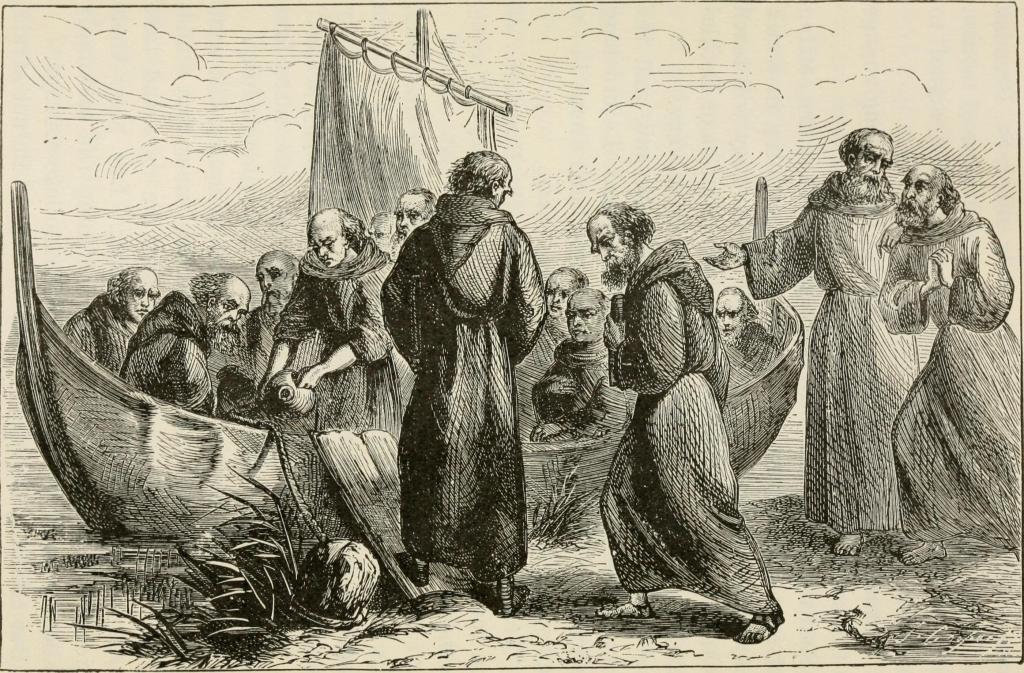
Willibrord, the Apostle to the Frisians, set out for Frisia with a group of fellow clerics. Willibrord himself carried a Bible, a crozier — a ceremonial walking staff — and a small handbell made of plate iron or copper alloy (Kramer 2015). Among his companions was the monk Adalbert. Like their colleague Ecgberht at the monastery of Rath Melsigi — also written as Rathmelsigi and currently identified with Mellifont Abbey, north of Dublin — they were Anglo-Saxons, too.
Their landfall came at a time when Frisia, under the command of King Aldgisl and King Radbod, was still able to withstand the land-hungry, imperialistic Franks from the south. At the same time, the arrival of the Irish and Anglo-Saxon monks opened a second front from the west — not a worldly or military one, but an ecclesiastical front, as the missionaries sought to bring Christianity into the Frisian lands.
The place where the peregrini, or wandering monks, came ashore in Frisia was, according to the late eighth-century Vita Willibrordi (Life of Willibrord) by the Anglo-Saxon clergyman Alcuin of York, a villam Walichrum nomine, which may be translated as ‘an estate or domain called Walichrum.’ For centuries, local tradition identified the modern village of Westkapelle, in the province of Zeeland, as the successor to this early settlement of Walichrum. Westkapelle is also traditionally regarded as the place where Saint Willibrord smashed a pagan idol and temple. Whether the temple was dedicated to the goddess Nehalennia or to the god Mercury/Woden, however, will probably never be known (Kuipers, Jensma & Vries 2011).
According to the tradition, the enraged pagan Frisians retaliated by striking Willibrord with a sword. A dark stain on a stone of the church altar was later believed to be his blood. Miraculously, however, Willibrord emerged from the attack without a scar and was thus denied the martyrdom he might otherwise have been granted. In this respect, his experience in Frisia was very different from that of Saint Boniface, who would meet a martyr’s death there several decades later.
Historians, however, no longer place villa Walichrum at Westkapelle, but more likely in the vicinity of present-day Domburg, about five kilometres northeast of Westkapelle. If this identification is correct, the area around Domburg would also have been the place where Willibrord and his fellow missionaries first set foot in Frisia (Henderikx 2021).
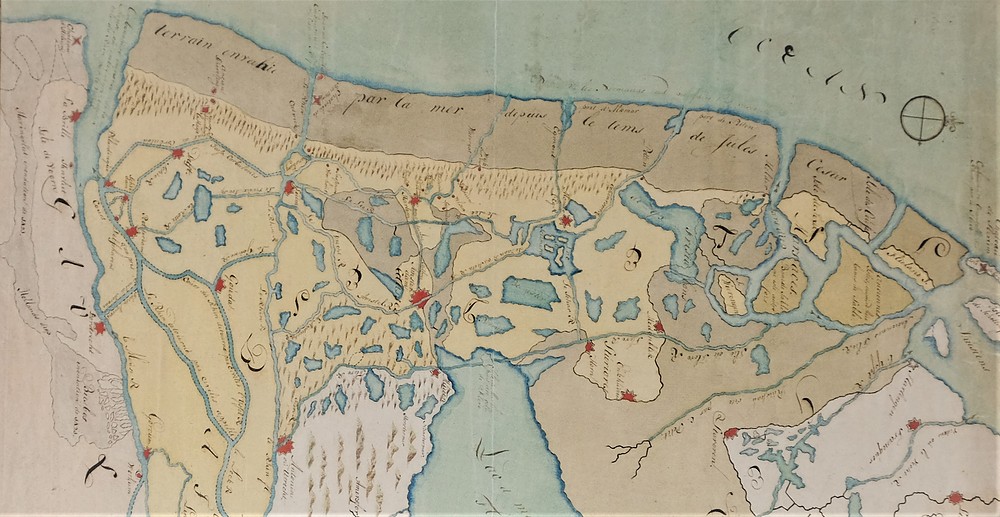
An important mission area was the wider region of pagus Kinhem, the ‘territory of Kennemerland,’ in western Frisia. Kennemerland essentially consists of a series of elevated, and therefore relatively dry, sandy ridges or geest soils running north–south, roughly parallel to the dunes of the North Sea coast. To the east, these ridges were bordered by a largely wooded and marshy peat landscape. The region stretched roughly from the present-day village of Monster in the south to that of Petten in the north.
Some have described this coastal zone as a “fine highway,” as a chain of settlements along the North Sea coast was closely connected by paths and roads from ancient times onward. Many of these ancient routes are preserved under the name Herenweg, literally ‘the road of kings or lords,’ and generally followed the higher, drier sandy ridges (Oneindig Noord-Holland 2024, Canon van Nederland website).
Trivia: the territory of Kennemerland even appears in medieval Icelandic verse, where it is referred to as Kinnlimasiðe. With a mention in these universally revered and thoroughly mythologized sources, Kennemerland has truly made the cut. Nowadays, the area is renowned for its bulb fields, attracting tourists from all over the world, who flock here every spring.
INTERMEZZO
Saint Suitbert – Another apostle who travelled together with Willibrord and Adalbert to Frisia, was Suitbert. Again an Anglo-Saxon monk, and one who had studied at the monastery of Rath Melsigi too. Besides Frisia, he also did a lot of work evangelizing the Saxons in among others the region of Westphalia, Germany. He ended his career on a small island in the River Rhine near the town of Dusseldorf, where he had built a monastery. After his death he was declared a saint as well.
Willibrord did what apostles do: he preached the Gospel and founded churches. Preferably, these churches were built on top of places of pagan cult — a strategy that would be enthusiastically copied by the Spanish conquistadors in Latin America many centuries later. Wooden churches were erected in settlements such as Heiloo, Noordwijk, Oegstgeest, Petten, Velsen, and Voorhout, while chapels were scattered liberally across the countryside.
Willibrord was, as mentioned, an Anglo-Saxon missionary educated in the Irish tradition. He made the Abbey of Echternach the ecclesiastical centre of the Frisian mission, while Traiectum or Trecht, ‘the present-day town of Utrecht, initially served merely as a missionary and monastic outpost within this ecclesiastical sphere. Only after the Franks defeated the Frisian King Radbod in AD 695, did the Frankish majordomo (‘mayor of the palace’), Pepin of Herstal, install Willibrord at Utrecht (Wood 2021). An advance position on the front, like a knight pushed deep into enemy territory on a chessboard.
The arrangement did not last long. Soon afterwards, the Frisians drove the Franks out again and regained control of the central river lands. The Franks had to wait until Radbod’s natural death from illness in AD 719 before they could reassert their control over the central river region. This time permanently. Willibrord, incidentally, had little sympathy for Radbod — or for the Danes. He described them as “obduratam moribus et idolatriae deditam et nullam melioris vitae spem habentem,” meaning ‘utterly stubborn in their practices, devoted to idolatry, and having no hope of a better life (Hines 2021).
After all his hard missionary work in Frisia, Willibrord saw that it was good. He retreated to his warm abbey in Echternach in present-day Luxembourg, where he served as abbot. The churches Willibrord had founded in Frisia consequently came under the authority of the Abbey of Echternach, and many others followed after his death.
By the eleventh century AD, no fewer than twenty-four churches, along with many more chapels, in Frisia west of the former River Vlie — roughly corresponding to the modern provinces of Zeeland, Zuid Holland, Noord Holland, and part of Utrecht, and thus to what is commonly called West Frisia — belonged to this powerful abbey. Understandably, it wielded considerable ecclesiastical influence throughout West Frisia.
East of the former Vlie, in what are now the provinces of Friesland and Groningen, and the region of Ostfriesland, the abbeys of Fulda and Werden were more influential.
The Frisian Rift — Willibrord versus Baniface
A final remark about Willibrord. A large statue of him, proudly mounted on a tall Frisian horse — the famous Friesian breed — with a typical Frisian Romanesque church resting on his outstretched hand, stands on Janskerkhof square in the historic centre of Utrecht, beside the eleventh-century AD Church of Saint John.
The irony of the statue is that it was Saint Boniface, the great church reformer, who made Utrecht the seat of the Bishopric of Utrecht and severed its ecclesiastical ties with Cologne after Willibrord’s death. The bishopric of Frisia encompassed an area corresponding roughly to what are now the provinces of Zeeland, Utrecht, Noord Holland, Zuid Holland, and Friesland.
Boniface and Willibrord were contemporaries — and, according to some historians, bitter rivals. Willibrord, as mentioned, was educated in the Irish monastic tradition. He was therefore primarily a missionary who placed monastic life at the heart of his work, with the monastery at Echternach serving as his ecclesiastical base. According to this interpretation, Willibrord was relatively undogmatic and tolerant of existing pagan rituals and practices.
Boniface, by contrast, was formed within the Anglo-Saxon Church tradition and was more a church reformer than a missionary in the mould of Willibrord. He was doctrinally rigorous and took a much more uncompromising, linear approach to the conversion of pagans. This difference is said to have contributed to the so-called ‘Frisian rift’ between the two (Wagenaar 2006).
Others, however, paint a rather different picture. Kuipers, Jensma & Vries (2011), for instance, argue that Willibrord was anything but lenient in his missionary work. Indeed, a soft approach to conversion may have been met with incomprehension in a martial society such as that of the Frisians. We simply do not know which of these opposing interpretations comes closest to the truth — another reminder of how fascinatingly arbitrary the surviving evidence of history can sometimes be. Still, Wagenaar may perhaps be given a little extra credit on this particular matter: he is, after all, a minister himself.
One thing, however, is certain: Willibrord, the Apostle of the Frisians, died peacefully in old age, after a long career of travelling and preaching in the pagan lands of Frisia, whereas Boniface was killed by the Frisians almost as soon as he set foot on their shores.
Considering all of the above, it is perhaps no surprise that, in 1947, someone decided to commission a statue of Willibrord and erect it — in a rather provocative choice of location — in Boniface’s former see, the town of Utrecht. Poor Boniface. Was this simply a case of historical ignorance, or, twelve centuries later, was the statue still making a statement about Boniface’s rather uncompromising way of doing things?
But surely the Frisians had already punished Boniface enough by sentencing him to death — after all, he had demolished their temples. Under Frisian law, the destruction of temples was a capital offence, so from the Frisian point of view, Boniface had arguably left them little choice. One might almost wonder whether the statue was intended as a final, posthumous victory for Willibrord over his old rival.
2. Monk Adalbert & Peregrinatio Dei
What about Willibrord’s help Adalbert we mentioned before?
If the reader had the impression Adalbert merely acted in the margins of this history, au contraire. Assistant Adalbert became a hermit. Maybe this was one of the targets of his job assignment. Maybe it was his in-breast. No, in fact, it all fitted within the Irish tradition of which he was an apprentice — the tradition of the peregrinatio Dei or peregrinatio pro Christo ‘wander for God’. Exile and voluntary suffering, in combination with preaching the Gospel in foreign lands. At least the peregrinatio Dei-part must appeal to solo thru-hikers.
In the Vita Sancti Adalberti (Life of Saint Adalbert) we can read that what Adalbert advised others in words, he himself performed in deeds first. According to Adalbert, it would be harmful if his words would not be put in practice by himself. Hermit Adalbert retreated somewhere in the area between Swithardeshaga, around the present-day town of Lisse, and Fortrapa, the present-day hamlet of Vatrop on the former Wadden Sea island of Wieringen. Hence, the region of Kennemerland.
Besides looking after the spiritual well-being of the people, Adalbert apparently also took care of more worldly matters. When pirates approached, he made sure that the coast in front of the settlement of Egmond was enveloped in a dense fog. According to the sagas, that is. Pirates, incidentally, had been a familiar presence along this coast since Late Antiquity, threating even the southern coasts of Britannia and giving the Romans a real headache. For more on this subject, see our blog post Our Civilization — It All Began With Piracy.
A remarkably similar miracle occurred in the second half of the ninth century AD at the Abbey of Saint Bertin, on the River Aa in what is now northern France. When Vikings were about to plunder the abbey for a second time, God conjured up a dense, impenetrable fog. The Northmen lost all sense of direction, and the abbey was spared. Curiously enough, the Vikings did manage to find their way to and successfully plunder quite a few other monasteries.
Around AD 740, the monk Adalbert died and was buried at the settlement of Hecmunda, present-day Egmond. Before long, the site of his grave began to attract pilgrims, following a series of reported miracles. Miracles, after all, have always had the potential to become quite lucrative, and a wooden church was consequently built over his grave.
After a life governed by the rule of peregrinatio Dei, Adalbert had, in death, rather ironically embraced the monastic principles of stabilitas loci, namely ‘steadfastness of place,’ and claustrum, namely ‘seclusion.’ He was no longer wandering anywhere. And it was not only the small number of converted Frisians who came to venerate him. Remarkably, pagan Frisians also brought offerings to his grave.
This, however, did not stop the equally pagan Vikings from sacking the church several times around AD 800. Apparently, the church had accumulated enough wealth from its pilgrims to attract the attention of these greedy sea raiders. And with the Viking homelands lying so close to Frisia, they were practically within smelling distance of all that gold and silver.
Thanks to a certain, untiring and valiant priest named Amalach (also Amalathus), the church was rebuilt. He must have been a remarkably phlegmatic fellow, given that pagan offerings were apparently being made at his church. During the rebuilding, it was discovered that one of the beams was too short. No problem, because as everyone is taught nowadays: it is okay to make mistakes — you learn from them. Moreover, there was no need for despair. After a long prayer, the beam had miraculously grown long enough by the following morning. At least, that is how the story is told in the Vita Sancti Adalberti.
Peregrinatio Dei became fashionable among Irish monks around AD 700. Adalbert was only one of many, and the region of Kennemerland was merely one of the destinations to which these wandering monks travelled. The phenomenon is described in the Liber de mensura orbis terrae, a ‘treatise on the geography of the world’ written around AD 825 by the Gaelic monk Dicuil.
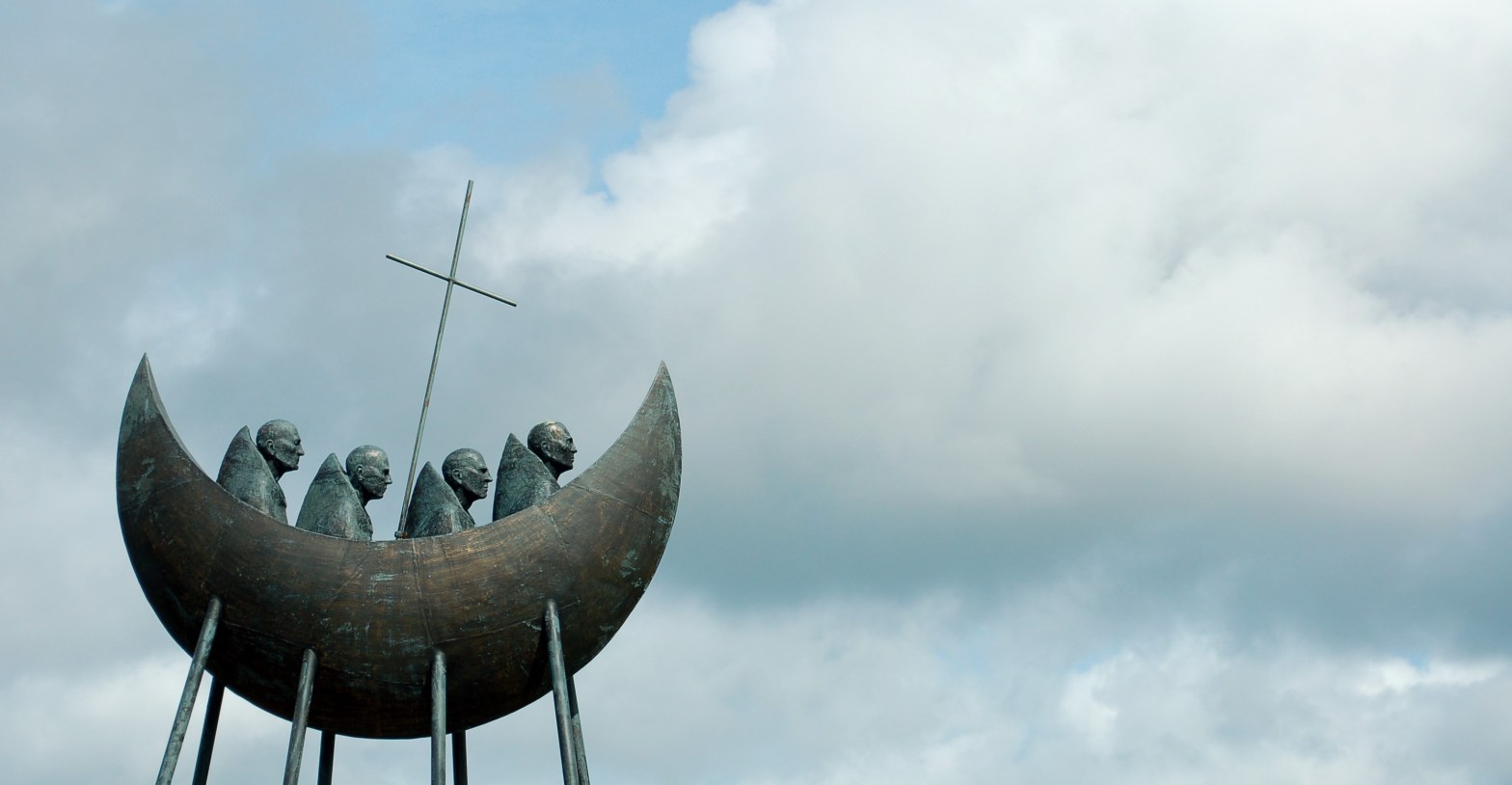
Fearless Irish and Scottish monks crossed the open sea in small, traditional — and decidedly fragile — Gaelic currach boats made of animal hide (see the featured image of this blog post), settling on islands and remote shores as hermits. It brings to mind the words of the dwarf Gimli in The Lord of the Rings: “Certainty of death. Small chance of success. What are we waiting for?”
In that sense, Irish and Scottish monks were the real explorers of the North Atlantic, long before the Vikings — and, perhaps more importantly, their modern descendants — claimed the title for themselves. These monks had already settled in the Faroe Islands, Iceland, Orkney, and Shetland before the Norsemen arrived in their admittedly impressive wooden longships. When the Norsemen reached these remote, inhabited lands, they called the monks papar, meaning ‘fathers.’
Much later, Norway and Denmark laid claim to these archipelagos, arguing that the Norse had been the first to settle them during the Viking Age. But were they really? One might reasonably wonder. The Irish papar had not exactly planted a flag on these islands, like the Americans did on the Moon, when they too had travelled far in a small vessel through empty space.
INTERMEZZO
The Voyage of Saint Brendan — We should also mention the Irish monk Saint Brendan of Clonfert and the Navigatio Sancti Brendani Abbatis, or Voyage of Saint Brendan. According to the tradition, this famous voyage took place in the first half of the sixth century AD. Saint Brendan, who was originally given the name Mobhi — or should we call him Moby, that divine mysterious creature roaming the seas? — in southwestern Ireland, is counted among the Twelve Apostles of Ireland. He set out across the North Atlantic in search of the Garden of Eden. He never found it, by the way. But perhaps he did find America. Could have been worse.
Moby Dick could also be named after another Irish apostle, Mobhí Clárainech. Just like Moby Dick, clergyman Mobhí was deformed, too. Yet another deformed clergyman was Bishop Hunger, about who we have dedicated a blog post.
Along the Frisia Coast Trail, on the Wadden Sea island of Terschelling in Friesland, stands an old lighthouse named after Saint Brendan: the Brandaris. The original lighthouse was built in 1323, but after being destroyed by a storm, it was rebuilt in 1594. It remains the oldest functioning lighthouse in the entire Wadden Sea region, stretching across Denmark, Germany, and the Netherlands. The oldest surviving lighthouse building, however, stands on the Wadden Sea island of Borkum in the region of Ostfriesland. Built in 1576, it bears a striking resemblance to the Brandaris in both design and appearance. It remained in service until 1879, when it was finally decommissioned as a lighthouse.
On the Wadden Sea island of Neuwerk stands yet another historic brick tower, der Große Turm (‘the Big Tower’), built between 1300 and 1310. Originally, it served to protect the waters near Hamburg from pirates. Between 1815 and 2015, it functioned as a lighthouse. Incidentally, the name of the island, Neuwerk, translates as ‘New Castle.‘
Hecmunda, or Egmond, where Saint Adalbert was buried, was not located at the same spot as the present-day village of Egmond(-Binnen). Hecmunda lay closer to the dunes of the North Sea coast. During the Early Middle Ages, the coastline was experiencing significant dune formation, with drifting sands gradually encroaching on settlements and cultivated land.
There is even a legend about these wandering sands. It tells how the famous Danish warlord Rorik of Dorestad — also written as Hrœrekr and, at the time, ruler of West Frisia — once arrived by ship at the church of Egmond. When he discovered that the church had been buried beneath sand and dunes, Rorik, for reasons that remain gloriously inexplicable, ordered his Vikings to dig it out the following day.
When they awoke the next morning, however, the church had miraculously emerged from the sand all by itself. No need, then, for Rorik and his uncouth men to start shovelling. Naturally, it was all the work of Saint Adalbert, who presumably had little interest in giving the northern devils any credit for rescuing his beloved church.
On the other hand, Rorik of Dorestad is remembered rather more positively in another case, namely in connection with the holy Runx Well, which we will come to later in this blog post. And let us not forget that, when Rorik became a vassal of the Frankish king, he converted to Christianity and was able to keep West Frisia relatively free from Viking raids (Van der Tuuk 2003).
INTERMEZZO
The Chapel of Saint Piran — Saint Piran, an Irish monk who lived in the fifth or sixth century AD, is the patron saint of the Kernowyon, the Cornish people. His importance to Cornwall stems in part from the legend that he discovered tin, which would become an important source of Cornwall’s wealth for centuries. Piran is said to have lived (also) as a hermit on Penhale Sands near Perranporth, where he built a chapel.
The chapel subsequently fell into obscurity after being buried beneath the dunes, until it was rediscovered and unearthed in the eighteenth century. At the beginning of the twentieth century, however, it was decided that the best way to protect what may be one of the oldest Christian buildings in the British Isles was to bury it under the sand once again. It was not until 2014 that the chapel was unearthed once more (Stedman et al 2022). Let’s see for how long it remains the case.
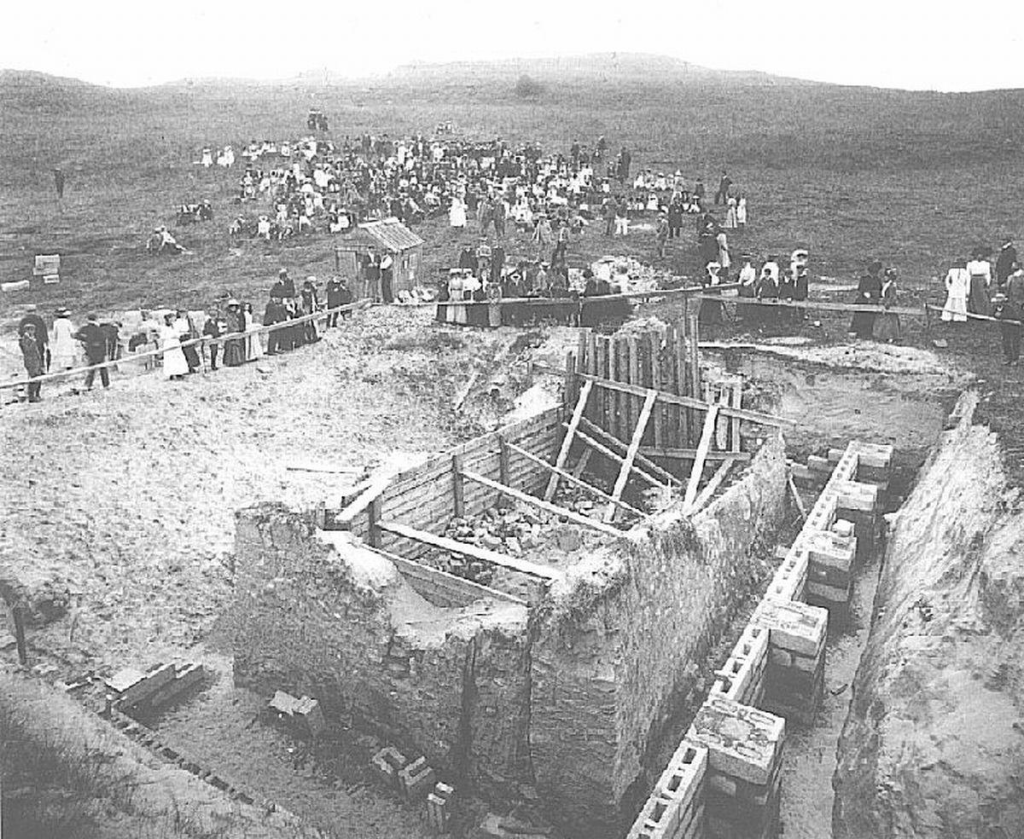
One wonders, however, whether Rorik and his party would have been quite so willing to uncover, recover, and then uncover the chapel again if they had been asked to do the same for the church at Egmond.
Egmond can be interpreted as ‘mouth of the Eg. The Eg’ — also recorded in older forms as Hegge or Egg — or the IJ may have been a branch of the estuary of the River IJ, which was originally connected directly to the North Sea. If so, this would explain why Egmond was still accessible from the sea in the ninth century AD. It may also explain why the Viking warlord Godfrid, also written as Guðröðr, the so-called Sea-King, is said to have established his stronghold here (see further below).
3. The Viking Age in West Frisia
Sorry for bringing up the Vikings yet again — the web and charity shops are already flooded with articles and books about these notorious sea bandits. However, they are an essential part of the history of the Abbey of Egmond and, ultimately, of the rise of Holland and, thus, the Netherlands.
Viking rule in West Frisia began in AD 841, when the aforementioned warlord Rorik of Dorestad became a vassal of King Lothair I of Francia. The Franks granted him the prefecture of West Frisia as a fief, effectively making him the warden of the Lower River Rhine. At the time, West Frisia encompassed the lands west of the former River Vlie, stretching from the River Scheldt in the south all the way north to the Wadden Sea islands of Texel and Eijerland. It also included substantial parts of the central river lands of the Netherlands, including the area around the Stichtse Vecht.
The estuaries of the rivers Scheldt and Meuse, what is today the province of Zeeland and the coast of Flanders, also belonged to West Frisia, but were since AD 837 de facto being ruled by different Danish warlords with their power base on the island of Walcheren. See for more about this history our blog post Walcheren Island. Once the Sodom and Gomorrah of the North Sea.
Naturally, the jewel in the jewel of the Rhine, the great trading emporium of Dorestad — the present-day town Wijk bij Duurstede and arguably the largest trading centre in north-western Europe — fell within Rorik’s jurisdiction as well. For more on Dorestad, see our blog post The Batwing Doors of Dorestad: A Two-Way Gateway of Trade and Power.
Taken together, these territories roughly corresponded to the modern provinces of Noord Holland and Zuid Holland, with parts of province Utrecht as well. Some historians therefore argue that, during the Viking rule of the ninth century AD, the foundations of what would eventually become the region of Holland were already being laid.
Rorik most probably had his seat at Dorestad, although it is also possible that, from around AD 860, he used the area around Egmond as an additional seat. Despite having to balance loyalties between his Frankish overlords, Viking warlords, and his own Danish forces, Rorik nevertheless ruled West Frisia more or less continuously until around AD 880, when he is thought to have died.
It is possible, however, that Rorik met his end as early as AD 876, when he suffered a defeat at the hands of the Frisians. The Frisians of West Frisia had already begun rebelling against Frankish rule under Rorik in AD 867, and that same year Rorik was driven out of Frisia altogether (Van der Tuuk 2003).
There is another legend connecting Rorik to the Egmond area: the story of the Runxputte, which translates as ‘Runx well.’ We have already mentioned it briefly. The well lies about three kilometres southeast of the present-day village of Egmond-Binnen, as the crow flies, and just south of the village of Heiloo. It is also known as Oesdom.
According to local tradition, the Runxputte was named after Rorik because he renovated the well — hence, supposedly, ‘Rorik’s well.’ The well is said to have sprung up during the first quarter of the tenth century AD. There is, however, a small chronological problem: Rorik lived in the ninth century AD. We are therefore still trying to reconcile these two storylines in time, preferably without the assistance of a DeLorean time machine. Perhaps mathematician Hinke Osinga could help us straighten out the resulting temporal chaos.
Chronological inconsistencies aside, it remains a fascinating piece of local tradition.
INTERMEZZO
The Miracle of Ermengarde — A miracle book of the (former) Saint Donatian Church in Bruges in the region of Flanders, tells of the great miracle that happened to the women Ermengarde around the year 1000. On a certain day, she went to draw water for her family at the Runxputte at Oesdom. Once there, she heard pleasant music coming from the Rorikberg (‘Rorik hill’), also known as Kruisberg, nearby. When she lay down on the slope of the hill to listen better, she fell asleep. Then the Devil saw its opportunity and doused her with boiling water, making her maimed and blind. Eight years later, she received a vision from Saint Donatian. Saint Donatian advised her to make a pilgrimage to Bruges to be healed through his intercession. Ermengarde did and, indeed, was healed from her blindness on 1 May 1011.
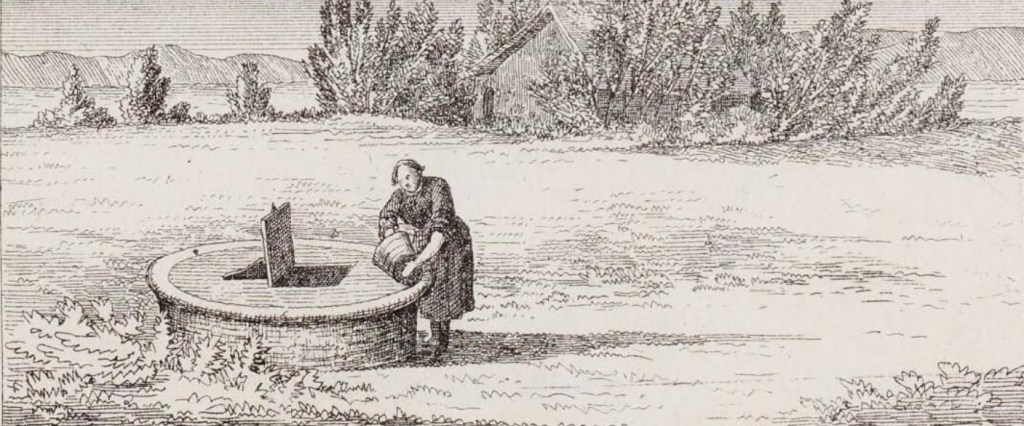
Please read our blog post One of History’s Most Enlightening Hikes: That of Bernlef and Ludger to understand the symbolic meaning of temporarily blindness as a punishment of God. Indeed, Ermengarde should not have listened to sinful music, and that, of course, left her vulnerable to the Devil.
The Runxputte stood beside a mound known as the Kruisberg, which translates as ‘Cross mountain.’ During the High Middle Ages, the site developed into a place of pilgrimage after a statue of the Virgin Mary was discovered in the surrounding fields. The statue was taken to the local church, but, miraculously, it kept returning to the fields near the Runxputte. Clearly, the Virgin Mary had other plans.
After a merchant who claimed to have been saved from drowning at sea through the intercession of the Virgin Mary built the Chapel of Our Lady for Distress on top of the Kruisberg, things really took off. Calling upon the Virgin Mary in a maritime emergency is hardly surprising: she is, after all, the patron saint of sailors and fishermen. The site became — and remained — a popular pilgrimage destination, even after the chapel was destroyed in 1537, and even after the Protestant authorities set about cleaning things up, removing the remains of both the ruined chapel and the Runxputte.
As an extreme measure to put an end to the pilgrimage, the Protestant authorities went so far as — the horror — to excavate the entire Kruisberg mound in 1769. It did not work. The pilgrimage continued.
Ironically, it was eventually the Catholic Church itself that toned down the pilgrimage in the early nineteenth century. A century later, however, the same Church apparently had a change of heart and restored the site. This, of course, was after the Catholic Church’s ecclesiastical hierarchy had been restored in the Protestant Netherlands in 1853. In 1930, a brand-new Chapel of Our Lady for Distress was built, a statue of Saint Willibrord was erected, and — following in the footsteps of the Danish warlord Rorik — the well was restored once again.
The restoration of the Catholic Church hierarchy, by the way, caused quite a stir at the Royal House of Orange. Read more about this in our blog post A Dutch King Once Yelled: “Je Suis Frison, et Je Suis Plus Têtu Que Vous!”
The Runxputte remains a popular pilgrimage site to this very day, and it is a place we heartily recommend visiting when hiking the Frisia Coast Trail. Quench your thirst with holy water.
A Fatal Trap for Godfrid and his Vikings
After the death of the feared Rorik of Dorestad, another Viking warlord entered the stage in AD 882: Godfrid the Sea-King. He received West Frisia as a fief from King Charles the Fat. According to local tradition, Godfrid established his stronghold near the village of Egmond. The castle at nearby Uitgeest is also mentioned in a mid-twelfth-century AD source as a possible stronghold of Godfrid. Nevertheless, there is no evidence to support all this
It was the death of Godfrid the Sea-King, only a few years later, that opened the door for the Frisian nobility to step forward. His assassination marked the beginning of the rise of the Gerulfing dynasty — and it all started with a good old-fashioned act of treachery. Godfrid’s assassination is recorded in the Annales Fuldenses, and the story goes as follows.
In the spring of AD 885, the warlord Godfrid sent two of his vassals, the Frisian noblemen Gardulf and Gerulf — brothers, according to some scholars — to meet representatives of King Charles the Fat at a place called Herispich. This was probably near the present-day village of Spijk, close to Lobith in the eastern Netherlands.
The two men dutifully delivered Godfrid’s demand: he wanted, believe it or not, several wine-producing territories near, among other places, the town of Koblenz, granted to him as a fief. Perhaps he was thinking of stocking his wine cellar, although historians generally believe the demand was deliberately provocative. Having delivered the call for alcohol to the king, Gardulf and Gerulf returned.
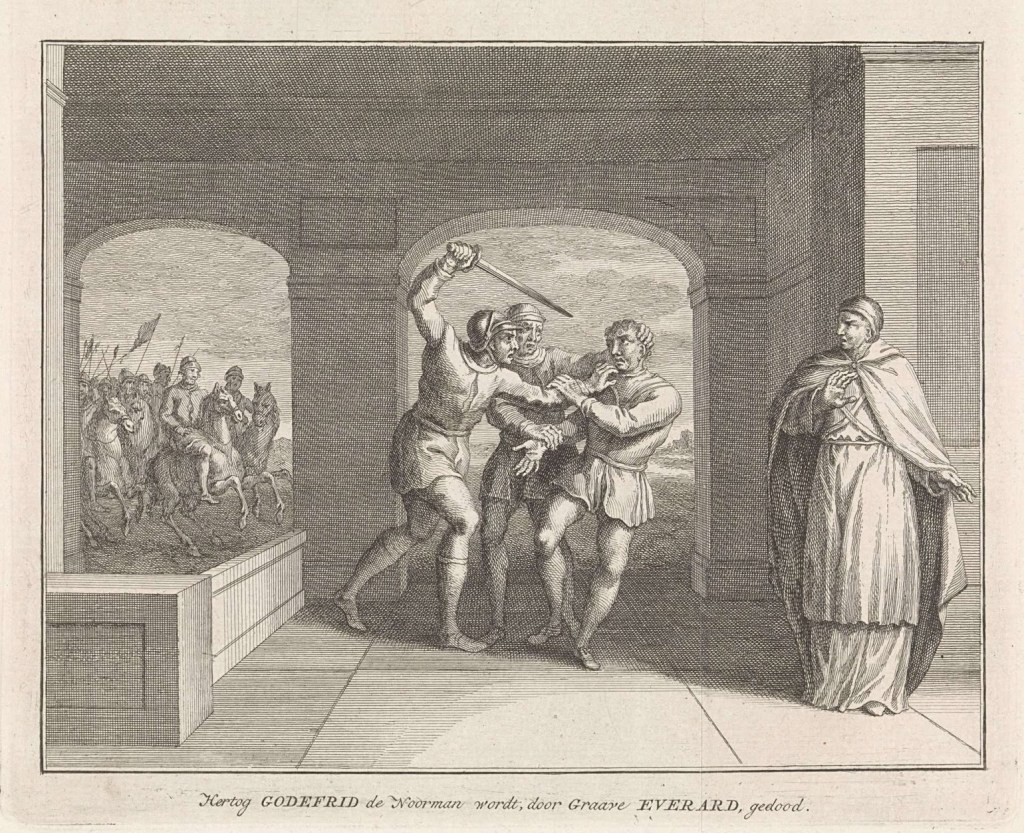
A second meeting was subsequently arranged at Herispich, this time between Godfrid himself and Henry, Margrave of the Franks. It was a trap. During the meeting, Godfrid was murdered by Everhard Saxo, Count of Hamaland. Godfrid’s army, which was encamped at Herispich, was simultaneously attacked and slaughtered by a combined force of Frisians and Saxons. All in all, it was a remarkably well-organized operation by Franks, Frisians, and Saxons to get rid of the Danish dukes. The end of the Dukes of Hazard, you might say.
With Godfrid’s death Viking rule in Frisia came to an end. And, more importantly for the story that follows, the door was now open for Frisian noblemen such as Gerulf to step into the political vacuum.
By the way, AD 885 was also the year that a war band of Dani et Frisones, ‘Danes and Frisians,’ raided the island of Sheppey in south-eastern England. See our blog post Foreign Fighters Returning From Viking Warbands for more on this subject.
So, Frisians were apparently operating on both sides: sometimes fighting against the Danes, and sometimes joining them on their raids. That the Frisians were fully occupied with politics back home as well becomes clear from what happened in AD 898, when Count Everhard Saxo was murdered by Waldger, the son of Count Gerulf of West Frisia. More about the cleverly operating Count Gerulf later (Van Bemmel et al 2022).
A striking fact is that, only a year before Godfrid and his army were overpowered, the Frisians had also fought a major battle against the Vikings in the territory of Norderland, part of the region known today as Ostfriesland. This was the Battle of Norditi, fought in AD 884. According to the chronicler Adam of Bremen, no fewer than 10,377 Vikings were killed — a staggering figure that should probably be treated with some caution, given that the Gesta Hammaburgensis was written almost two centuries after the battle.
After this bloody battle — some think battles — in which so many bodies were said to have piled up, the Frisians were granted control over the liberated lands by King Arnulf of Carinthia as well (see further below). Was there perhaps a master plan by the Franks, working in league with the Frisians, to get rid of the Danish presence on Frisian soil — the mark of Francia — altogether that was played out in AD 884 and 885? But why then, in that very same year, AD 885, did Frisians and Vikings join forces in a raid on England? What exactly was going on politically between the Frisians and the Franks?
See our blog post A Theelacht. What a Great Idea! to read more about this extraordinary and violent battle in Ostfriesland in AD 884, and about the remarkable innovation it brought forth.
4. The Origins of the Abbey and the Gerulfing Dynasty
Four years after the murder, in AD 889, most of West Frisia that had previously been granted in fief to the warlords Rorik and Godfrid was granted in fief once again. This time, King Arnulf of Carinthia granted the lands as a benefice to a Frisian nobleman for the first time: Gerulf. The very same Gerulf who, as mentioned, had been a vassal of the warlord Godfrid the Sea-King and had been involved in the events at Herispich. All very intriguing, of course. The fief included the pagus, or ‘territory,’ of Niftarlake, together with the strategically important River Stichtse Vecht. We know this because Niftarlake later appears as a possession of Gerulf’s son Waldger, whom we mentioned earlier.
Historians do not agree on whether Gerulf himself was part of the conspiracy to murder Godfrid. Reputedly, the Public Prosecutor remains unwilling to investigate the crime. Whatever Gerulf’s role may have been, one thing was clear: West Frisia was no longer ruled by the bearded axes from the north. From now on, it would be ruled by Frisian counts under the authority of the Frankish kings.
Presumably, Gerulf was a descendant of Gerulf the Elder. To avoid confusion, he is therefore generally referred to as Count Gerulf II. Gerulf the Elder, or Gerulf I, is known from the Viking attack on the island of Walcheren in AD 837. During this attack, the Franks lost the strategically located island at the mouth of the River Scheldt. Gerulf the Elder, who had sided with the Franks, was blamed by the king for the disaster. As punishment, his benefices in Mid Frisia — an area roughly corresponding to the modern province of Friesland — were taken away from him.
Both Gerulf the Elder (Gerulf I) and Count Gerulf II held possessions in the pagus, or ‘territory,’ of Westergo, which formed part of Mid Frisia. Historians therefore assume that both men originated from this Frisian heartland at the Wadden Sea.
The next phase in the genesis of the Abbey of Egmond began in AD 923, when King Charles the Simple granted the Church of Saint Adalbert at Ekmundam — that is, Egmond — to Count Dirk I, son of Count Gerulf II, as an allodial possession. The grant included all the church’s holdings at Suithardeshaga (as explained earlier, near the modern village of Lisse), Fortrapa on the former island of Wieringen, and Kinhem, probably on the Wadden Sea island of Terschelling.
Soon after receiving this gift, Count Dirk I ordered the relics of Saint Adalbert to be transferred from the church at Egmond to the nearby settlement of Hallem, where they were placed in a wooden church. The decision to move the relics slightly farther inland may well have been influenced by the ongoing dune formation along the coast, which, as mentioned earlier, was steadily reshaping the landscape.
Moreover — and somewhat predictably — miracles accompanied the translatio, or transfer of the relics. Somehow, translationes are always susceptible for the occurrence of miracles. At the very spot where Adalbert’s remains were exhumed, a spring of fresh water is said to have burst forth from beneath the tomb. This quickborn, known as the Adalbertusput (‘Adalbert’s well’), produced clear, fresh water that soon acquired a reputation for healing powers — a reputation it retains to this day.
Both the relics and the well were believed to possess the power to cure the possessed, the crippled, and the blind. According to tradition, the daughter of Count Dirk II was cured of her blindness by drinking the water from the well. Why she had become blind in the first place, is not being told.
The name Egmond travelled along with Adalbert’s remains to Hallem. Gradually, the old name Hallem was replaced by Egmond, which eventually became the present-day place name Egmond-Binnen. Around the same time, Count Dirk I commissioned the construction of a wooden monastery for nuns at Hallem, or Egmond-Binnen, laying another important foundation for what would eventually become the Abbey of Egmond.
INTERMEZZO
Investiture Controversy — The church at Hallem was a so-called proprietary church: a church owned by a secular power. The feudal lord, therefore, nominated the ecclesiastic personnel of the church. Most ‘ecclesia propria’ or proprietary churches were established between the seventh and the eleventh centuries.
In the eleventh century AD, church and state clashed across Europe in what became known as the Investiture Controversy. It was a long-running conflict between ecclesiastical and secular powers over who had the right to appoint senior church officials. The famous Road to Canossa undertaken by King Henry IV was part of this struggle.
After a long journey through the cold Alpine mountains, Henry IV arrived on 25 January 1077 at the gates of the castle of Canossa, where he and the pope had agreed to meet. Pope Gregory VII, however, made the king wait outside for three days, standing in the snow, before finally allowing him through the gates. Of course, Henry had brought provisions and presumably did not actually have to sleep in the snow. But that was hardly the point. The humiliation was.
It did not, however, settle the investiture issue yet. That only came to an end in the first quarter of the twelfth century, when finally it was settled only the Roman Catholic Church had the right to invest bishops and abbots, and no longer secular leaders as well.
Central-Place-Complex Hallem
Before we continue, the name Hallem, the predecessor of present-day Egmond-Binnen, deserves a closer look and needs to be placed within the early medieval context of central-place complexes.
Hallem points to the presence of a hall or seal in Mid Frisian, vividly described in the Old English epic poem Beowulf. These were large longhouses where kings and other powerful men gathered to drink mead and wine, feast, and — on the following day — break rings to forge new alliances or reaffirm existing loyalties. The reason for the two-day arrangement? According to the traditional customs of the Germanic peoples, the first day was for drinking together and the second for conducting business. But that is another story.
Besides Hallem, the local topographical placename Smithan, which has survived in the surrounding area, suggests that this was also a place of craft and metalworking. A hall(em) and a smith(an) together point to the presence of a comital estate: a centre where a count’s household, administration, feasting, craftsmanship, and political networking could all come together.
Additionally, the etymology of the pre-Christian placenames of the nearby settlements Hargen and Heiloo points to places associated with heathen worship. The name Hargen derives from the Old Germanic harguz and is comparable to Old High German harug and Old English hearg. It means something like ‘pagan sanctuary’ or ‘idol’ (Van Renswoude 2021). The name also occurs in the southwest of the province of Friesland, in the village of Harich. The name Heiloo, recorded in the eleventh century AD as Heileginlo, can be interpreted as something like a ‘holy open place within the forest.’
Trade, another essential function of a central-place complex, was possible via the North Sea, either through a branch of the estuary of the River IJ or perhaps via the area of the present-day town of Velsen. As explained earlier, Egmond can be interpreted as ‘mouth of the River Eg.’
Lastly, the etymology of the toponym Schepelenberg, at the village of Heemskerk near Hallem, probably points to a former thing assembly site, also known as a ting or ding. These were places where people gathered, laws were made, disputes were settled, and justice was dispensed. For centuries, it was customary for newly appointed counts to be honoured by their subjects on the Schepelenberg mound. This custom may well have originated in the time when the mound still functioned as a thing site. See our blog post Well, the Thing Is… Speaking From the Moral High Ground of Old for more about these ancient assembly places.
Taken together, all these functions — access to trade, a smith, a thing assembly site, a place for the performance of (religious) rituals, and a toponym referring to a hall — suggest that Hallem may have been the power centre of a local political entity from as early as the Early Middle Ages, comparable to the central-place complexes found in southern Scandinavia (Dijkstra 2011). The presence of such a central-place complex might also explain why the Danish warlord Godfrid the Sea-King is said to have established his stronghold — or hall — in the Egmond area.
For more background on central-place complexes in early-medieval Frisia, see also our blog post Tolkien Pleaded in Favour of King Finn. An Immortalized Royal Tragedy
INTERMEZZO
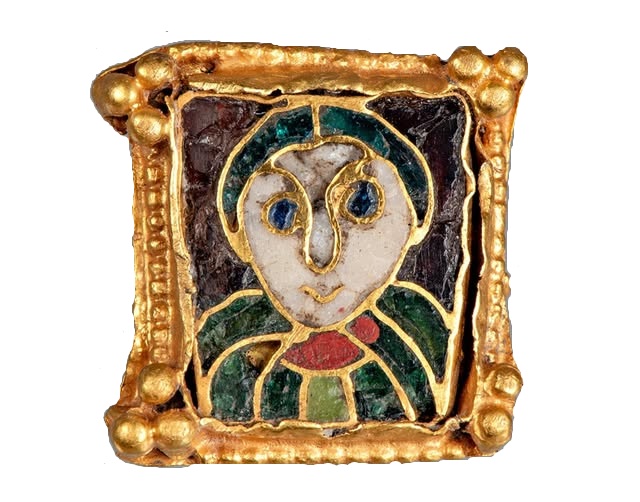
Hallem and Hallum — Besides Hallem in the province of Noord Holland, there is another Hallum in the Netherlands, namely in the old pagus ‘territory’ Oostergo in the province of Friesland. Finds of gold, parts of a sixth- or seventh-century vendel helmet at Hallum and a pommel of a so-called ring sword at the town of nearby Dokkum, indicate an early-medieval power base here as well. At Hallum a possible hall of the local leader has been identified, dating eight-ninth centuries AD. It is a ca. 18.2 meters long and 6.2 meters wide building. Contrary to the other building with walls made of turfs/clay sods, its walls are also made of (expensive) wood (Postma 2020, Nieuwhof 2023).
Archaeologists still hope to find traces of the hall of Hallem (Egmond-Binnen) in the province of Noord Holland, to have actually proof local Frisian big men or kings had their citadels there.
Around the middle of the tenth century AD, Dirk II, Count of West Frisia, replaced the wooden monastery for nuns with a stone monastery for monks. The nuns had endured quite a lot during the relatively short period in which they lived and prayed at Egmond. According to the already mentioned tenth-century AD Vita Sancti Adalberti, the monastery was burned down twice. During both fires, the shroud containing the bones of Saint Adalbert was miraculously preserved.
The fires, however, were apparently not the only problem. The nuns also had to contend with the so-called “beastly and hostile men of Frisia.” These men supposedly made it impossible for the nuns to live a sufficiently pious life, and this was said to be the real reason they eventually had to leave Egmond. Count Dirk II therefore provided the nuns with a new home at Suithardesharga, near the present-day town of Lisse in the province of Zuid Holland. The community was headed by Abbess Erlinde, who, somewhat conveniently, happened to be Dirk’s own daughter.
“For the word of God is alive and active. Sharper than any double-edged sword, it penetrates even to dividing soul and spirit, joints and marrow; it judges the thoughts and attitudes of the heart”
Hebrews 4:12
During the Middle Ages, the integration of church and state was more the rule than the separation of the two, as is common today in much of the Western world. The Church provided the worldly ruler with legitimacy, while the ruler, in turn, supported and endowed the Church. Count Dirk II was the man who transformed Egmond into a prestigious religious centre, with an abbey destined to become the grand mausoleum of the Gerulfing dynasty: a place where monks prayed and sang for the spiritual welfare of deceased counts and countesses whose generosity had helped sustain the monastery.
Perhaps it was at Egmond that the monks composed the hymn Humili prece, with its invocation to Saint Adalbert: Doctor Adalberte sint omnia prospera per te, et nobis famulis tu miserere tuis, ‘O learned Adalbert may all things prosper through you, and have mercy on us your servants.’ A fitting call upon Saint Adalbert, their patron saint.
Until AD 1133, when Count Floris the Black died, Egmond remained the burial place of the counts and countesses of the Gerulfing dynasty. From then on, Rijnsburg Abbey took over this role as the dynastic burial place (Dijkstra 1979).
Between AD 960 and 980, construction of the stone church and monastery was completed, bringing the Abbey of Adalbert into being. It is, in fact, considered the oldest abbey founded in the Netherlands.
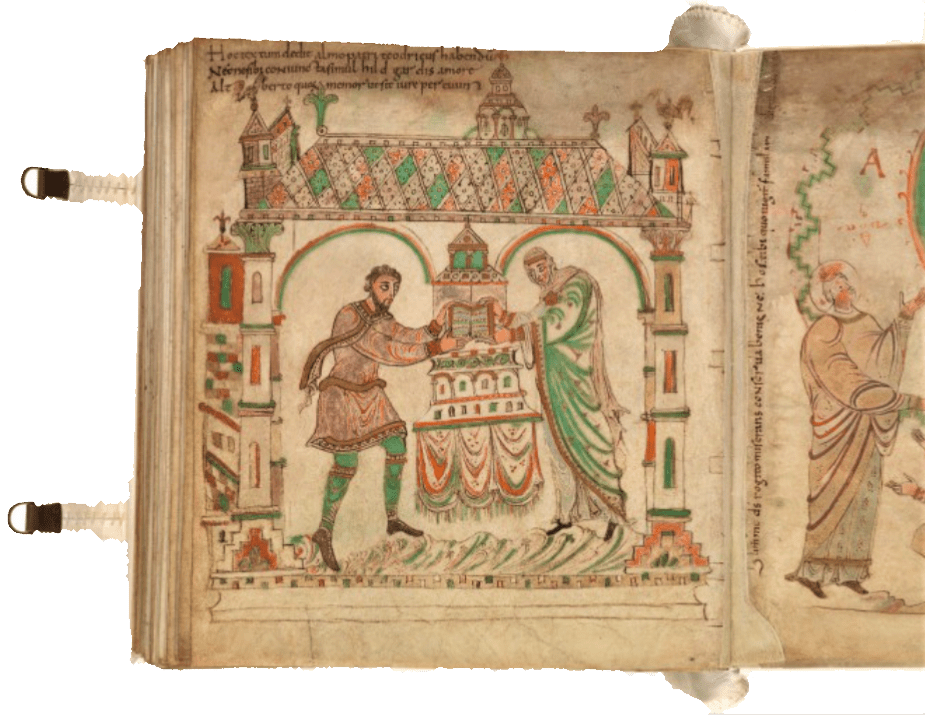
The foundation and early history of the abbey have been preserved in an exquisite tenth-century AD illuminated manuscript, the Evangeliarium (‘evangeliary’) of Egmond, now kept at the Koninklijke Bibliotheek (‘national library’) in the city of The Hague. The manuscript itself was part of the abbey’s cultural legacy — and, not coincidentally, also documented the glory and prestige of its generous Gerulfing benefactors.
Around AD 1110, the monks began compiling their own yearbooks, the Annales Egmundenses. And, naturally, they continued to glorify the dynasty that had so generously supported them.
Saint Jerome of Noordwijk
To give the Abbey of Egmond even more prestige, another translatio, or transfer of relics, took place. This time it concerned the remains of Saint Jerome, from the nearby settlement of Northgo, or Nordcha, corresponding to the present-day town of Noordwijk in the province of Zuid Holland. His relics were exhumed and transferred to the brand-new abbey, somewhere between AD 983 and 988.
Jerome was a Gael or Scot who had travelled to Frisia around AD 847 to do what missionaries did: preach the Gospel. He probably lived as a hermit at Noordwijk from the early AD 850s onward. This was a time when Danish warlords wielded their double axes over western Frisia — although, as mentioned earlier, Rorik of Dorestad had received West Frisia as a fief from the Frankish king and had converted to Christianity. According to tradition, Jerome was beheaded after refusing to renounce his faith before the pagan Vikings. Recte vivendo, neminem timeas — “Live rightly, fear no one.”
After his death, the spirit of Saint Jerome supposedly appeared to a local farmer named Nothbodo and revealed the location of his buried remains. Rather like a zombie who apparently needed a little assistance getting out of his grave. Nothbodo duly unearthed the remains, and as relics they were transferred to Egmond.
The abbey now proudly possessed the relics of two saints: Adalbert and Jerome. Let the pilgrimage — and the flow of revenues — begin, and may it all contribute to the power and prestige of the Frisian counts!
INTERMEZZO
Four King’s Charters — The library of the Abbey of Egmond (probably) also kept the so-called Four King’s Charters. In these charters, the West Frisian counts received gifts and fiefs from (West and East) Frankish kings. From the twelfth century AD onward, these four charters are being presented by the Egmond tradition as the formal bases of the county and dynasty of the West-Frisian counts. The four charters are:
- AD 889 gifts of King Arnulf of Carinthia to Count Gerulf (four years after the death of Godfrid the Sea-King);
- AD 923 gifts of King Charles the Simple to Count Dirk I;
- AD 969 gifts of King Lothair of France to Count Dirk II, and;
- AD 985 gifts of Holy Roman Emperor Otto III to Count Dirk II.
From these charters we know what the size and nature of the territories that were attributed to the West-Frisian Gerulfings by the Frankish kings. Copies of these four charters have been preserved in the Cartularium (‘cartulary’) of Egmond written in the fourteenth century AD.
The prestige of the abbey was further enhanced by the donation of churches. In AD 988, Count Dirk II donated the churches in the villages of Noordwijk and Voorhout to the Abbey of Egmond. In AD 993, Count Arnulf donated the church at Vlaardingen to the abbey. With these possessions came the right to nominate candidates for the priesthood and to receive a form of ecclesiastical tax, the decima regalis, or tienden — the ‘tenths.’
During the course of the eleventh century AD, the Gerulfings donated still more churches to the abbey: those at Heiloo, Oegstgeest, Petten, and Velsen, all of which were traditionally associated with foundations by Saint Willibrord as early as the eighth century AD. Much more on these so-called Willibrord churches further below, because they would eventually become quite an issue — not only within the Roman Catholic Church, but also between the Church and the counts.
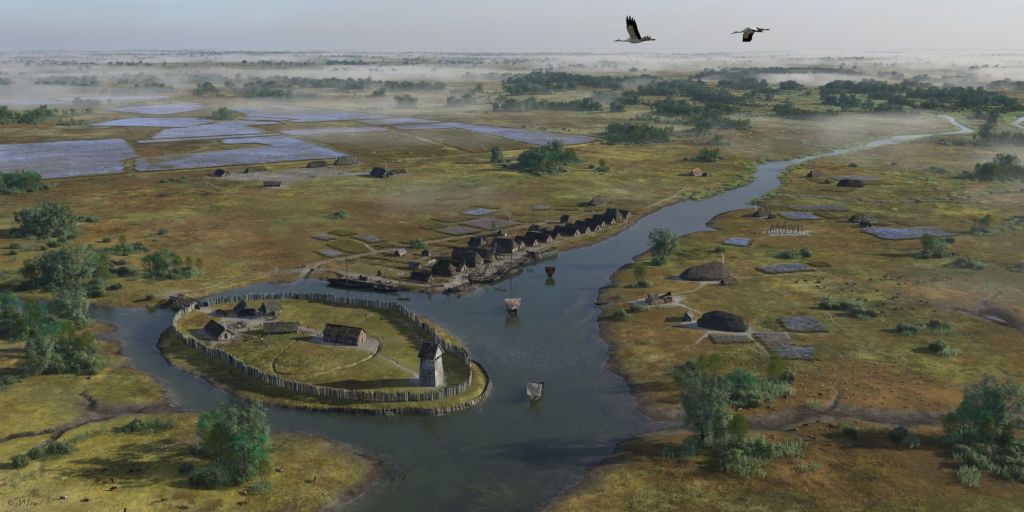
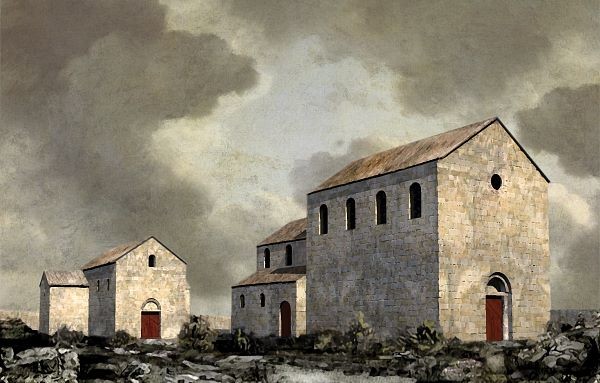
In general, all these churches were so-called aisle-less churches, known in German as Saalkirchen, in Dutch as zaalkerken, and in Mid Frisian as sealtsjerken. The generic element sele derives from the Germanic saliz, meaning a ‘single-room house’ (Deckers 2013). These early churches measured roughly nine metres wide and twenty-two metres long. And size does matter, as we will see later in this blog post.
The churches had no attached towers. Where a bell tower was present at all, it usually stood separately from the church building. Examples of these free-standing bell towers can still be seen in the terp region, particularly in the region of Ostfriesland and, to a somewhat lesser extent, in the province of Groningen. In the province of Friesland, by contrast, bell towers are for the most part an integral part of the church, usually positioned at the western end of the nave. Like the Frisian gulf farmsteads, Groningen and Ostfriesland have common building traditions.
By the way, the coastal region comprising the provinces of Friesland and Groningen, together with the region of Ostfriesland, has the highest densities of medieval Romanesque churches in the world. The number of medieval monasteries was impressive, too, although virtually all were demolished or fell into ruin after the Reformation. In late-medieval Frisia, between the former River Vlie and the River Weser, there were around 115 monasteries (De Boer 2017). Combined with the hundreds of churches scattered across the Wadden Sea landscape, they must have made Frisia look like an exceptionally pious corner of the medieval world.
5. The Emergence of the County of Frisia
All in all, this — the foundation and expansion of the abbey — was a clear demonstration of the rising power of the self-confident West Frisian counts, who increasingly began to operate independently of the Frankish kings. This growing desire for autonomy culminated in the Battle of Vlaardingen, fought in the present-day town of Vlaardingen in the province of Zuid Holland in AD 1018. There, Frisian Count Dirk III defeated a Frankish army — although the utter confusion, indiscipline, and lack of preparation among the Frankish forces contributed more than a little to Dirk’s victory.
The Battle of Vlaardingen is traditionally regarded as the starting point of an increasingly independent West Frisian polity, which about a century later would become known as the County of Holland. Unfortunately, regional historians, mostly from Holland, often gloss over the intervening period — the County of Frisia, from AD 889, when Count Gerulf emerged as the first count of Frisia, to AD 1101, when Count Floris II styled himself Count of Holland — and retrospectively label this entire period the County of Holland as well. As so often happens, the ‘science’ of history is not merely the study of the past; it can also become an exercise in identity politics.
To increase their power even further, the Gerulfings also had to curb — or break — the influence of the Abbey of Echternach, which owned many of the so-called Willibrord churches and chapels within the territory of West Frisia. As mentioned earlier, these were churches and chapels traditionally attributed to foundations by Saint Willibrord in the late seventh and early eighth centuries AD. The solution was simple: the counts of West Frisia usurped the the whole lot. A remarkably straightforward — and, from the counts’ perspective, highly effective — way of doing business, if you have the power.
The Willibrord churches became a serious issue in the tenth and eleventh centuries AD, illustrating the power struggle between the Bishopric of Utrecht, the Abbey of Echternach, and the Abbey of Egmond — that is, the Gerulfings. At the Synod of Mainz in AD 1049, with the approval of Holy Roman Emperor Henry the Pious, the churches were formally assigned to the Abbey of Echternach. Afterwards, however, nothing changed in practice.
Things became even more complicated because not only did the Abbey of Echternach want its churches back, but the Bishopric of Utrecht claimed the Willibrord churches as well. In AD 1063, with the matter still unresolved, the Synod of Utrecht divided the disputed possessions: twelve churches and chapels were assigned to the Church of Utrecht and twelve to the Abbey of Echternach. Fifty-fifty. (Now the reader understands where the Dutch concepts polderen and Dutch treat originate from.)
Still, it did not change a thing. “Bite me,” the counts of West Frisia must have thought. It was also a classic case of the Dutch saying Als twee honden vechten om een been, loopt de derde ermee heen — literally, ‘when two dogs fight over a bone, the third runs off with it.’ And that was precisely what happened here: while Utrecht and Echternach fought over the Willibrord churches; the Gerulfings simply kept them.
The reason why the Abbey of Echternach and the Bishopric of Utrecht claimed these parochial Willibrord churches was, unsurprisingly, also about money, as it so often is in life and politics, albeit not exactly what the Benedictine and Franciscan Orders advocated. With the commercial exploitation of peat and the large-scale reclamation of land beginning around this time, the population of West Frisia — later known as the region of Holland — increased rapidly. And as the population grew, so did the number of ecclesiae mediae, smaller churches dependent on a parish church, as well as chapels.
More ecclesiae mediae and chapels meant more parishioners, and therefore significantly greater revenues for the parochial churches that controlled them. It was a bit like Monopoly: the more green houses and red hotels you collect, the more rent you can charge. If the Vatican ever decides to produce a Monopoly: Churches & Monasteries edition, we hereby declare this idea copyright-free. A small print saying “An idea by Frisia Coast Trail” would nevertheless be appreciated. Perhaps the red building could be abbeys and the green ones churches?
For an idea of the sheer scale of the commercial exploitation of these peatlands, also known as the Great Reclamation, see our blog post The United Frisian Emirates and Black Peat. How Holland Became Dutch.
Whatever the formal declarations of synods and the seals of emperors, the Gerulfings simply continued to regard the Willibrord churches as ecclesiae propriae — proprietary churches, or Eigenkirchen in German. In a way, they had some valid arguments for doing so.
When Viking attacks began to ravage the region, Bishop Hunger of Utrecht temporarily moved the see between AD 857 and 861 to the village of Sint-Odiliënberg in the modern province of Limburg, apparently returning to Utrecht around AD 861. Bishop Hunger, a Frisian by birth, took the archives of Utrecht with him. Actually, the decision of Bishop Hunger to move the see may well have had something to do with Rorik of Dorestad having left Frisia for a while, thereby leaving the door open to Viking raids and plundering. Later, in AD 882, the see was moved again, this time to the town of Deventer in the modern province of Overijssel. Only around AD 925, did Bishop Balderic return from Deventer to the see at Utrecht.
During the bishopric’s absence from Utrecht, and especially after its return in AD 925, the cartularium and lists of possessions were expanded. This was not entirely unusual. A similar thing happened at the Abbey of Prüm in present-day Rhineland-Palatinate, which compiled an Urbar in AD 893, following Viking raids, apparently to document and reclaim its properties (Arnold 2024).
The Bishopric of Utrecht likewise had an obvious interest in strengthening its claims to property that had slipped from its grasp. It also sought to mend and butter up its relations with the Holy Roman Emperor, hoping to recover as many of its former possessions as possible.
All this suggests the bishopric was preparing to reclaim its rights in West Frisia. However, the Gerulfings, who had taken care of the parochial churches in the meantime, were not really amused with the renewed interest of these, maybe in their eyes, cowards of Utrecht. Or, should we say, gold-diggers? They had forfeited their rights, according to the counts – who liked gold themselves, too.
Eventually, in the year AD 1156, the Abbey of Echternach renounced its claim of the churches in exchange of land on the island of Schouwen in the current province of Zeeland. A century of bickering about the legacy of Saint Willibrord had ended. Nevertheless, the efforts of the Bishopric of Utrecht were a bit successful. Bishop Balderic succeeded to receive the old Frisian pagus ‘territory’ Niftarlake from Holy Roman Emperor Otto I, possessions of the Frisian Count Hatto in 948, when Hatto fell somehow in disgrace with Otto. Pagus Nifterlake has a unique history, and read more about it in our blog post Attingahem Bridge, NY.
6. A Prestigious Abbey & Salvation of the Gerulfings
Back to the eleventh century AD, when the core of the Abbey of Egmond had been established with the building of a monastery (for men…) and church of stone, relics of two saints secured, and the (disputed) gifts of quite some parochial churches.
The next phase in the genesis of the Abbey of Egmond was initiated by the remarkable Countess Petronilla of Lorraine (ca. AD 1082–1144). She was a half-sister of Holy Roman Emperor Lothair III and the wife of Count Floris II, also known as Floris the Fat. After Floris died in AD 1121, Petronilla became regent for their young son, Count Dirk VI, in AD 1122. She must have been quite a character.
A year before her husband’s death, Petronilla had commissioned a thorough renovation and enlargement of the abbey, apparently also responding to the monks’ complaints that their aisle-less church was simply too small — and rather embarrassing. At only eight by twenty-one metres, it was hardly an impressive building for an abbey of such stature. “Those are the dimensions of an ordinary church, not an abbey worthy of the Gerulfings,” they must have thought and whispered during Lauds, Sext, and Vespers.
Part of the reconstruction was the creation of the sandstone Tympanum of Egmond. Measuring 175 cm wide and 88 cm high, it is generally dated to around AD 1121–1130. It is the only surviving sculptural fragment of the once-impressive abbey and the oldest contemporary stone portrait of a member of the Gerulfing dynasty, namely the young Count Dirk VI.
Today, the tympanum can be admired in the Rijksmuseum (‘national museum’) in Amsterdam. At its centre stands Saint Peter the Apostle, flanked by the young, praying Count Dirk VI on his right and Countess Petronilla on his left. Saint Peter holds the two keys to the gates of Heaven, making it abundantly clear who was in charge of opening the door to salvation.
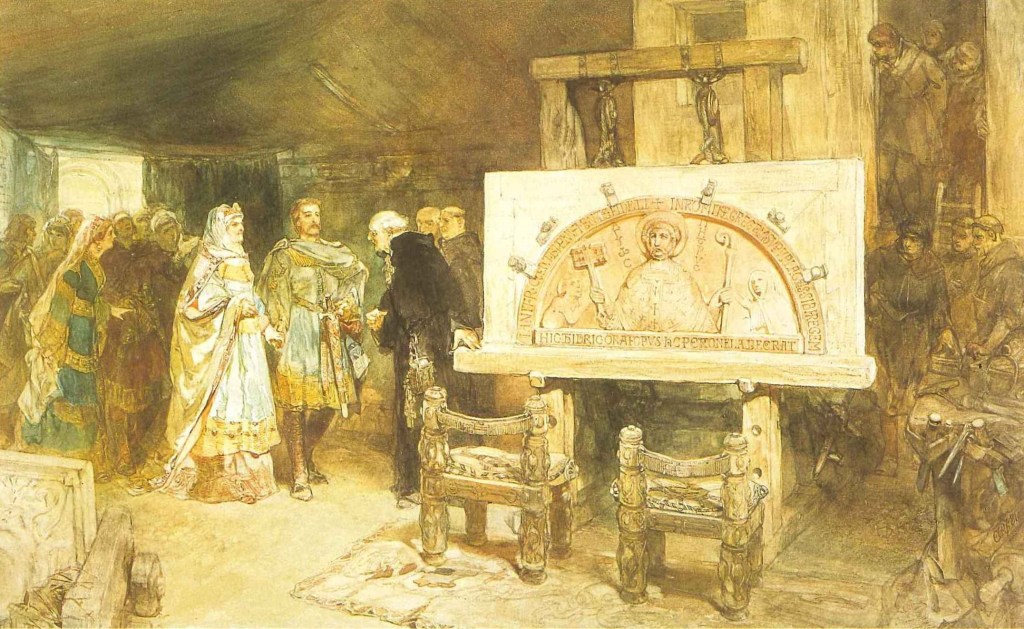
The central inscription, following the arch, reads: ianitor o celi tibi p[ro]num mente fideli + intromit[te] gregem sv[per]v[m] placans sibi regem — ‘O Janitor of Heaven, [I am] devoted to You with a faithful heart + admit the flock of the heavenly ones, and win the King’s favour.’ Another inscription reads: hic thid[e]ric orat. opus h[o]c pet[r]onilla dec[o]rat — ‘Here Thideric [Dirk] prays. Petronilla adorns this work.’
The tympanum therefore served as a permanent reminder to the monks entering the church beneath the arch: pray for the salvation of the souls of their benefactors, Count Dirk VI and Countess Petronilla (Den Hartog 2023). A detailed stone copy of the tympanum can be seen inside the abbey today, when staying there as a guest of the monks (see ‘Suggested hiking’ at the end of this blog post).
The rebuilding of the abbey was finally completed in AD 1143, when the altar of the church was consecrated.
With somewhat less grandeur, the church of the former terp village of Larrelt, north of the city of Emden in the region of Ostfriesland, also received a tympanum as a gift. It dates to around AD 1200 and, according to its Latin inscription, depicts Ippo the Elder (Ippo der Greis), who donated the tympanum. It was made by a stonemason named Menulfus, while Ludbrud was the builder of the church. The (unusual) inscription reads: “Ippo, Senex Saxo dat suis ovibus ostia facta. Menulfus me fecit. Ippo nonparvus fuit / Artifici mihi largus,” which translates as “Ippo, the old Saxon, gives these doors to his sheep. Menulfus made me. Ippo was not small-minded; he was generous to me, the craftsman.’ Who Ippo was, is unclear.
The ceremony consecrating the altar of the abbey church was documented in a charter issued in October of the same year. In it, Bishop Hartbert of Utrecht confirmed that the Abbey of Adalbert had received papal privileges and reconfirmed its exemption from tolls, a privilege that had been granted three years earlier. The surviving charter is an important contemporary document dating from AD 1143.
By this time, the Abbey of Egmond had acquired more than twenty churches and had replaced around thirteen wooden churches with costly buildings constructed from tuff, a volcanic stone imported from Germany. The abbey had clearly developed into a considerable ecclesiastical and economic power.
On a side note, Hartbert van Bierum originated from an area called Bierumen (Schroor 2015), a ribbon of settlements along a former elevated shoreline in the northern part of the pagus ‘territory’ Westergo, in the present-day province of Friesland. The element bier derives from bere, meaning ‘house’ or ‘barn.’ The area is still known in the Mid Frisian language as Bjirmen and encompasses the villages of Oosterbierum, Pietersbierum, Sexbierum, and the drowned village of Westerbierum.
What makes this particularly interesting is that, on the occasion of the consecration in AD 1143, Bishop Hartbert expressed his amazement that so many relics of saints, apostles, martyrs, virgins, and others were being kept at the outermost edges of the world — the very edge where he himself had been born and raised. Just check the map to see where Bjirmen is located. In addition, we should remind the reader that this Wadden Sea coastal region has the highest densities of Romanesque churches in the world.
Incidentally, two centuries earlier, another Frisian from Sexbierum had become bishop of Utrecht: Frederick of Utrecht. See our blog post Walcheren Island. Once the Sodom and Gomorrah of the North Sea for more about Bishop Frederick and his tragic fate.
From around AD 1200, under the leadership of abbots Steppo and Allert, a scriptorium was established, and the abbey began producing both secular and ecclesiastical histories (Burgers 2008). It was around this time that writing slowly began to take shape as an instrument of record-keeping and authority. The counts of West Frisia/Holland, too, only began issuing their own charters from around AD 1200. This was relatively late compared with their immediate neighbours in the region of Flanders and the Bishopric of Utrecht.
The West Frisians/Hollanders apparently relied for longer on oral tradition and witnesses of flesh and blood than on these relatively new technologies of written charters on parchment, later reinforced by seals, as evidence and proof.
INTERMEZZO
Proof is written — It is from the second half of the thirteenth century AD the production of charters exploded in Europe, including West Frisia/Holland, although there a bit later, to the end of the century. Also, the language used in charters changed almost instantly from Latin into the lingua franca of the area. Charters gaining more trust as evidence than the oral tradition with witnesses. A practice that had existed in living memory.
England was ahead with the use of charters. Introduction of charters there started already in the late-sixth century AD of which many concerned the Church. The logic explanation for the lead by the Church is that a monastery or an abbey could not inherit like kin did in secular society. Therefore, land property and how the Church had acquired it (usually it were gifts from kings) had to be explicitly fixed in writing.
In the thirteenth century AD, the English took things a step further. In the year AD 1290, King Richard the Lionheart formally ruled, probably in a charter, that proof of transactions of goods had to be in writing. In England it meant the definitive transition of the legal system from oral to written. England was the first to do so, north of the Alps.
The icing on the cake of the growing confidence of the West Frisian counts — and a significant moment in the emergence of Holland — came in AD 1101, when Floris the Fat (re)styled himself from count of Frisia as count of Holland. It was already briefly mentioned. The name Holland, or Holdland/Holtland, meaning ‘woodland,’ had appeared by the mid-eleventh century AD, initially referring primarily to the wooded area around the mouth of the River Old Rhine. In AD 1063, the count of Flanders was still known as Robrecht de Fries (‘Robert the Frisian’), while the region of West Frisia was described in contemporary sources as both Holdlandiae and Fresie.
The name Frisia did not simply disappear. Like an old soldier, it gradually faded from use after having served for around eleven centuries to designate the western coastal region. Counterfactual questions may be of little relevance to the study of history, but they can nevertheless be intriguing: what if the counts of West Frisia had held on to their original title? How might the world look today if they had continued to call themselves counts of Frisia rather than counts of Holland? What is in the name?
A few more words on Robert the Frisian, or Roberto comite Frisone (‘Robert, Count of Frisia’). In the region of Flanders, he was known as Robbrechte de Vriese. He acquired the epithet ‘the Frisian’ during his lifetime, following his marriage in AD 1063 to Countess Gertrude of Saxony, the widow of Count Floris I of (West) Frisia, or Fresia. The marriage thus connected Robert to the Frisian territories and provided the basis for his distinctive nickname.
Robert also acquired another epithet, this time posthumously: Roberto comiti Aquarum, or ‘Robert the Water Count.’ This mocking title alluded to his marriage to Gertrude, who was portrayed as the countess of the wet and swampy land of Frisia (De Maesschalck 2012, Nieuwenhuijsen 2022).
Robert himself would soon become Count of Flanders and, following his marriage to the widowed Gertrude of Saxony, would also serve for a time as regent of West Frisia. Gertrude and her young son, Dirk V, had been forced to flee West Frisia and seek protection in the County of Flanders. When Gertrude and Robert married in AD 1063, probably at the instigation of Count Baldwin V of Flanders (ca. AD 1013–1067), the rights of her son Dirk V to West Frisia were respected. Through the marriage, Baldwin V may also have hoped to prevent a future power struggle between his two sons, Robert and his brother, over the succession to Flanders after his death. Robert established himself at the stronghold of Vlaardingen, in what is now the province of Zuid Holland (De Maesschalck 2012).
The Houses of Flanders and West Frisia had maintained close and generally friendly relations throughout the Early Middle Ages. In AD 1061, Count Floris I was killed in battle, and his army was narrowly defeated by a force commanded by the bishop and acting under the auspices of the Holy Roman Emperor, Henry IV. Fifteen years later, in 1076, an army led by Robert the Frisian and Dirk V advanced to reclaim West Frisia from Bishop Conrad of Utrecht. The decisive battle took place at the stronghold of IJsselmonde, on the River Meuse near the present-day city of Rotterdam. Bishop Conrad was defeated, and after fifteen years of exile in Flanders, young Count Dirk V regained control of his West Frisian territories (Nieuwenhuijsen 2022).
As the Rijmkroniek van Holland (‘rhymed chronicle of Holland’), written in the early fourteenth century AD, recounts:
Men spreect noch an tot yselmonde, leghet noch menich halsberch inden gronde.
Yet people say near IJsselmonde, many coats of mail lie in the ground.
7. The Abbey’s Heydays, its Decline & Resurrection
Then, for almost four centuries, the stones and walls of the abbey remained more or less undisturbed, from around AD 1100 to 1500. Socially, however, the world beyond them was anything but quiet. Outside the hortus conclusus, literally a ‘walled garden,’ and beyond the monastery walls, an extraordinary amount was unfolding.
Among the most consequential developments were the Friso-Hollandic Wars of the thirteenth century onward, followed by the civil conflict between the Hoeksen (‘hooks’) and Kabeljauwen (‘cods’), better known as the Hook and Cod Wars. These conflicts erupted in the aftermath of the death of Count William IV, who was killed by Frisian militias at the Battle of Warns in AD 1345, and continued, in one form or another, until the end of the fifteenth century AD.
The Hook and Cod Wars were eventually followed by an even greater struggle: the wars of independence waged by the provinces of the Low Countries against the Spanish Empire, collectively known as the Eighty Years’ War. Beginning in AD 1568, these wars unfolded alongside the rapid spread of Calvinism from the second half of the sixteenth century AD onward. Vertiginous four centuries — and that is no understatement.
The reader can read a little more about these wars of independence in our blog post, Yet Another Wayward Archipelago, The Wadden Sea.
It was also during these centuries that West Frisia underwent a profound transformation of identity, gradually becoming Dutch, while the Frisian language — also known as Coastal Dutch — almost completely disappeared from the region. For more on this remarkable social and linguistic transformation of West Frisia into Holland, see our blog post The United Frisian Emirates and Black Peat. How Holland Became Dutch.
The County of Holland eventually grew into a powerful economic and political force in the Low Countries. As mentioned above, the Eighty Years’ War against the Catholic Spanish king began in AD 1568. With the Act of Abjuration in AD 1581, the Republic of the Seven United Netherlands — more commonly known as the Dutch Republic — was formally established. Holland, together with the coastal provinces of Zeeland and Friesland, became a driving force behind the struggle for independence.
From these relatively small coastal territories emerged one of the most powerful maritime and colonial states of the early modern world. It is doubtful that Count Gerulf II could ever have imagined such an outcome when he began consolidating his county in the region Kennemerland in the ninth century AD.
Let’s focus again on the Abbey of Egmond.
From the second half of the thirteenth century AD onward, the counts of Holland waged a series of costly wars against the Mid Frisians in an attempt to subjugate the still-independent peasant republic of Frisia, roughly corresponding to what is now the province of Friesland. The most famous — and most disastrous — of these campaigns was the already mentioned Battle of Warns, fought in late September AD 1345.
Contrary to what the name suggests, the battle was not actually fought at Warns itself, but near the Abbey of Saint Odulf, close to the town of Stavoren (Staveren). Count William IV of Holland was killed in the fighting, as were three lords of Montfoort. Such an outcome was highly unusual for medieval warfare. Capturing noblemen was generally far more profitable than killing them: a captured count or lord could be held for ransom, often yielding a considerable sum.
Yet this supposed uncivilized behaviour of the Frisians left the Rijksmuseum (‘national museum’) in Amsterdam with one of the oldest surviving paintings in the Netherlands, if not the oldest: the Memorial Tablet, painted toward the end of the fourteenth century AD and shown below.
Incidentally, the fact that Frisian peasants killed high ranking persons in battle was hardly a matter of chance. It appears to have been a deliberate strategy. Count William IV of Holland was not the first high-ranking ruler to meet his end while attempting to subdue the Frisians. In AD 1252, the Eiderfriesen killed King Abel of Denmark. Just four years later, in AD 1256, the Westfrisians killed William II, King of the Romans and elected Holy Roman Emperor, when he attempted to bring an end to the independent Frisian peasant republics in the region.
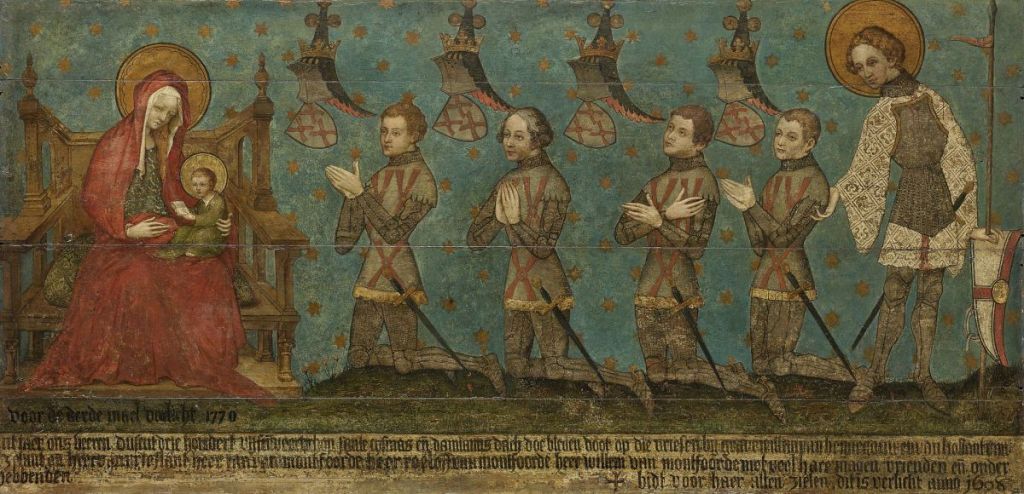
After the battle, the Frisians prayed to the Virgin Mary, the Lady of Distress, at the Abbey of Saint Odulf in Stavoren. Devotion to Mary was widespread among the Frisians, particularly in Westergo, and her cult appears to have been closely associated with the defence of Frisian Freedom against external powers. The collective veneration of Mary as patron and Queen of Heaven resonated with an emerging sense of shared Frisian identity, expressed in the concept of Frisia tota (Mulder-Bakker & Van Beek 2021).
In this context, Mary became a powerful symbol of the Frisian struggle for independence. The remains of the slain soldiers and knights of Holland were kept at the Abbey of Saint Odulf, where the victory over William IV was commemorated annually for nearly two centuries. The tradition came to an end in AD 1527, when Emperor Charles V ordered the remains of the counts to be removed from the abbey, apparently in an effort to suppress the annual commemoration of the Frisian victory. The tradition was revived only in 1945, this time at the cliffs of Warns, where the battle is commemorated to this day, only without the bleached bones of the Hollanders.
But it was not only the Frisians who sought strength through the Virgin Mary; the people of the free famers republic of Dithmarschen more to north along the Wadden Sea coast did so as well. A quote from AD 1447: “Hirumme en denke wii noch en willen de vrighei unses landes, de God alleweldich unde de erwerdige moder Cristi, de hochgelovende junkfrowe Maria, uns gegeven hebben, nicht van uns setten,” which translates as ‘Therefore, we still remember, and we do not wish to surrender the freedom of our land, which Almighty God and the venerable Mother of Christ, the most blessed Virgin Mary, have granted us’ (Stoob 1959).
The so-called Friso-Hollandic Wars continued well into the sixteenth century. In the year AD 1515, the Abbey of Egmond was caught up in these conflicts, albeit only indirectly. A Habsburg mercenary force known as the Zwarte Hoop (“Black Heap”) had spent some time ravaging and plundering the province of Friesland, having been hired and instructed to do so. But eventually, they turned against the hand that had fed them.
That same year, the Zwarte Hoop sacked the town of Alkmaar in Holland, prompting the renowned philosopher and humanist Erasmus — apparently somewhat naïve in his expectations — to express his childlike astonishment:
“This gang had been fighting for us against the Frisians only recently!”
Erasmus
Erasmus should perhaps have known better. As Pope Innocent III famously remarked of Otto IV in AD 1210, after having crowned him Holy Roman Emperor: “The sword we forged ourselves inflicts heavy wounds upon us.”
After the sack of Alkmaar, the Zwarte Hoop — known to contemporaries also as the Tent der Aethiopiërs (‘camp of the Ethiopians’) (Dekker & Nielsen 1984) — turned its attention to the village and abbey of Egmond. Dozens of houses in the village were burned, and the abbey was plundered before the mercenaries continued their march southward.
From a letter written by a monk of Egmond, originally from the monastery of Hemelum near Stavoren in the province of Friesland, and who witnessed the events first-hand, we learn that the abbey had received sufficient warning of the approaching force. As a result, the monks were able to take precautions, and the abbey itself escaped relatively lightly.
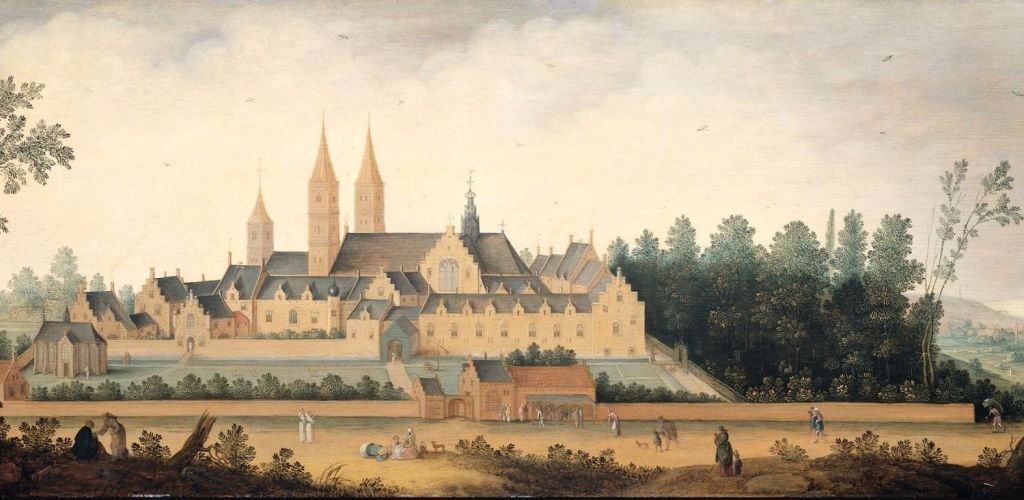
It was during the Eighty Years’ War that the Abbey of Adalbert was finally destroyed — not by the enemy, but by none other than William of Orange, the founding father of the Dutch Revolt. In AD 1573, (supposedly) fearing that Spanish forces might use the abbey as a fortress, William ordered the Watergeuzen (‘sea/water beggars’) to demolish the oldest monastery in the region.
Only the western front of the abbey, with its two towers and the tympanum mentioned earlier, was left standing amid the fields surrounding the village of Egmond-Binnen. The relics of the saints, together with the Evangeliarium, were fortunately saved from looting by the Geuzen and entrusted to private households in the town of Haarlem. Not everything survived, however. The golden binding of the Evangeliarium was lost, and the passage of time eventually claimed the abbey’s remaining towers as well. The first collapsed in AD 1596; the second followed in 1798.
Incidentally, the proceeds from the demolition and looting of the once-mighty West Frisian Abbey of Egmond helped William of Orange finance the founding of the University of Leiden. A rather bitter irony — and, for Catholics, something of a forbidden fruit. So perhaps think twice before receiving your education there, especially if you are Catholic.
This raises an intriguing question: was the supposed threat of Spanish forces using the abbey as a fortress merely a pretext for William of Orange to seize its wealth and help finance his new university?
With the introduction of Protestantism in the Low Countries, Catholic belief and practice came under increasing pressure. The public celebration of Mass, religious processions, and pilgrimages was prohibited. The destruction of the Chapel of Our Lady of Distress and the Runxputte, both south of the village of Heiloo and described earlier in this blog post, were among the many consequences of this religious upheaval.
Yet in the countryside of Kennemerland, Protestant rule did not necessarily translate into Protestant conviction. Many inhabitants remained loyal to the Catholic faith, maintaining their traditions and religious practices despite official restrictions. In parts of the region, this Catholic identity survived for centuries and persisted well into modern times.
The Geuzen initially consisted largely of sea raiders operating from the mid-sixteenth century AD in the Wadden Sea and the inland Zuiderzee. They would, however, become a crucial force in the struggle for the independence of the Low Countries. The Geuzen were a loose confederation of privateers, rebels, and militias, led largely by impoverished Calvinist nobles who opposed Spanish rule.
Their uncompromising attitude toward Catholicism was captured in their motto, Liver Tvrcx dan Pavs, meaning ‘rather Turkish [i.e. Muslim] than Papist [i.e. Catholic].’ The name Geuzen itself derives from the French gueux, meaning ‘beggars’ or ‘paupers,’ a term originally associated with people of the non-noble third estate. What began as a term of contempt was eventually adopted as a badge of honour by the rebels.
Read in our blog post ♪ They Want You as a New Recruit ♪ how, by whom, and where the military alliance between the Geuzen and William of Orange came about — and with a surprising Frisian twist.
INTERMEZZO
The Real Puppet Masters — William of Orange was assassinated in AD 1584. And, identical to the assassination of Godfrid the Sea-King in AD 885, the long arm of the Frisian elite was not far away with the presence of the Frisian nobleman Gerulf back then. When William of Orange was murdered he was having lunch with, indeed, the mayor of the town of Leeuwarden Rombout van Uylenborgh. Yet again a Frisian at the historic scene of the crime. Van Uylenborgh, the (future) father-in-law of the famous Dutch painter Rembrandt van Rijn, by the way. Coincidence you think? Sorry. The long, invisible arm of the Frisians in Dutch politics and government is still present.
In 2007, a book titled ‘De Friese Maffia. 296 Friese politici in Den Haag’ (translated: The Frisian Mafia. 296 Frisian politicians in The Hague) described their influence. Those innocents who say the Frisians of the province of Friesland are striving for independence fail to see the Frisians are much more sly and cunning than that and steer the Low Countries with an invisible hand for many centuries already. The real puppet masters.
We can only speculate about what Saint Adalbert might have thought of the destruction of ‘his’ abbey. Adalbert, the humble companion and assistant of the great Saint Willibrord, was a hermit who withdrew to the dunes along the North Sea. He was a man who emphasized the importance of putting into practice the values one professes — a forerunner, perhaps, of the modern Frisian saying sizzen is eat, dwaan is in ding: ‘to say is one thing, to do is another,’ or, more simply, practice what you preach.
Would Adalbert have approved of the close association between ‘his’ abbey and the worldly, often ruthless military ambitions of the Gerulfing dynasty? And what would he have thought of the central role the abbey came to play in those ambitions? One can only wonder.
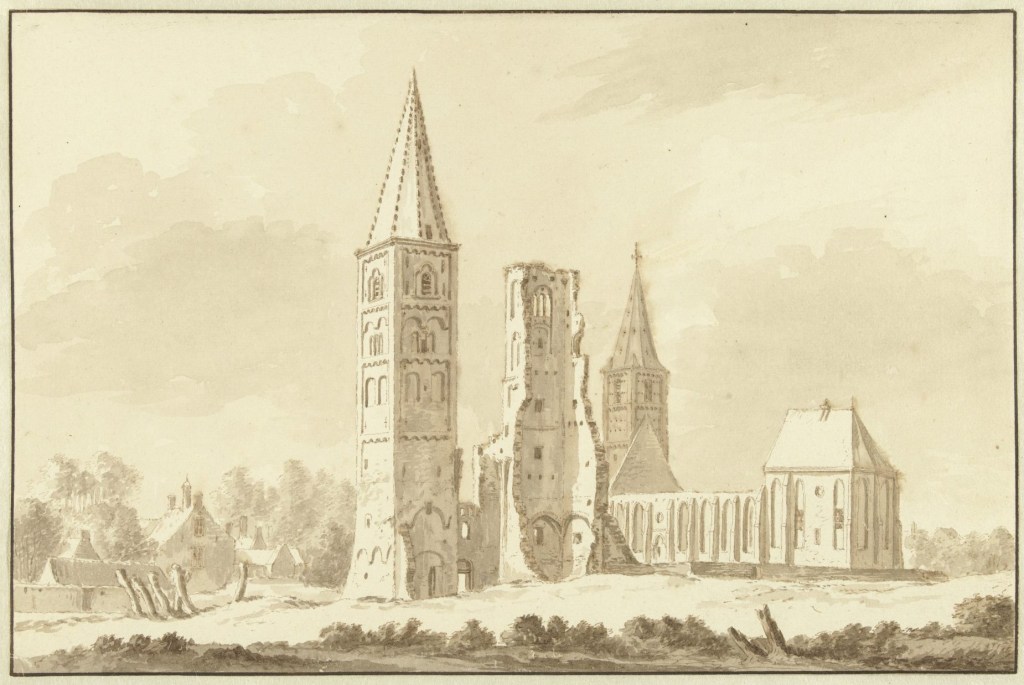
In the year 1800, the remaining stones were cleared away, and cows began grazing over the graves of the once-mighty Gerulfing dynasty; the counts of West Frisia and Holland.
But Phoenix Adalbert rose from the ashes once again. The final phase — the apotheosis of the long genesis of the Abbey of Egmond — began in 1935, when a new priory was built on the site where the proud medieval abbey had once stood. This time, we know the architect: A. Kropholler (1881–1973). After an absence of four centuries, monks once again settled at Egmond-Binnen.
In 1950, the priory was enlarged and, in the spirit of the Easter miracle, elevated by the Vatican to the status of an abbey. It was given the name:
Adelbertusabdij
— the Anglo-Saxon monk who travelled to West Frisia almost 1,300 years ago —
(Abbey of Adalbert)
Note — The life of Saint Adalbert, or Vita Sancti Adalberti, is written by the monk Ruppert of Mettlach from Trier in Germany in the tenth century AD. It is considered as maybe the most important source considering the history of the county West Frisia and consequently that of the region of Holland.
Suggested hiking
The Frisia Coast Trail passes the Abbey of Adalbert. For hikers the abbey offers a great spot to rest and the medicinal well (viz. Adelbertusput) is an ideal spot for refilling your water bottles or camelback. Especially, since this holy water cures the cripple. But the monks brew beer too!
- When continuing north from the village of Egmond-Binnen, you can opt to hike via the hamlet of Wimmenum. Here, near the dunes at the crossing of Banweg Rd and Herenweg Rd, used to be a chapel dedicated to the saints and twin-brothers Cosmas and Damian, saints who can support you when suffering from an illness or injury and hiking becomes difficult. Legend has it that the chapel was founded by Count William I of Holland after he and a band of Frisians conquered the city of Damiate in Egypt during the Fifth Crusade in the thirteenth century. See also our blog post Terrorist Fighters From the Wadden Sea. The Era of the Crusades to learn more about the Frisians actively participating in the Crusades.
- Also, for hikers there is the Monnikenpad (‘monks path’). It is a circular walk of a bit less than 10 kilometers between the abbey and the well. Try it and feel a phoenix reborn!
- And since this area is full of spiritual and sacred grounds, also the diocese of the Chapel of Our Lady for Distress, viz. Virgin Mary, developed a 17 kilometers circular hike which takes you along three holy fresh water wells, namely: the Runixputte (‘Rorik’s well’) at the Chapel of Our Lady for Distress, south of the village of Heiloo, the Adelbertusput (Adalbert well) at the Abbey of Egmond, and the Willibrordusput (‘Willibrord well’) at the center of the village of Heiloo. Route descriptions can be purchased at the starting point at the Chapel of Our Lady for Distress annex the Runixputte.
- In 2024, foundation Oneindig Noord-Holland (‘endless North Holland’) has developed a cycling trail along the Herenweg Rd. It is a route marking the historic places with exhibitions of the old Herenweg Rd between the villages of Castricum and Schoorl in the province of Noord Holland.
Moreover, in this region hikers have a unique opportunity to stay in monasteries and experience monastic life:
- With its motto Deo vacare, the Abbey of Adalbert (of Egmond) receives guests from two to six nights. You are expected to join the monks during Metten from 06:00 hours to Completen at 20:00 hours, and eat your meals in silence. Costs are at the time of writing 55 euros per night. If you are poor, lower prices can be applicable. Your are allowed twice a year to stay as guest at the abbey. From our own experience, we can highly recommend it.
- Then, close by (1,5 kilometers away from the Abbey of Egmond), you have another monastery, the Saint Liobak monastery. It is a mixed monastery, both monks and nuns. Again, your are expected to join the monks and nuns in church. Costs are 62,50 euros. Here too, if you are poor, you may pay less.
- Lastly, there is the also nearby (2,5 kilometers away from the Abbey of Egmond) former monastery and Church of Our Lady for Distress. No monastic life in this building, but still on an important site of pilgrimage and therefore the atmosphere of contemplation and silence is expected from guests. Costs are 65 euros.
Suggested music
- Gala, Freed from Desire (1996)
- R.E.M., Losing My Religion (1991)
- Laverman, N., Hallelujah (2008)
Further reading
- Arnold, E.F., Medieval Riverscapes. Environment and Memory in Northwest Europe, c. 300-1100 (2024)
- Bemmel, van, A.A.B., Cohen, K.M., Doesburg, van J., Hermans, T., Huiting, J.H., Poppe, E.L., Renes, J. & Vliet, van J., De dam bij Wijk en het Kromme Rijngebied in de middeleeuwen; Doesburg, van A.A.B. & Huiting J.H., Macht, bezit en samenleving rond het jaar 1000 (2022)
- Boer, de D.E.H., Emo’s reis. Een historisch culturele ontdekkingstocht door Europa in 1212 (2017)
- Boer, de D.E.H. & Cordfunke E.H.P., Graven van Holland. Middeleeuwse vorsten in woord en beeld (880-1580) (2010)
- Bos-Rops, Y., Schenkingen, privileges en het ontstaan van een systeem. Hollandse graven en hun archief (889-1299) (2018)
- Brooks, S. & Harrington, S., The Kingdom and People of Kent AD 400-1066. Their history and archaeology (2010)
- Broome, R., The Lost Conference Papers II: Religion and Conversion in Early Medieval Frisia (2019)
- Buitenhuis, P., De ondergang van de abdij van Egmond in 1573 (2022)
- Canon van Nederland, De Herenweg (website)
- Cordfunke, E.H.P., Begraven verleden. Hoven en kastelen in Kennemerland [850-1350] (2018)
- Cordfunke, E.H.P., Een graafschap achter de duinen. Het ontstaan en de vorming van het graafschap Holland [850-1150] (2018)
- Cusack, C.M., Between Sea and Land: Geographical and Literary Marginality in the Conversion of Medieval Frisia (2021)
- Deckers, P., A toponymic perspective on the early medieval settlement of the southern North Sea shores of mainland Europe (2013)
- Dekker, T.W. & Nielsen, C., Kastelen, kerken en kloosters. Kerkgeschiedenis van Harlingen en Midlum (1984)
- De Maesschalck, E., De graven van Vlaanderen (861-1384) (2012)
- Dijkstra, B.K.S., Graven en gravinnen van het Hollandse huis. Onderzoek van de stoffelijke resten, opgegraven op het terrein van de voormalige abdijkerk te Rijnsburg (1979)
- Dijkstra, M.F.P., Rondom de mondingen van Rijn en Maas. Landschap en bewoning tussen de 3e en 9e eeuw in Zuid-Holland in het bijzonder de Oude Rijnstreek (2011)
- Dirks, C.H., Geschichte Ostfrieslands. Von der Freiheit der Friesen bis zu Deutschlands witzigsten Otto (2023)
- Eijnatten, van J. & Lieburg, van F., Nederlandse religiegeschiedenis (2015)
- Eschner, K., The Real-Life Whale That Gave Moby Dick His Name (2017)
- Flierman, R., Religious Saxons: paganism, infidelity and biblical punishment in the Capitulatio de partibus Saxoniae (2016)
- Groenewoudt, B., Beek, van R. & Groothedde, M., Christianisation and the Afterlife of Pagan Open-Air Cult Sites. Evidence from the Northern Frankish Frontier (2016)
- Hartog, den E., De Griekse inscriptie op het timpaan van de abdijkerk te Egmond (2023)
- Heeringen, van R.M. & Velde, van der H.M. (eds.), Struinen door de duinen. Synthetiserend onderzoek naar de bewoningsgeschiedenis van het Hollands duingebied op basis van gegevens verzameld in het Malta-tijdperk (2017)
- Henderikx, P.A., Land, water en bewoning. Waterstaats- en nederzettingsgeschiedenis in de Zeeuwse en Hollandse delta in de Middeleeuwen (2001)
- Henderikx, P.A., Walcheren en de Vita sancti Willibrordi van Thiofried van Echternach (2021)
- Henstra, D.J., Friese graafschappen tussen Zwin en Wezer. Een overzicht van de grafelijkheid in middeleeuws Frisia (ca. 700-1200) (2012)
- Hines, J., Religion and Conversion amongst the Frisians (2021)
- Historiek, De Abdij van Egmond is een Benedictijnerabdij in Egmond-Binnen (website)
- Jong, de M., De Friese maffia. 296 Friese politici in Den Haag (2007)
- Klerk, de A., Vlaardingen in de wording van het graafschap Holland 800-1250
- Koch, A.C.F., Oorkondenboek van Holland en Zeeland tot 1299 (1969)
- Kok, A., Biografie van de Noordzee. Verhalen over leven met het water (2025)
- Kramer, K., Klänge der Unendlichkeit. Eine Reise durch die Kulturgeschichte der Glocke (2015)
- Langen, de G. & Mol, H., Kerk, macht en ruimte in Holland tot het midden van de 11de eeuw. De uitbouw van het parochiewezen tussen Maas en Vlie (2018)
- Lasance, A., Wizo van Vlaanderen. Itinerarium Fresiae of Een rondreis door de Lage Landen (2012)
- Looijesteijn, H., Adelbertusakker, Egmond-Binnen (2023)
- Margry, P.J., Bedevaart en Bedevaartplaatsen in Nederland. Heiloo, H. Willibrord (Willibrordus) (1995)
- McNair, F., The Frisian Church and the Frisian Vikings (2022)
- Meertens Instituut van het Koninklijke Nederlandse Akademie voor Wetenschappen (KNAW), Bedevaart en bedevaartplaatsen in Nederland: Egmond-Binnen, H. Adelbert (Adelbertus) (website)
- Meier, D., Seefahrer, Händler und Piraten im Mittelalter (2004)
- Mulder-Bakker, A.B. & Beek, van L., Maria, Onze Lieve Vrouw. Hemelkoningin en Redder in Alle Nood (2021)
- Molenbroek, van J., Nederlandse kruisvaarders naar Damiate aan de Nijl. Acht eeuwen geschiedenis en fantasie in woord en beeld (2016)
- Nicolay, J. & Boer, de J., Roem voor de eeuwigheid. Een vroegmiddeleeuwse zwaardknop uit Friesland (2019)
- Nicolay, J., Oortmerssen, van G., Os, van B. & Nobles, G., Een Vendelhelm uit Hallum? Verslag van een archeologische zoektocht (2017)
- Nicolay, J., Pelsmaeker, S., Postma, S. & Veenstra H., Hallum: ‘nieuwe Friezen’ in beeld (2018)
- Nieuwenhuijsen, K., Het ontstaan van het graafschap Holland. Twee oude bronnen opnieuw bezien (2018)
- Nieuwenhuijsen, K., Robrecht de Fries. Graaf van Vlaanderen, held van Holland (2022)
- Nieuwenhuijsen, K., Strijd om West-Frisia. De ontstaansgeschiedenis van het graafschap Holland: 900-1100 (2016)
- Nieuwhof, A., Ezinge in de vroege middeleeuwen (2023)
- Oneindig Noord-Holland, Herenweg (website)
- Porck, T., The Latest Miracle of Anglo-Saxon Missionary Saint Adalbert of Egmond (d. c.740) (2015)
- Postma, D., House plan analysis Hallum-Hellema (Friesland). A three-dimensional reconsideration of the early medieval turf buildings (2020)
- Renswoude, van O., Hof, harg en hal: het heten van heiligdommen (2021)
- Schroor, M., Harlingen. Geschiedenis van de Friese havenstad (2015)
- Speet, B., Historische Atlas van Kennemerland. Hart van Holland (2014)
- Stedman, H., Newton, J. & McCrohan, D., Cornwall Coast Path. SW Coast Path Part 2 — Bude to Plymouth (2022)
- Stoob, H., Geschichte Dithmarschens im Regentenzeitalter (1959)
- Thiers, O., ‘t Putje van Heiloo. Bedevaarten naar O.L. Vrouw ter Nood (2005)
- Tuuk, van der L., Gingen de Utrechtse bisschoppen Hunger, Odilbald en Radbod vanwege de Noormannen in ballingschap? (2003)
- Vandermeulen, J., The Frisian Tribe: from Caesar to Charlemagne (1998)
- Vis, G.N.M. (ed.), Het klooster Egmond: hortus conclusus (2008)
- Wagenaar, H., Bonifatius en de Friese Landen. Europa: Bonifatius en de Friese Landen (2006)
- Weijert, de R., Memoria rond Montfoort. Het testament van ridder Roelof de Rover van Montfoort (2021)
- Wood, I., Franks and Frisians (2021)
- Zeeuw, de M. (ed.), Puttentocht langs Heilige Bronnen. Maak kennis met drie eeuwenoude bronnen in en bij Heilloo: de Runxputte, de Willibrordusput en de Adelbertusput (2013)

