

After the Roman Empire had incorporated a big chunk of the British Isles in the first century, the empire needed a military force to defend their northern limes (‘border’). Like elsewhere, they made use of mercenaries. Many Frisians, (still) living along the coast of present-day the Netherlands, joined the Roman army as mercenaries to fight in Britannia. So, what do we know about these early mercenaries?
The practice of hiring soldiers from a different nation is a common occurrence throughout history and across different regions. Even today, it is a well-known and fully accepted method of warfare. Consider the feared Gurkha regiments from Nepal, who swear allegiance to the British Crown, and the French Foreign Legion, which operates as part of the French army. We can also mention the African-American Harlem Hellfighters infantry regiments, who served anonymously for the U.S. Army in World War I and II.
According to the laws of war, apparently regulating warfare is not a contradictio in terminis; the Gurkhas and the Foreign Legionnaires are officially non-mercenaries because they are part of the national army at war. Probably, Frisian mercenaries, like other mercenaries within the Roman imperial army such as Hispanics from Spain, Tungri from Belgium, and Saxons from the Elbe-Weser triangle, were seen as part of the army too. Therefore, if we were to apply today’s Geneva Convention, strictly speaking, the classification ‘mercenary’ probably would not be correct. Nevertheless, we use it here because they are all mercenaries, of course.
Whatever de jure the definition, and since during war everything is allowed de facto anyway, Frisian legionnaires might have had a similar reputation as the Gurkha’s and the French Legionnaires of today. They are being paid less but fight fiercer. So, when you see them: run! We will come back to it below.
Frisii and Frisiavones
The first record of the Frisians, called Frisii or Fresones, by the Romans dates back to 12 BC. It is about how the Frisian tribes were allies during a battle against the Chauci tribe in the area of what is now the Wadden Sea coast of northwest Germany, roughly between the River Ems and the River Elbe. Like the Frisians, the Chauci were also not pacified. They both were notorious pirates. Go to our blog post Our civilization — It All Began With Piracy for more details about the raiding Chauci and Frisians.
The Romans distinguished, besides other tribes living in the big delta, the Cananefates, the Frisii or Fresones, the Batavi, and the Frisiavones. According to soldier Pliny in his book Naturalis Historia, the Frisiavones lived on islands “inter Helenium ac Flevum.” This is generally explained as the islands between the broader mouths of the River Meuse and the (former) River Vlie. But scholars are still having disputes where to exactly pinpoint the civitas Frisiavones. We suggest just to describe it as the coastal section of the province of Zeeland south, part of the province of Zuid Holland, and parts up the River Meuse in the province of Noord Brabant. Based on archaeological finds, location Goedereede-Oude Wereld on the island of Goeree-Overflakkee, is a strong candidate for the former capital of the Frisiavones (Dhaeze 2019).
Furthermore, the Frisiavones may be regarded as a Romanized branch of the Frisians (IJssennagger 2017). The element -avo has been interpreted as meaning ‘belonging to’ or ‘descending from,’ suggesting that the Frisiavones were a people belonging to, or descended from, the Frisians (Neumann 2008). The ceramics associated with the Frisiavones also display characteristics of Frisian tradition. Thus, the Frisiavones the mannered part of the Frisians, and the Frisii being the rude, barbaric but independent part of the Frisii living in the north. Something that, of course, has all changed today. Archaeological evidence suggests that the Frisiavones occupied the area between the Lower Rhine and Lower Meuse from the mid-first century AD onwards, in a region comparable to that inhabited by the civitas Batavorum.
That the civitas Frisiavones were subjects of province Germaniae Inferioris and of an administrative area or region called Frisavonum, is supported by a stone inscription found in 1958, in the Roman province Africa Proconsularis, present-day Tunisia. It is dated between AD 169-177. It concerns an inscription in honour of a certain procurator (that is, administrator of a military district) named Q. Domitius Marsianus, with the text reading:
PROCVRATOR AVGVSTI AD CENSVS IN GALIA ACCIPIENDOS PROVINCIARVM BELGICAE PER REGIONES TVNGRORVM ET FRISAVONVM ET GERMANIAE INFERIORIS ET BATAVORVM
INTERMEZZO
Tunisia — By the way, in the year AD 1270, the Frisians would land on the coast of Tunisia again, but this time as fighters part of the Eighth Crusade under the banner of King Louis IX. See our blog post Terrorist Fighters From the Wadden Sea. The Era of the Crusades to understand more about the atrocities committed by the Frisians during these campaigns.
As said, the tribe of the Frisians more or less lived in the area of the present-day provinces of Noord Holland, Friesland and (partly) Groningen. Curiously, a shrine dedicated to the idol Matres Frisiavae has been found at present-day Wissen in Germany. Wissen, a town halfway between the cities of Cologne and Frankfurt. In Roman sources the Frisians are also nicknamed transrhenana gens, meaning ‘people across the River Rhine.’
The Frisiavones, part of the Roman Empire, had their own military unit, the Cohors I Frisiavonum, meaning first cohort of the Frisiavones. This cohort was deployed in Britannia. Frisiavones also were enrolled in special forces like equites singulares ‘horse guards’ and as corpore custos ‘bodyguards’ of the Roman emperor. The Frisii were more individual entrepreneurs, and enlisted in the Roman army as individuals at first. From around AD 200 onward the Frisii formed their own military chapters, under the name cunei ‘unit’ Frisionum or Frisiorum and stationed at Hadrian’s Wall.
Job vacancies
The proximity of the Roman Empire also offered opportunities to the Frisian wildlings. One opportunity was to join the ranks of the imperial army, and fight in Britannia for wealth and glory. For about three centuries Frisians were recruited for the Roman army.
Traces of Frisian men who served in the legions, both Frisii and Frisiavones, have been found at sites in present-day England, including Bicester, Burgh-by-Sands, Carrawburgh, Cirencester, Glossop, Hexham, Manchester, and Papcastle. From the swamp forests and tidal marshlands of what are now the provinces of Noord Holland, Friesland, and Groningen, they could have sailed to the present-day town of Domburg on the island of Walcheren, or to Colijnsplaat, both in the province of Zeeland. From there, they could cross the North Sea to Kent in south-eastern England, perhaps travelling alongside merchants carrying goods such as wine from Cologne or Trier, whose trade with Britannia is known to have been particularly intensive.
Of course, no such sea crossing would have been undertaken without first making offerings to Nehalennia, the goddess who protected travellers crossing the North Sea. The island of Walcheren was therefore much more than simply a convenient stopping point: it formed one of the major ‘ferry ports’ connecting the Continent with Britannia. Read more about the remarkable importance of Walcheren as a gateway between the two shores of the North Sea in our blog post, Walcheren Island. Once the Sodom and Gomorrah of the North Sea.
Concerning the presence of Frisian legionnaires in Britannia, it is instructive to point out that Tuihanti tribesmen, of whom we know that they were deployed by the Roman army in Britannia too, have been interpreted as Frisians as well (Nijdam 2021).
Not only did Frisians serve in Britannia. Closer to home, along the limes, the Roman frontier and its associated military road, Frisians were also deployed in what is now the Netherlands. During the period from around AD 70 to 220, the Frisians did not have a specific military unit or cohort bearing their own name. Instead, they served in other units, including those of the Batavi. Indeed, Batavian cohorts may have included significant numbers of Frisians and Cananefates as well (Heeren 2020).
The website Portable Antiquities of the Netherlands (PAN), a project that inventories archaeological finds made by metal detectorists over the years, offers valuable additional evidence for understanding the presence of Frisians in the Roman military. The database therefore provides a fascinating way to gain a deeper insight into, among other things, the Frisians who joined the Roman ranks.
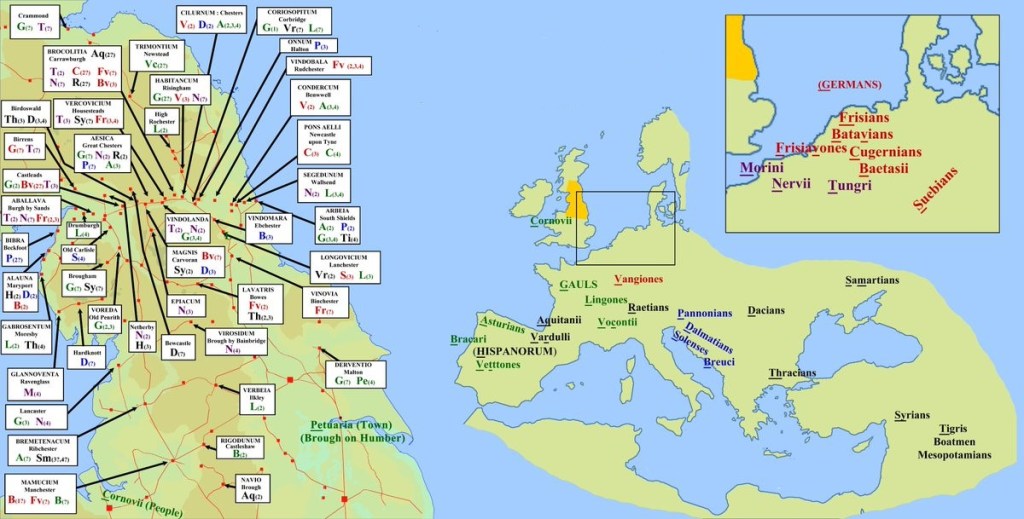
Besides joining the army as mercenary, the other opportunity the close proximity of Roman wealth offered, was plunder and piracy. The regions north of the River Rhine, especially the Wadden Sea area, were heartlands of piracy. From here, Germanic tribes raided the coasts of Britannia and of northern Gaul. Learn more reading our blog post Our civilization — It All Began With Piracy.
Before reading further about the presence of Frisian mercenaries in Britannia, we need to elaborate a little on the military vocabulary used in the sources.
You will notice that the term cunei is frequently used below. A cuneus was an auxiliary infantry or cavalry force of varying strength, named after the cuneus, or ‘wedge-shaped’ offensive formation that such forces could adopt in battle. These cunei were mainly composed of men from non-allied tribes who offered their services as mercenaries. Here, too, we might draw a parallel with the Gurkhas and the French Foreign Legion of today: troops deployed where the fighting was fiercest, at the front lines. The rough boys, so to speak, whose casualties do not always attract quite as much public attention. You do not mess with them — and, indeed, you had better run.
Interestingly, a late-third-century AD ode to the Emperor Maximian mentions enslaved Frisians and Chamavi, a tribe living east of the Frisii, working the land for the Romans. Their fate offers a rather grim testimony to their former reputation as tough and formidable warriors: even the tough tribes could, eventually, be subdued.
Time to list the documentation of Frisian mercenaries working for ancient Rome. These are altar stones, funerary inscriptions, memorial pillars, an imperial document, and diplomas:
1. Fort Derventio Carvetiorum at Papcastle
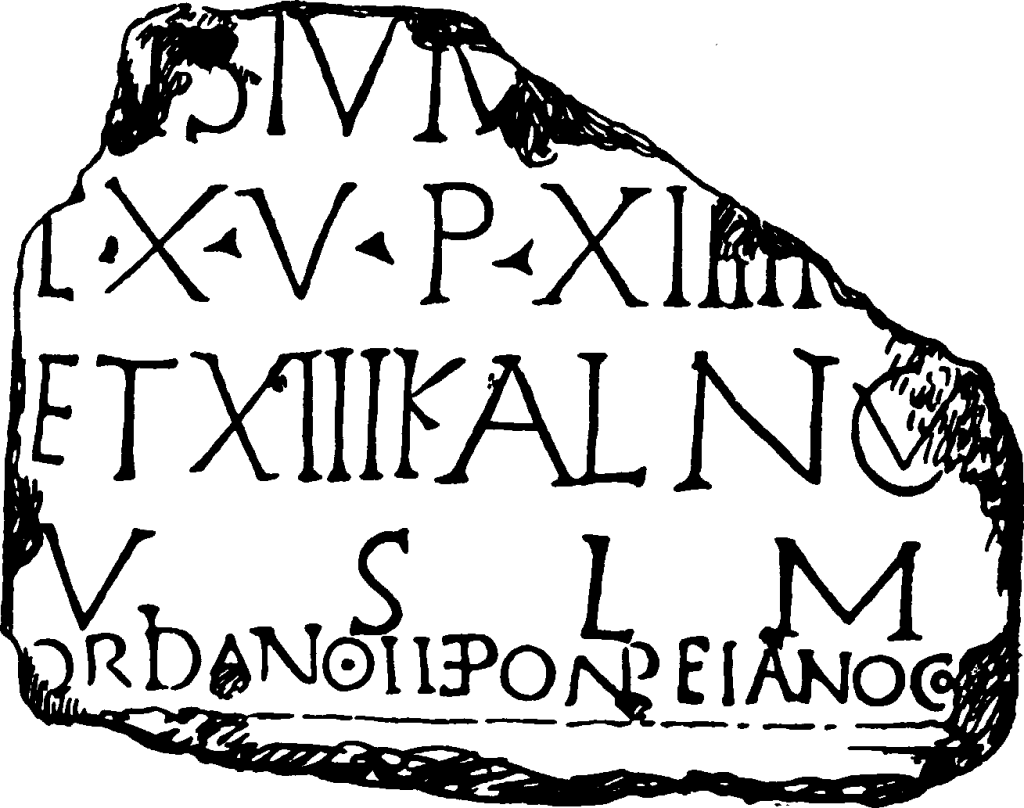
[…] IN CVNEVM FRISIONVM ABALLAVE […] EX V P XIIII KAL ET XIII KAL NOV VSLM G II E PONPEIANO COS
(altar stone AD 241)
“… to the cuneus of the Frisians of Aballava (present-day Burgh-by-Sands) … in accordance with his vow set this up on October 19 and 20 in the consulship of Gordian for the second time and Ponpeianus, gladly and deservedly fulfilling his vow”
nota — That this cuneus force came from the settlement Aballava, meant they had been stationed there before.
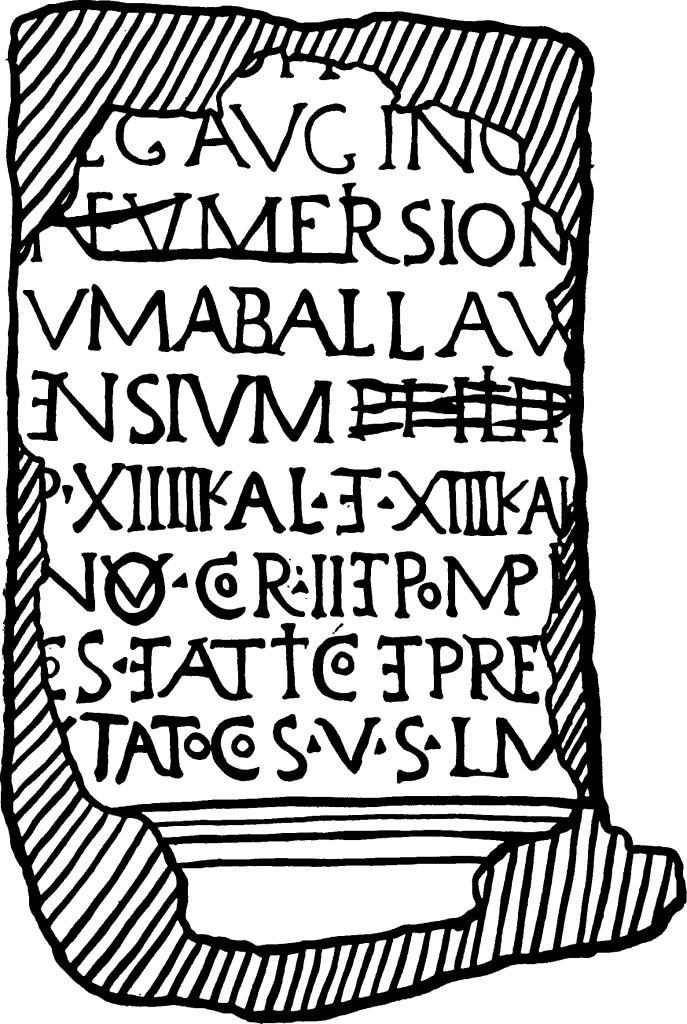
[…] EG AVG IN C NEVM FRISIONVM ABALLAVENSIVM P XIIII KAL ET XIII KAL NOV GOR II ET POMPEI COS ET ATTICO ET PREXTATO COS VSLM
(inscription AD 242)
“… transferred by (?) the Emperor’s legate to the cuneus of the Frisians of Aballava (present-day Burgh-by-Sands), styled Philippian, on October 19 and 20 in the consulships of Gordian for the second time and Pompeianus and of Atticus and Pretextatus, gladly and deservedly fulfilled the vow”
2. Fort Vinovia (Fort Binchester) near Bishop Auckland
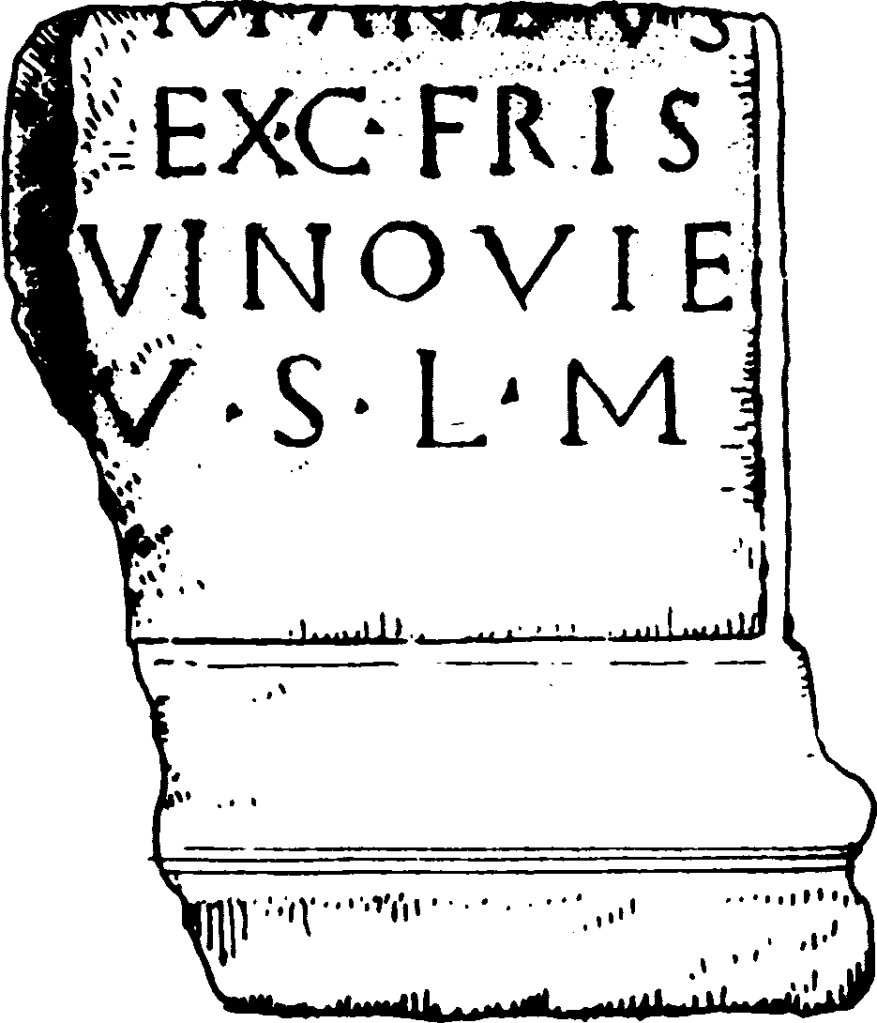
[…] MANDVS EX C FRIS VINOVIE VSLM
(altar stone AD 43-410)
“… Mandus veteran of Frisian Cuneus of Vinovia gladly and deservedly fulfilled his vow”
3. Fort Vercovicium (Fort Housesteads) near Hexham
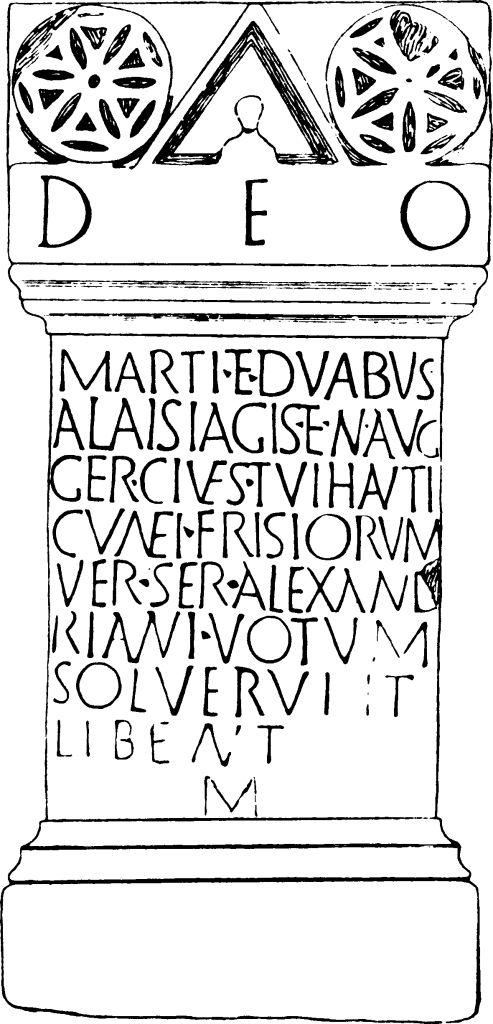
DEO MARTI ET DVABVS ALAISIAGIS ET N AVG GER CIVES TVIHANTI CVNEI FRISIORVM VER SER ALEXANDRIANI VOTVM SOLVERVNT LIBENTES M
(altar stone AD 222-235)
“to the God Mars the two Alaisagae goddesses and the divine spirit of the Emperor, the German tribesmen from Tuihantis serving in Frisian cunei formation, true servants of the Alexandrian, gladly and deservedly fulfil their vow”
nota — Tuihantis is the present-day region of Twente in the eastern Netherlands. Fort Vercovicium was part of Hadrian’s Wall.
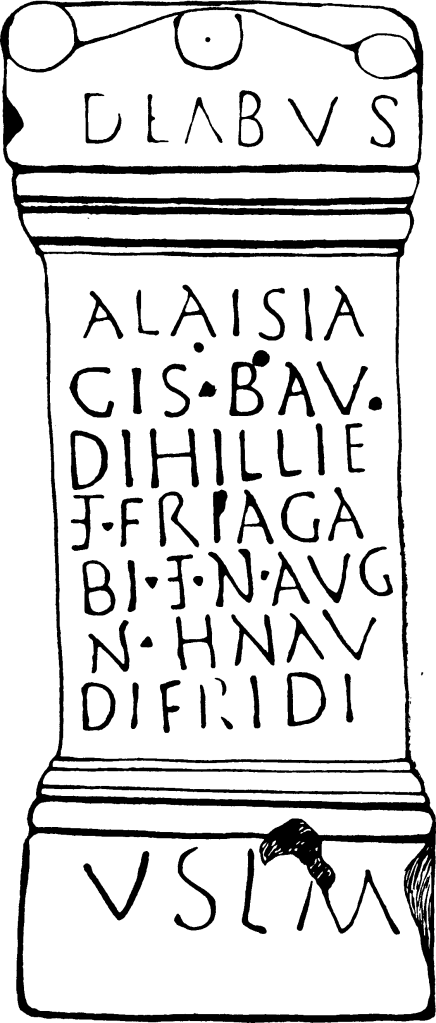
DEABVS ALAISIAGIS BAVDIHILLIE ET FRIAGABI ET N AVGN HNAVDIFRIDI VSLM
(altar stone AD 222-235)
“to the goddesses the Alaisiagae, Baudihillia and Friagabis, and to the divinity of the Emperor the unit of Hnaudifridus gladly and deservedly fulfilled its vow”
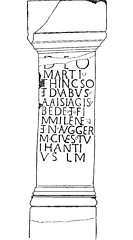
DEO MARTI THINCSO ET DVABUS ALAISIAGIS BEDE ET FIMMILENE ET N AVG GERM CIVES TVIHANTI VSLM
(stone pillar AD 222-235)
“to the god Mars Thincsus and the two Alaisiagae, Beda and Fimmilena, and to the Divinity of the Emperor the Germans. Tribesmen of Twente, fulfilled (their) vow willingly and deservedly” (after Mees 2023)
nota — The name Tuihanti refers to the region of Twente in the east of the modern Netherlands. These Tuihanti tribesmen, however, have been interpreted by different scholars either as Frisians (Nijdam 2021) or as tribesmen from Twente who joined the cavalry of the cuneus Frisorum (Mees 2023).
Deo Mars Thincsus can be translated as ‘to the god Mars Thincsus,’ with Thincsus generally understood in connection with the Germanic thing, also written þing, ting, or ding, meaning a people’s assembly. The inscription is therefore particularly interesting because Mars Thincsus is generally interpreted as a Roman identification of a Germanic deity associated with the thing. This deity is commonly connected with Tiwaz, later known as Tīw or Tiw, the Germanic god whose name survives in English Tuesday and Frisian tiisdei. The pillar thus provides fascinating evidence not only for the presence of people from the Frisian region in Britannia, but also for the existence and religious significance of the thing. And, to make it even more interesting, the monument was erected by men identified as Frisii.
In German and Dutch, Tuesday is called Dienstag and dinsdag, respectively, names traditionally connected with the day of Tiw/Tīw. English Tuesday and Frisian tiisdei, meanwhile, preserve the name of the same deity more directly. If you want to know everything there is to know — or at least everything we are trying to sell you here — about the Germanic thing, the people’s assembly, have a look at our blog post Well, the Thing Is… Speaking From the Moral High Ground of Old.
nota — This inscription is considered one of the most important Germano-Roma epigraphic finds in Britain (Mees 2023).
4. Fort Ardotalia (Fort Melandra) near Glossop
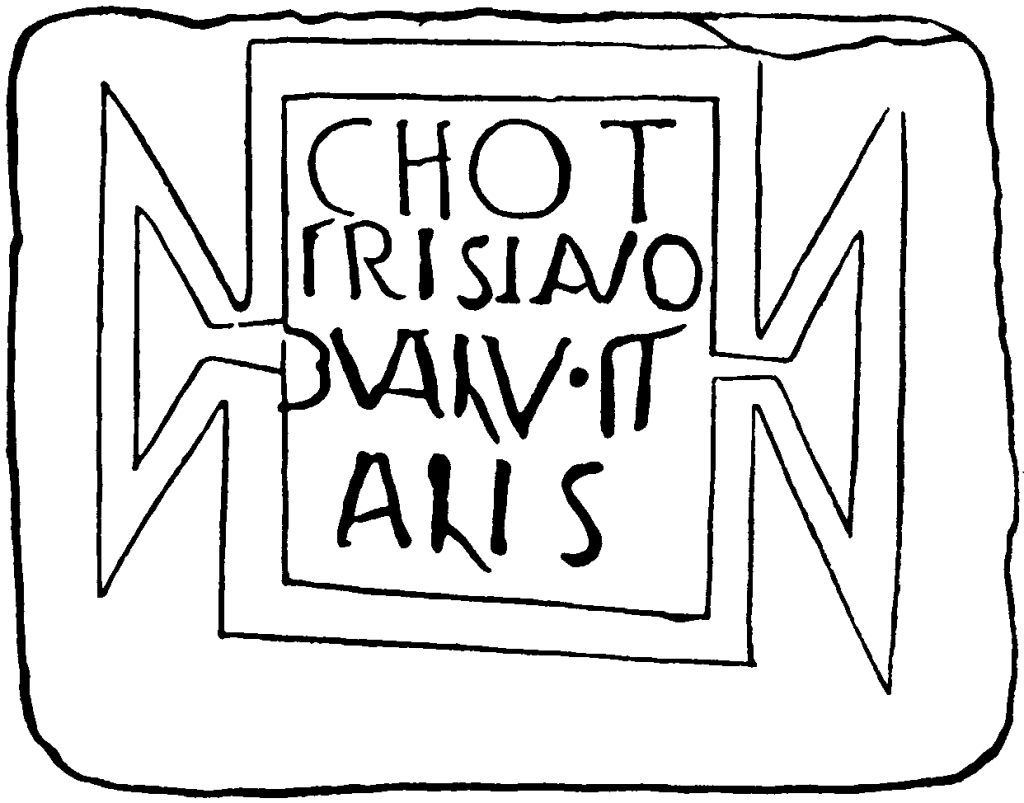
CHO I FRISIAVO VAL VITALIS
(stone inscription AD 43-410)
“from the First Cohort of the Frisiavones the century of Valerius Vitalis [built this]“
5. Fort Mamucium at Manchester
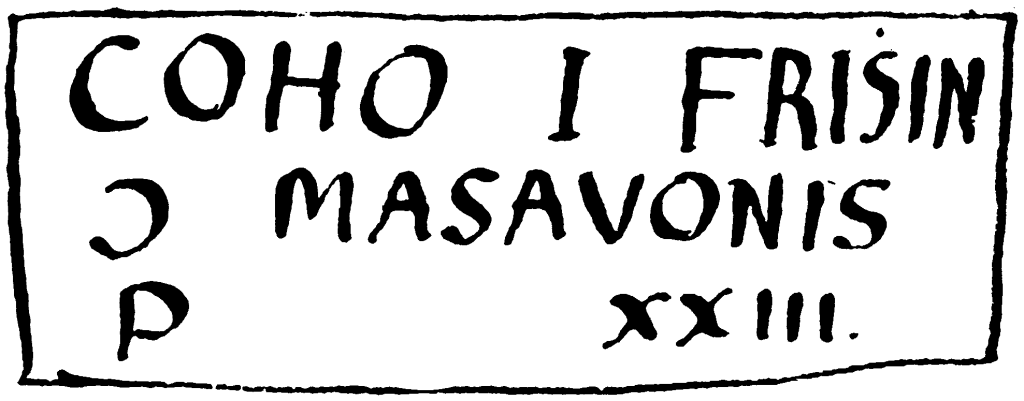
COHO I FRISIAV MASAVONIS P XXIII
(inscription building stone AD 43-410)
“from the First Cohort of the Frisiavones the century of Masavo [built] 23 feet“
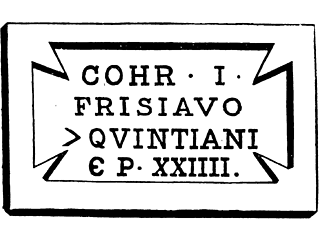
COHR I FRISIAVO QVITIANI P XXIIII
(inscription building stone AD 43-410)
“from the First Cohort of Frisiavonum the century of Quintianus (built) 24 feet“
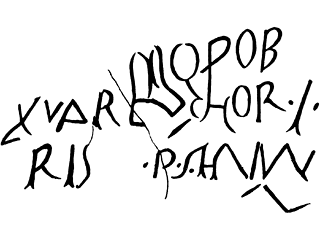
CVDRENI CHOR I FRISIAV P […]
(inscription centurial stone AD 43-410)
“the century of Cudrenus from the First Cohort of the Frisiavonians [built] … feet“
nota — The latter inscription of Cudrenus cannot be definitely attributed to the First Cohort of the Frisiavones because it fails to mention the unit. However, its similarity to the three other inscriptions suggests that it refers to the Frisiavones (Galestin 2016).
6. Fort Brocolitia at Carrawburgh
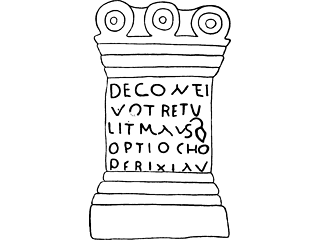
DE CONVETI VOT RETVLIT MAVS OPTIO CHO P FRIXIAV
(altar stone AD 43-410)
“to the goddess Convetina. Mausaeus, optio of the First Cohort of the Frixiavones, paid his vow“
7. Fort Corinium Dobunnorum at Cirencester
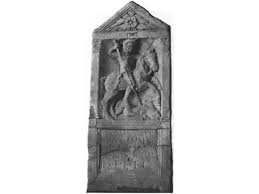
SEXTVS VALERIVS GENIALVS EQES ALAE TRHAEC CIVIS FRISIAVS TVR GENIALIS AN XXXX ST XX H S E H F C
(tombstone ca. AD 45-75)
“Sextus Valerius Genialis, trooper of the cavalry regiment of Thracians, a Frisiaus [Frisii] tribesman, from the troop of Genialis, aged 40, of 20 years’ service, lies buried here. His heir had this set up“
8. Diplomas
Eight military diplomas have been found concerning Frisian mercenaries in the Roman army. These diplomas was a proof that the soldier was honourably discharged from the army, and/or received Roman franchise/citizenship.
The military diploma (no. 1), found at Sydenham in London, England, dates to around AD 105. It was issued under Emperor Trajan and mentions the First Cohort of the Frisiavones (cohors I Frisiavonum). The Frisiavones appear alongside several other auxiliary cohorts:
I FIDA VARDVLLORVM I FRISIAVONVM I NERVIORVM
The military diploma (nr. 2) found at Delwijnen in the Netherlands, dates from ca. AD 116. This diploma was issued by Emperor Trajan and mentions the First Cohort of the Frisiavones also. The text of the diploma is reconstructed as follows:
AVGVSTA ET I (…) M ET I FRISIAVONVM ET (…) ET MENAPIO RUM(…) M ET III LINGONVM ET (…) ET IIII LINGONVM ET (…) ET SVNT IN BRITANNIA SVB (…)
The military diploma (nr. 3) found at A-Szöny, current Komárom, in Hungary, dates from AD 122. This diploma was issued by Emperor Hadrian and mentions the First Cohort of the Frisiavones also. The diploma mentions:
I FRISIAVON (and) I FRISIAVONVM
The military diploma (nr. 4) found at Göhren in Germany, dated ca. AD 129-134. This diploma was issued to a common soldier, a Frisian veteran. The text of the diploma is reconstructed as follows:
(…) ALAE AVRIANAE CVI PRAEST (..) BASSVS ROMANVS EX GREGALE (…) LI FILIO FRISIO ET (…)INI FILIAE VXORI EIVS BATAVAE ET (..)ELLINAE FILIAE EIVS (…) FELICIS (…) ALCIDIS (…) PROCVLI (…) DAPHNI (…) AMPLIATI (…)
This Frisian soldier was enrolled in the Ala I Hispanorum Auriana, an auxiliary unit, under the command of Bassus from Rome. The Ala Auriana unit, mostly with recruits from Spain, operated in the Balkans, Austria, and Switzerland. The owner of the above diploma had a Batavian wife and daughter, both their names ended with –ellinae.
Another military diploma (no. 5), testifying to the presence of Frisians, was found at Stannington in England and dates to AD 124. It was issued under Emperor Hadrian. Yet another military diploma (no. 6), also issued under Hadrian, has been reconstructed from two fragments: one found somewhere in the Balkans and the other in London. It dates to AD 127.
Military diploma no. 7, found at the Roman fort near Ravenglass in England, was issued under Emperor Antoninus Pius in AD 158. The final military diploma (no. 8) was issued under the joint emperors Marcus Aurelius and Commodus. It was found somewhere in Bulgaria and dates to AD 178.
9. Notitia Dignitatum
The famous Notitia Dignitatum ‘list of offices’ dated early fifth century AD, also mentions a Frisian contingent deployed at Hadrian’s wall. One unit deployed at Rudchester is called Cohors Prima Frixagorum, a Frisian cohort (Galestin 2016).
10. Emperor’s bodyguards and horse guards
In Rome two funerary inscriptions have been found in the Monumentum Liberorum Neronis Drusi, a subterranean mausoleum attesting of Frisians in service of Rome, in this case corpore cvstos ‘bodyguards’ of Emperor Nero Drusus. These date from the first quarter of the century AD and read:
BASSVS NERONIS CAESARIS CORPORE CVSTOS NATIONE FRISIVS VIX A XL
Bassus bodyguard of Nero Caesar of Frisian [Frisii] origin lived forty years
HILARVS NERONIS CAESARIS CORPORE CVSTOS NATIONE FRISAEO VIX A XXXIII
Hilarus bodyguard of Nero Caesar of Frisian [Frisii] origin lived thirty-three years
Also in Rome, eight funerary inscriptions of equites singulares ‘horse guards’ have been found that are of Frisians, either Frisii or Frisiavones. These were inscription on tombstones. These eight inscriptions date to the second and (fewer) third centuries AD. We have listed the tombstone inscriptions in the annex to this blog post (see down below). Who knows, these riders venerated the Celtic goddess Epona, goddess of horses. The only foreign idol worshiped in Rome.
Lastly, there is a writing-tablet tabulae Vindolandenses ‘tablet of Chesterholm’, dated between ca. AD 92-97. It contains several names of soldiers of the Cohort XIIII Batavorum, among them a certain bloke named Frissiaus.
We have put all the locations of Frisii and Frisiavones om utens ‘abroad’ during the Roman Period in a map for your convenience. The map illustrates that Frisians were active as soldiers throughout the Roman empire:
You want me on that wall — You need me on that wall!
Two of the forts mentioned are part of the famous Hadrian’s Wall, namely fort Brocolitia and fort Vercovicium. The latter better known as fort Housesteads, “perhaps the most famous and dramatic of all” (BBC 2017). There were in total fifteen forts along Hadrian’s Wall, and around 10,000 soldiers were deployed along the wall. The wall was erected between AD 122 and 128, and was about 117 kilometers long.
Fort Housesteads is one of the major fortresses along Hadrian’s Wall, with an associated civilian settlement, or vicus, known as Vercovicium (also written Viroconium). In fact, the settlement resembles a garrison town more than a fortress itself. Interestingly, a distinctive type of pottery found at Housesteads shows close parallels with pottery from Frisia, particularly from the province of Noord Holland, including the Wadden Sea island of Texel. This pottery has so far been found only in the vicus, and not within the fort itself.
The same type of Frisian pottery has also been found at the fortress of Birdoswald, west of Housesteads near Gilsland. Again, the pottery was found in the civilian settlement outside the fortress walls rather than within the fort itself. This raises an intriguing question: did Frisian soldiers at Housesteads and Birdoswald produce the pottery themselves? Was it imported from Frisia? Or did Frisian women accompany their men to Britannia and produce the pottery there? Some scholars have even suggested the existence of an ancient Frisian settlement near Housesteads, inhabited by soldiers and their families (Mees 2023).
The last option might actually not be as far-fetched as it may seem. Consider, for example, how the colonial Royal Netherlands East Indies Army (KNIL) functioned in the nineteenth and twentieth centuries. In that context, women and concubines of KNIL soldiers could follow the men and live in settlements adjacent to military forts (Lanzing 2005). Women were ‘mobile’ in Roman times as well. Archaeological research in the Netherlands has led to the widely accepted theory that exchanges between tribes and communities took place, among other ways, through the marriage or exchange of women. These women could bring their own cultural practices and technological knowledge with them, including pottery-making techniques, potentially explaining the presence of so-called foreign pottery at archaeological sites (Nieuwhof 2016).
In the case of Housesteads and Birdoswald, however, there is currently no archaeological evidence proving that women lived in the vici alongside the Frisian soldiers. The possibility remains interesting, but for now it remains just that — a possibility.
The third inscription of the overview given above, mentions the numerus ‘unit’ of Hnaudifridi. A group of mercenaries at Hadrian’s Wall based at fort Housesteads. This was an irregular force, or actually more a gang, named after their Frisian chieftain Hnaudifridus, or in his native tongue Notfrid. Presumably, Notfrid was a Frisian chieftain and led a Frisian mercenary force. These irregular forces became a common practice in the third century onward. Whether these irregular forces would still be classified as non-mercenary units according to Geneva Convention, we do not dare to answer.
It is not sure whether this unit belong to the infantry or to the cavalry. Frisians did have horses at their homelands. In fact, tidal marshland is excellent soil to breed strong horses. A smaller breed than the Roman horses. Frisians horses of Late Antiquity until the Early Middle Ages only had a height of about 135 centimeters at withers. When Frisians were deployed in the cavalry, it is likely they rode Roman breed horses. Romans disapproved of the small Germanic horse. Some historians think the odd are the Frisians were deployed in the infantry (Savelkous 2016).
Still, the odds are that Notfrid and his gang formed a cavalry unit (Mees 2023). Men who lived together with their own horse in the same barrack (BBC 2017). More Frisians were based in the cavalry. For example, the Frisian Sextus Valerius Genialis from the fortress Corinium Dobunnorum at Cirencester (stone inscription nr. 7 above) was a horseman too. And in Rome eight funerary inscriptions have been found of Frisian horse guards (see Annex).
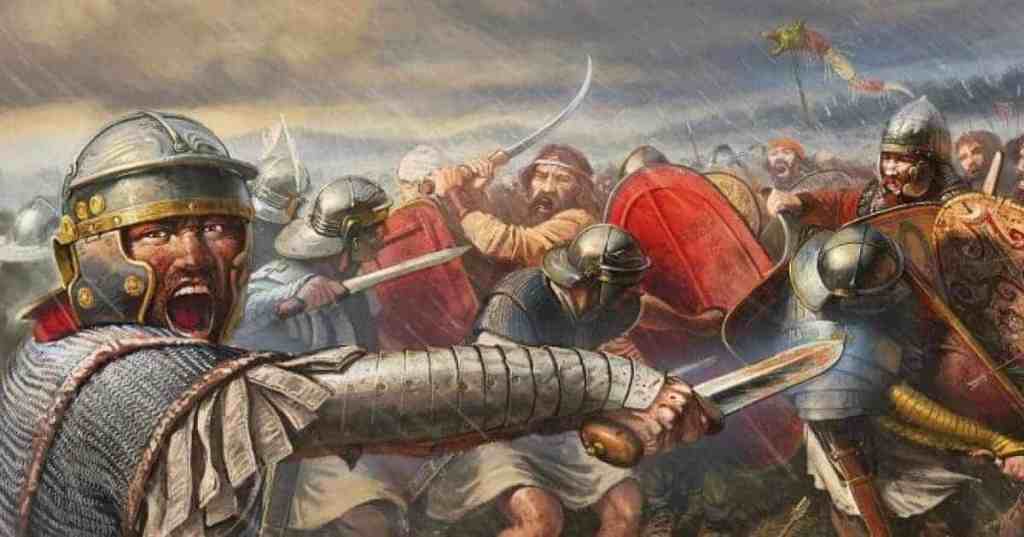
Know that Notfrid will probably be indicted by the International Criminal Tribunal of Frisia (ICTF) at the town of Aurich in the region of Ostfriesland, Germany. See our blog post about his provisional indictment by the ICTF.
Nota I — Did you know that between 1504 and 1795, ancient Roman Law in its purest form was the applicable law in the province of Friesland? Check our blog post Medieval Migration Law. A Matter of Liability for more about this anomaly in European law practice.
Nota II — The term Germanic is an invention of the Romans. Actually, the tribes above the River Rhine might have been Celtic or a mixture of Germanic and Celtic. The Frisians (both the Frisiavones and the Frisii) might have been this, including the two Frisian kings or local leaders Verritus and Malorix who travelled all the way to Rome in the year AD 58, to plead with Emperor Nero their case for the use of land bordering the limes north of the Lower River Rhine. See our blog post Barbarians Riding to the Capital to Claim Rights on Farmland to learn more about these two kings — or traitors? — and their Celtic-Frisian connection.
Nota III — Well into the fifth century AD, the Romans made use of mercenaries from the coastal area of the Wadden Sea. We even have a name of one of them, namely ᚲᛋᚫᛗᛖᛚᛚᚫ ᛚXᚢᛋᚲᚫᚦI reading ksamella lguskaþi and meaning ‘Deer Hunter’. Check our blog post The Deer Hunter of Fallward, and His Throne of the Marsh.
Nota IV – Credit featured image of this blog post by karakter.de
Annex
Eight funerary inscriptions of equites singulares ‘horse guards’ have been found in Rome, which are of Frisians, either Frisii or Frisiavones. These were inscription on tombstones. The inscriptions date to the second and (fewer) early third centuries. The reconstructed but incomplete and thus still difficult to interpret texts relating to Frisian mercenaries, read as follows:
- DIS MANIBVS (…) EQVITI SINGVLARI AVGVSTI TVRMA V (…) NATION(…) NE FRIS(…) T FLAVIVS C(…) EQVES SINGVLARIS AVGVSTI FRATRI PIISSIMO (…)
- DIS MANIBVS AVRELIO R(…) NATIONE FRISIAVO (…)
- DIS MANIBVS T FLAVIO GENIALI EQVITI SINGVLARI AVGVSTI TVRMA LARCI PROCLINI NATIONE FRISAONI STIPENDIORVM XVIII VIXIT ANNOS XXX X(…) ROMANVS (…)
- (…) TVRMA VRBANI NATIONE FRISIAVO VIXIT ANNOS (…)X XVII MILITAVIT ANNOS (…) X
- DIS MANIBVS AVRELIO VERO EQVITI SINGVLARI AVGVSTI NATIONE FRISEO TVRMA AELI GEMINI VIXIT ANNOS XXX MILITAVIT ANNOS XIII AVRELIVS MOESICVS HERES AMICO OPTIMO FACIENDVM CVRAVIT
- (…) NATIONE FRISAONI TVRMA (…) ANI (…) MILITAVIT ANNOS INVS (…) I (…)
- DIS MANIBVS (…) L (…) EQV (…) S (…) FRISIAVO (…) F AGRA (…) F CHIV (…) CAND (…) H (…)
- DIS MANIBVS T FLAVIO VERINO NATIONE FRISAEVONE VIXIT ANNOS XX T FLAVIVS VICTOR EQVES SINGVLARIS AVGVSTI FRATRI DVLCISSIMO FACIENDVM CVRAVIT
Suggested hiking
- We hikers would not be worth a penny if we would not point out there is a fantastic hike along Hadrian’s Wall too: the Hadrian’s Wall Path. It is a national trail, and is 135 km long. So, an excellent hike for a week. With all the Frisian warfare history at this wall, we dare to consider it as a natural extension of the Frisian Coast Trail after you have reached the end of the trail at the town of Ribe in southern Denmark. Just cross the North Sea in western direction from there until you hit the shores of England. Or, do it the old way. Travel to the island of Walcheren in the southwest of the Netherlands, give some offering to the gods and sail with a ship to the county of Kent.
- More walls and hiking paths along old walls can be found in our blog post Another Brick in the Wall. A Love-Hate Relationship.
Suggested music
- Dolly Parton, Down From Dover (1969)
Further reading
- BBC, The Horsemen of Hadrian’s Wall (2017)
- Bosman, V.A.J., Rome aan de Noordzee. Burgers en barbaren te Velsen (2016)
- Broeke, van den P.W., Pierenpaté? Fries aardewerk ten zuiden van de Nederrijn (2018)
- Buijtendorp, T., De gouden eeuw van de Romeinen in de Lage Landen (2021)
- Bunt, van de A., Wee de overwonnenen. Germanen, Kelten en Romeinen in de Lage Landen (2020)
- Dhaeze, W., The Roman North Sea and Channel Coastal Defence. Germanic Seaborne Raids and the Roman Response (2019)
- Galestin, M.C., Frisii and Frisiavones (2016)
- Gelder, van J., Nieuwenhuis, M. & Peters, T. (transl.), Plinius. De wereld. Naturalis historia (2018)
- Ginkel, van E. & Vos, W., Grens van het Romeinse Rijk. De limes in Zuid-Holland (2018)
- Goldsworthy, A., Hadrian’s Wall. Rome and the Limits of Empire (2018)
- Heeren, S., Grensoverschrijdingen. Romeins-Germaanse interactie (2022)
- Heeringen, van R.M. & Velde, van der H.M. (eds.), Struinen door de duinen. Synthetiserend onderzoek naar de bewoningsgeschiedenis van het Hollands duingebied op basis van gegevens verzameld in het Malta-tijdperk (2017)
- Hexham Abbey, Flavinus’ Tombstone (website)
- Huisman, K., De Friese geschiedenis in meer dan 100 verhalen (2003)
- Hunink, V (transl.), Tacitus. In moerassen en donkere wouden. De Romeinen in Germanië (2015)
- Jongstra, A., Friezen in Rome (2024)
- Looijenga, A., Popkema, A. & Slofstra, B. (transl.), Een meelijwekkend volk. Vreemden over Friezen van de oudheid tot de kerstening (2017)
- Mees, B., The English language before England. An epigraphic account (2023)
- Meijlink, B. & Silkens, B. & Jaspers, N.L., Zeeën van Tijd. Grasduinen door de archeologie van 2500 jaar Domburg en het Oostkapelse strand (2017)
- Mijle Meijer, van der R.A., Scheveningseweg gemeente Den Haag. Archeologische begeleiding rioolvervanging (2011)
- Neumann, G., Namenstudien zum Altgermanischen (2008)
- Nieuwhof, A. & Nicolay, J., Identiteit en samenleving: terpen en wierden in de wijde wereld (2018)
- Nijdam, H., Law and Political Organization of the Early Medieval Frisians (c. AD 600-800) (2021)
- Lanzing, F., Soldaten van Smaragd. Mannen, vrouwen en kinderen van het KNIL 1890-1914 (2005)
- Lendering, J., Romeinen in Velsen (2016)
- Londen, van H., Ridder, T., Bosman, A. & Bazelmans, J., Het West-Nederlandse kustgebied in de Romeinse tijd (2008)
- Mol, J.A., Vechten, bidden en verplegen. Opstellen over de ridderorden in de Noordelijke Nederlanden (2011)
- Preskar, P., The Imperial German Bodyguard. The Roman emperors trusted foreigners more than their own Romans (2021)
- Renswoude, van O., De witte goden der wachthouders (2026)
- RIB Online, Roman Inscriptions in Britain (website)
- Rushworth, A., Housesteads Roman Fort — The Grandest Station. Volume I Structural Report and Discussion (2009)
- Savelkouls, J., Het Friese Paard (2016)
- Soenveld, J.P., Romeinen ronselden veel ‘Friese’ soldaten (2020)
- Southern, P., Hadrian’s Wall. Everyday life on a Roman frontier (2016)
- Stedman, H. & McCrohan, D., Hadrian’s Wall path. Wallsend (Newcastle) to Bowness-on-Solway (2006)
- Stolte, B.H. (ed.), Germania Inferior. Untersuchungen zur Territorial- und Verwatungsgeschichte Niedergermaniens in der Prinzipatszeit (1972)
- Tuuk. van der L., De Romeinse Limes. De grenzen van het Rijk in de Lage Landen (2017)
- Vanderbilt, S., Roman Inscriptions of Britain (RIB), website
- Vugts, T. (ed.), Varen op de Romeinse Rijn. De schepen van Zwammerdam en de limes (2016)
- Weij, van der A., Deabus et Dis Communibus. Thesis on the religious identity of auxiliary soldiers on the northern frontier of Roman Britain (2017)


Thankyou very much, I will be coming back for further reading as it is very interesting!
Kind regards,
Costas
LikeLike
Great to hear!
LikeLike
Can I ask you something? Where exactly was Helenium, which is a very intriguing name? What is a region or a town, if you know?
LikeLike
Helenium, Helinium, Helius, or Helinius was a bay at the confluence of the rivers Scheldt, Meuse and Waal at the North Sea Coast i n the Netherlands. (see our post: “A Frontier known as Watery Mess: the Coast of Flanders” https://frisiacoasttrail.blog/2021/08/08/the-frontier-collectively-known-as-watery-mess-the-coast-flanders/)
The name might be of Celtic origin and ‘hel‘ could mean something like ‘low/hollow watery land, swamp’ but can also associated with ‘underworld/concealed place’. (see our post: “When the Gate of Hell opened at the Golden Necklace” https://frisiacoasttrail.blog/2023/08/27/when-the-gates-of-hell-opened-at-the-golden-necklace/).
Another, explanation is that the word hel is related to the Celtic halein ‘salt’ or heli‘ ‘sea’. (see post: “Het raadsel van Nehalennia ontrafeld” https://www.nemokennislink.nl/publicaties/het-raadsel-van-nehalennia-ontrafeld/). Hehalennia was an idol worshiped in the Netherlands 2,000ya.
Yet another explanation is that helle in the modern town of Hellevoetsluis (located where once the confluence of Helinium used to be) derives from hille and must be understood as ‘hill/elevation’ (Van Berkel & Samplonius 2018).
You could summarise the above with “nobody has a clue”. Personally, I think hel as described in the blog post “When the Gate of hell opened at the Golden Necklace” is the most plausible one.
LikeLike