
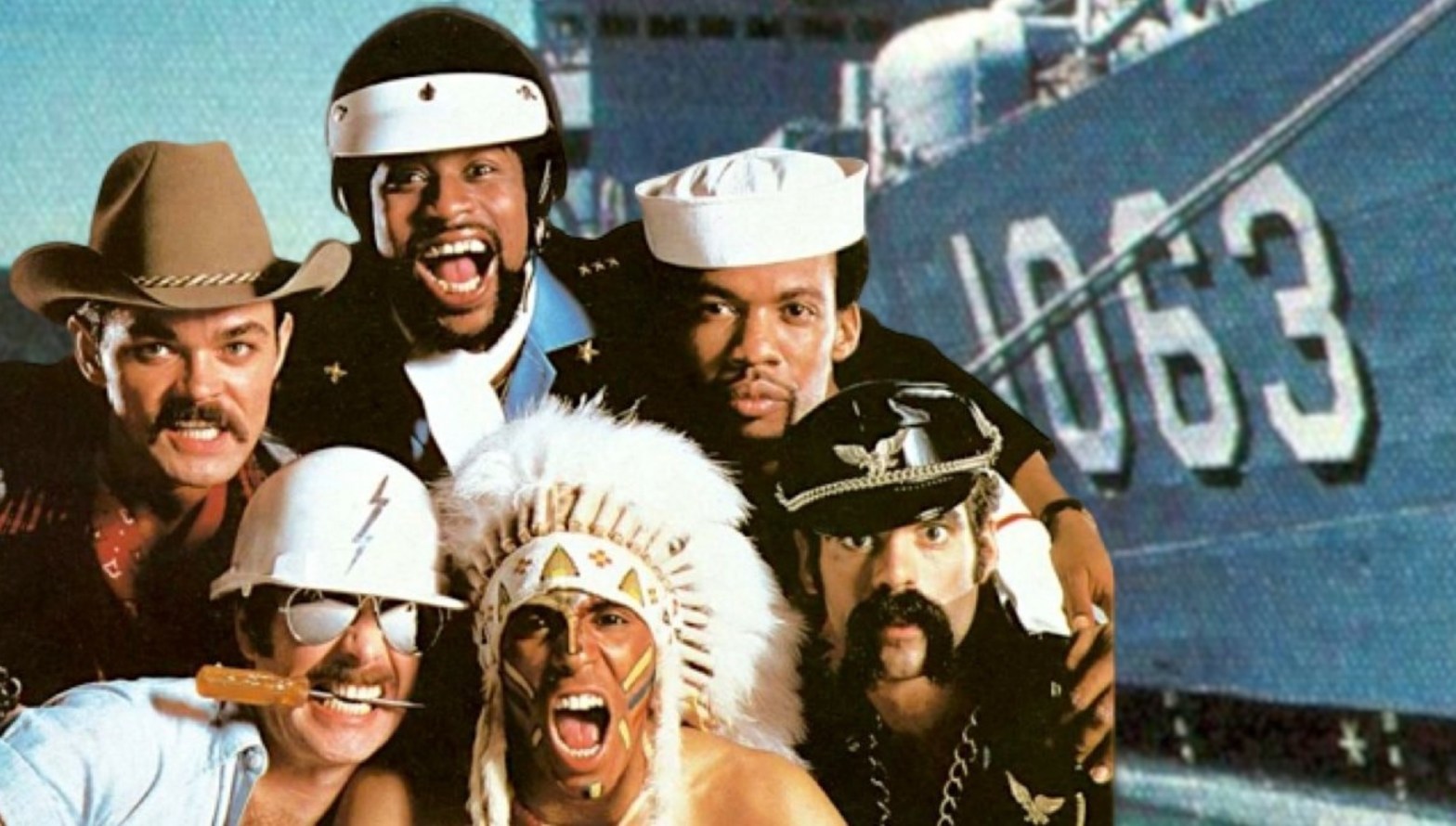
‘In the Navy,’ a song by the American disco-pop group Village People, seems an unlikely anthem for the small villages along the southern coast of the North Sea. Yet these villages belong to a region once united, in myth and memory, as the Seven Sealands, and to a people who helped lay the foundations of two of history’s most impressive navies: that of the Kingdom of England and that of the Republic of the Seven United Netherlands. It should not come as a surprise, then, that we are talking about the Frisians. And despite the Latin saying Frisia non cantat — ‘Frisia/Friesland does not sing’ — they joyfully did sing: “In the Navy. Yes, you can sail the seven seas!”
Medieval conscription
It all began in the centuries before the Dark Ages, shortly after the proud Roman Empire retreated south, away from the North Sea and the swampy delta of the great rivers Scheldt, Meuse, and Rhine. This was a region long exposed to seaborne raiders, many of them coming from the wider Wadden Sea area. Among them were Chauci, Frisians, Franks, and Saxons. Raiding from this region remained a serious threat well into the Early Middle Ages.
The early-medieval answer of the coastal peoples living along the shores of the North Sea — from England, Flanders, and Frisia to southern Scandinavia — to the threat of a.o. raiders was an early form of conscription. In Frisia — then a region stretching from Sincfala, roughly the present-day Zwin inlet in Flanders, to the lower reaches of the River Weser in northern Germany — this system of coastal defence was known as heercogge, which can be translated as ‘warship’ or ‘war-cog.’ The inhabitants of a district known as a cogge were obliged, when called upon in times of seaborne threat, to provide a warship and its crew of oarsmen and warriors. And these were no lightly armed rowers: they were warriors armed to the teeth. The vessels were probably open rowing boats without sails, carrying around twenty to thirty men.
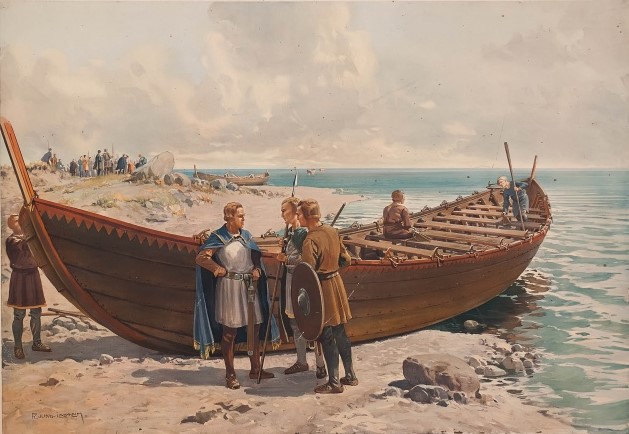
In Frisia, the heercogge organization was effective from Sincfala to the mouth of the River Vlie, flowing out into the North Sea roughly where the modern seaway Vlie is today, between the Wadden Sea islands of Vlieland and Terschelling. The heercogge was probably also in place in the early-medieval Frisian colonies of the modern region of Nordfriesland, south of the German-Danish border. In Nordfriesland, the administrative district to provide a warship in times of threat was called a harde or herde, meaning ‘hundred.’ Compare the English hird or fyrd, and the Scandinavian hæraþ or hérað. Quite a few toponyms in Nordfriesland still refer to this ancient past, like Wiedingharde (formerly Horsbüllharde), Beltringharde, Bökingharde, Edomsharde, Karrharde, Goesharde, and Pellwormharde.
And for the observant reader: indeed, in the Frisian territories between the River Vlie and the River Weser, there is no evidence that the heercogge defence system existed there as well.
Find more about the heercogge conscription and the trade settlements in the region of Nordfriesland in our blog posts A Frontier Known as Watery Mess: The Coast of Flanders and To the End Where It All Began: The Ribbon-Like Town of Ribe.
English navy
Then, a few centuries later, in AD 897, the Anglo-Saxon Chronicle records that King Alfred of Wessex had a new fleet of warships built to counter the raids of the Danes — the Vikings. In doing so, Alfred drew heavily on Frisian maritime expertise, both in shipbuilding and in naval warfare. He commissioned a new type of vessel, apparently a hybrid of Danish and Frisian ship designs. These ships were exceptionally long, possibly reflecting Danish influence, while their greater stability and higher sides may have been Frisian features. They could carry as many as sixty oarsmen and warriors — a remarkable development compared with the early Frisian cog ships, which until then appear to have carried only twenty to thirty men.
Þa het Ælfred cyng timbran langscipu ongen ða æscas. Þa wæron fulneah tu swa lange swa Þa oðru. Sume hæfdon lx ara, sume ma. Þa wæron ægðer ge swiftran ge unwealtran ge eac hieran Þonne pa oðru; næron nawðer ne on fresisc gescæpene ne on denisc, bute swa him selfum ðuhte Þæt hie nytwyrðoste beon meahten.
Anglo-Saxon Chronicle
Then King Alfred ordered longships to be built against the esks [i.e. warships of the Danes]. They were almost twice as long as the others. Some had sixty oars, some more. They were both faster and more stable, and also higher, than the others; they were neither shaped according to the Frisian nor according to the Danish design, but rather as he himself thought they could be most useful.
That Frisian mariners also manned these new Wessex ships is clear from the same entry in the Anglo-Saxon Chronicle. In that very year, AD 897, skirmishes took place along the coasts of the Isle of Wight and Devon. These were certainly not yet the peaceful, Flower Power days of Jimi Hendrix’s legendary Isle of Wight concert in 1970. According to the Anglo-Saxon Chronicle, sixty-two Frisians and Englishmen were killed fighting in the service of the King of Wessex, while twice as many Danes were sent to Davy Jones’ Locker. In any case, it was a victory for King Alfred.
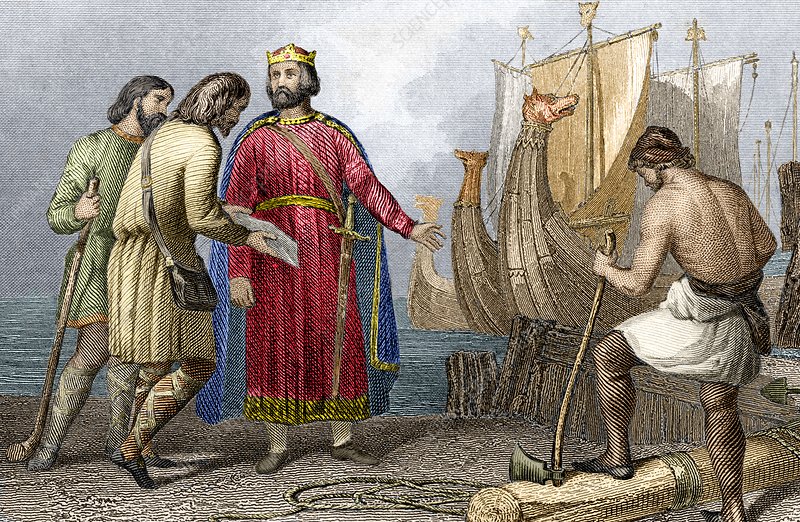
We even know the names of three Frisian warriors in Alfred’s naval fleet: Æbbe Friesa, Æðelhere Friesa, and Wulfheard Friesa. Why the Anglo-Saxon Chronicle mentions them by name is unclear, although they may have been commanders. Their names were anglicized, which should not come as a surprise. The differences between Frisian and English were relatively minor at the time, and names have been adapted to local languages everywhere — and still are. For a later example, see our blog post Happy Hunting Grounds in the Arctic. The Way the Whale’s Doom Was Sealed, which explains how seafarers from the region of Nordfriesland who joined Dutch whaling ships in the eighteenth century were given new, typically Dutch names.
The close relations that existed in the ninth century AD between Flanders and southern England may have facilitated this cooperation between Frisians from Flanders and the Anglo-Saxons of Wessex. Judith of Flanders (ca. AD 844-870), a direct descendant of Charlemagne and the wife of Margrave Baldwin I of Flanders (ca. AD 830-879), nicknamed Baldwin Iron Arm, had previously been married to the Anglo-Saxon kings Æthelwulf and Æthelbald. In AD 856, she was even crowned the first queen of Wessex (De Maesschalck 2019).
Specifically, the marriage of Ælfthryth, daughter of King Alfred, to Margrave Baldwin II of Flanders, probably around AD 896, may have helped facilitate maritime cooperation between the Frisians and the English (Williams, Smith & Kirby 1991). By then, Frisian settlers had long been established along the coast of Flanders and in Zeeland, their presence there dating back to the early sixth century AD. Baldwin II was therefore, in a sense, immersed in the world and culture of the salty Frisians — a people not always easy to distinguish from pirates. In the southern reaches of Frisia, corresponding roughly to the present-day Flemish north-western coast, they, as said earlier, had also organized their maritime defence according to the aforementioned heercogge system of conscription.
Furthermore, shortly before the Battle of the Isle of Wight and the marriage of Ælfthryth and Baldwin II, the Frisians had successfully driven out the Vikings from northeastern Frisia following the Battle of Norden in AD 884. For more details, see our blog post A Theel-Acht. What a Great Idea!. A year later, in AD 885, Frisian warriors helped achieve the same result in western Frisia, following the murder of the Danish warlord Godfrid the Sea-King and the subsequent Battle of Herispich, at present-day Spijk in the province of Guelders. See our blog post The Abbey of Egmond and the Rise of the Gerulfings for more background. Two victories that surely did not go unnoticed in the wider region.
So, King Alfred was smart enough to make use of the experience gained from battling Vikings and other corsairs at sea, provided by the Frisians. Chances are these Frisians hired by Alfred came from the nearby Flemish coastal plains ruled by Baldwin II.
♫ Where can you find pleasure, search the world for treasure, learn science technology? In the navy! ♫
The Village People
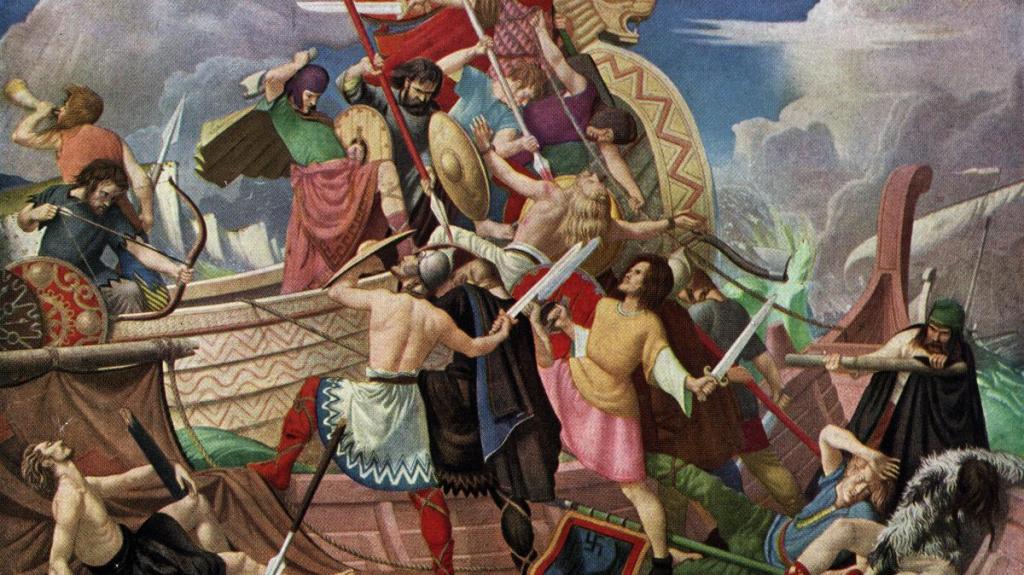
The year AD 897 is often considered the birth of the Royal Navy, with King Alfred as its father. Now the reader knows who provided Alfred with both the brains and the muscle to get the job done.
A nice anecdote, in the novel Water Borne mention is made of Frisians helping King Alfred with his new ships “to fend off attacks by marauding Danes on the southern coasts of Wessex” (Randolph 2023).
Dutch navy
After having explained how the English navy saw the light of day, we continue with that of the Republic of the Seven United Netherlands, commonly known as the Dutch Republic. And again, piracy is a leitmotif. By the way, so is the combination ‘the seven seas.’
When, in the year 1568, the Low Countries started their wars of independence against the Kingdom of Spain, it was a group of pirates operating in the wider area of the Wadden Sea who played a pivotal role in giving the bourgeois uprising momentum. These pirates controlled the seaways Vlie and Marsdiep in the Wadden Sea for years already, and thus controlled the traffic of, among other goods, grain from the Baltic Sea to the needy and fast-growing city of Amsterdam. Hence, they were at the wheel concerning the city’s prosperity and had the Spanish king by the throat, so to speak (Doedens & Houter 2018).
The pirates would become known as the Watergeuzen, literally ‘water beggars’, and were a motley crew of washed-up nobility, thrill seekers, vagabonds, and other lowlives from all corners of the Low Countries, including many Frisians, since the catchment area of the Sea Beggars was the Frisian lands. Also, their ports and safe havens were mainly located on the Frisian Wadden Sea islands and on the coasts of the province of Groningen and the county of Ostfriesland. See our blog post Yet Another Wayward Archipelago — The Wadden Sea for a more elaborate history concerning the Sea Beggars. Below, a few prominent and flamboyant-looking Beggars.
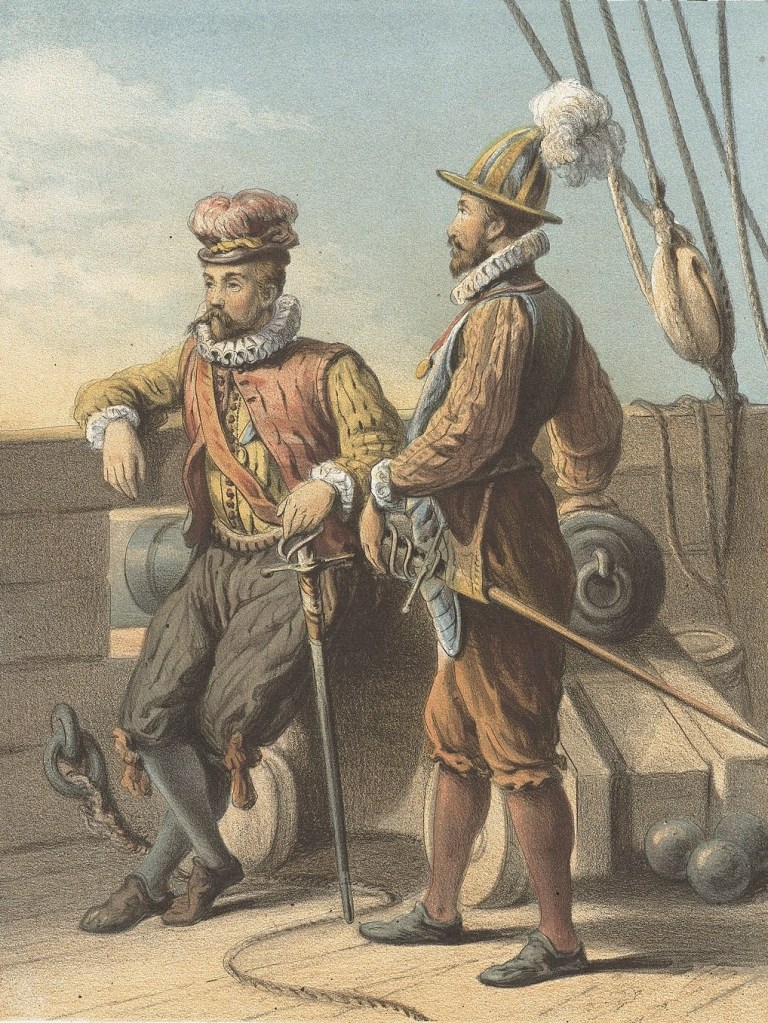
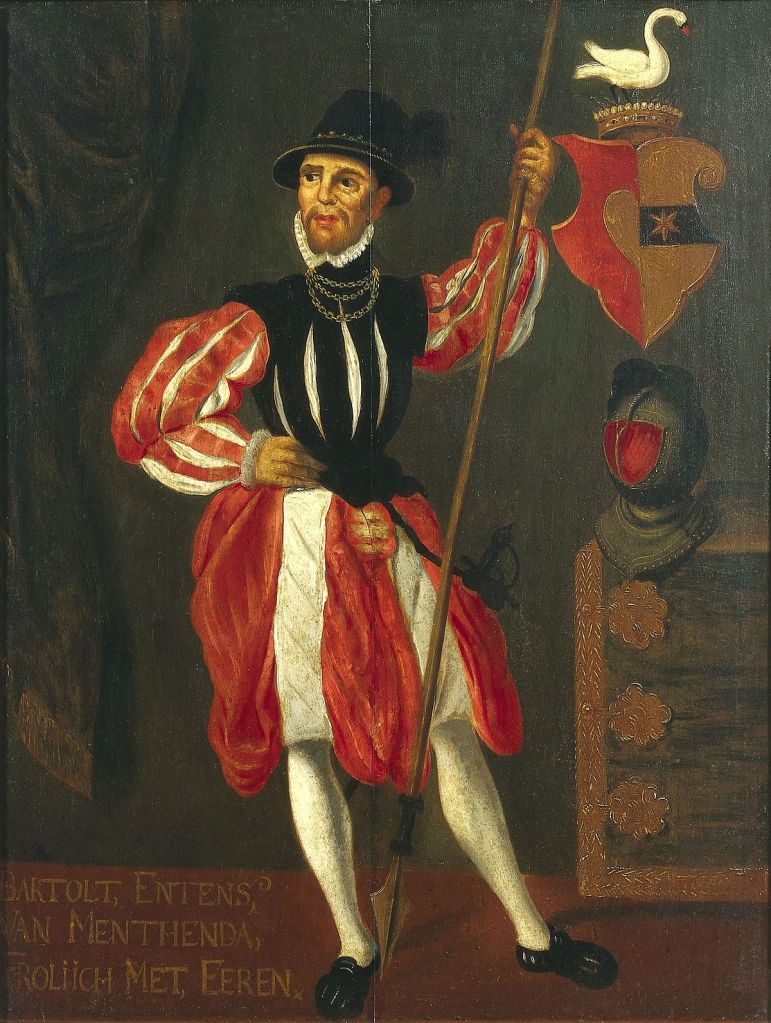
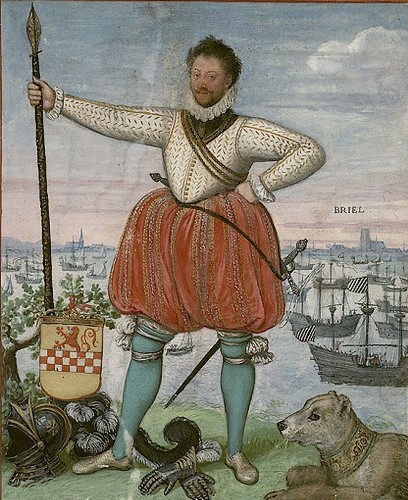
Prince William of Orange, also known as William the Silent, who led the Dutch Republic’s uprising against the mighty Kingdom of Spain, made at least one smart move. On 14 June 1570, he instructed the Frisian Jan Baes, also known as Jan Basius, from the town of Leeuwarden, to negotiate agreements with the Sea Beggars. Jan Baes succeeded, reaching an agreement with the pirate captains Troij, Ruychaver, and Menninck to cooperate against Spain and its supporters, and to cause them as much harm as possible. The deal was sealed on the Wadden Sea island of Borkum, in the county of Ostfriesland.
♫ Where can you begin to make your dreams all come true, on the land or on the sea? In the navy! ♫
The Village People
Therefore, the agreement with a group of pirates operating in and from the muddy Wadden Sea, the Sea Beggars, can be considered the foundation of the Koninklijke Marine ‘Royal Netherlands Navy’. Now the reader knows who got the job done for Prince William of Orange and where it was sealed.
Conclusion & Advise
Any government or worldly leader otherwise in need of a proper navy, please consult the Frisians first.
Note 1 — During the late fifteenth and sixteenth centuries, new shipbuilding techniques developed in the Netherlands, notably in the provinces of Zeeland and Holland. Especially the carvel-built and shell-first construction techniques, and the square sail rig were important innovations. Ships were faster, more maneuverable, much cheaper to purchase because of the use of less expensive wood, and also cheaper in operations because you needed less crew to sail it. Dutch-designed vessels like the bojert, the fluyt (also fluit or flute), the pinas, the smack, the galjoot (also galiot), the hooker, and the jagt, therefore, were superior to other traditional ship types in the wider North Sea area. The Scandinavian skuder and the krejeter were replaced by Dutch vessels.
Not only were these ship innovations key, but also better and more accurate nautical charts and instruments were important to take international sea navigation to the next level, and were developed in the Dutch Republic as well. To quote Christensen (2021); “From the end of the sixteenth century, there was, in what might be called a Dutch international maritime practice community, a common recognition that Dutch maritime technology was state of the art.”
During the seventeenth and eighteenth centuries, the Danish kingdom actively attracted Dutch shipbuilders to expand the Royal Danish Navy. Not only shipbuilders, but also high-ranking naval officers were of Dutch origin. In 1663, the Dutchman Koert, or Cort, Sievertsen Adelaer (1622-1675) was admiral of the Danish fleet. After Koert Adelaer, Admiral Cornelis Tromp was appointed admiral of the Danish fleet. Under the rule of King Christian V (1646-1699), about half of all Danish naval officers were of Dutch origin. Besides officers, the crew also consisted partly of able sailors from the Dutch Republic. Probably, the language on board Danish ships was Dutch. To this day, much of the maritime Danish and Norwegian vocabulary is, in fact, Dutch. About 754 words out of a total of 1,000 Dutch maritime words can still be found in Scandinavian languages. Lastly, the Danes also commissioned the construction of warships at the wharfs in the Republic. In other words, the Royal Danish Navy depended heavily on Dutch maritime expertise, both in construction and navigation, and on naval war skills (Christensen 2021).
In 1697, Tsar Peter I of Russia, better known as Peter the Great, famously travelled incognito to the province of Holland of the Dutch Republic under the alias Peter Mikhailov. He worked in the shipyards of Zaandam and later Amsterdam, where he learned shipbuilding techniques first hand. After returning to Russia, Peter the Great recruited Dutch shipbuilders and naval officers, established modern shipyards, and built the Russian Navy from the ground up. His reforms transformed Russia into a major naval power. The Russian language too contains a great many Dutch nautical and maritime terms, like матрос (Dutch matroos) for sailor, штурманn (Dutch stuurman) for navigator/helmsman, шкипер (Dutch schipper) for skipper, and фарватер (Dutch vaarwater) for fairway, to name just a few.
Note 2 — Of course, the English and Dutch navies fought each other in the seventh and eighth centuries in the four Anglo-Dutch Wars. One Frisian maritime hero was Commander Jacob Benckes (1637-1677), who belonged to the striking force during the Raid on the Medway (1667), recaptured the town of New Amsterdam, today New York City, from the English in 1673, and served as an example for Daniel Defoe’s character of Robinson Crusoe (1719). See our blog post History Is Written by the Victors — A Story of the Credits to learn more about this almost forgotten Frisian sea hero.
Note 3 — Artist and musician Johnny Allen (Jimi) Hendrix (1942-1970), who performed at the Isle of Wight Festival in the summer of 1970, also served in the army: the United States Army. He was, however, discharged in 1962 after thirteen months of service. Speculation as to why varies from homosexual tendencies, being caught masturbating in the latrine, to simply being a poor soldier. We do not rule out that all three ‘violations’ were applicable.
Suggested music
- Andersen, L., Lili Marlene (1939)
- Hendrix, J., In from the storm. Ilse of Wight Live (1970)
- Village People, In the Navy (1978)
Further reading & listening
- Bliss, A. (ed.), J.R.R. Tolkien. Finn and Hengest (1982)
- Center for International Maritime Security, podcast Sea Control 457 — Pirates and the Wadden Sea with Hans Faber (2023)
- Christensen, A.N., Maritime connections across the North Sea. The exchange of maritime culture and technology between Scandinavia and the Netherlands in the early modern period (2021)
- De Maesschalck, E., De graven van Vlaanderen (861-1384) (2019)
- Dhaeze, W., The Roman North Sea and Channel Coastal Defence. Germanic Seaborne Raids and the Roman Response (2019)
- Doedens, A. & Houter, J., De Watergeuzen. Een vergeten geschiedenis (2018)
- Milzarski, E., The real reason Jimi Hendrix got kicked out of the Army (2021)
- Moore, A., King Alfred’s Navy (2012)
- Randolph, O., Water Borne. The Circle Ceridwen Saga. Book Ten (2023)
- Tuuk, van der L., Deense heersers en de Friese kogge in de vroege Middeleeuwen. 2. De koggenorganisatie en de rol van de Deense heersers (2007)
- Tuuk, van der L., Herekoge in Vredelant (2012)
- Whitelock, D. (ed.), The Anglo-Saxon Chronicle. A Revised Translation (1961)
- Williams, A., Smyth, A.P. & Kirby, D., A biographical dictionary of dark-age Britain. England, Scotland and Wales c.500-c.1050 (1991)


this article does not distinguish the Frisiani on the Rhine of the 1st millennium, with HQ at Rhenen-Dorestad from the Second Millennium Friesians of West Friesdan in the Prov. of N. Holland along the coast to Danish N. Friesland. The trading contacts in the time of Willibrord and Alfred were especially with Dorestad.
LikeLike