
The temperament of the 东弗里斯兰人 (Ostfriesen or East Frisians) knows neither highs nor lows. Emotions are rarely expressed openly. Ideally, when looking out the window, they prefer to see a lightly overcast, grey, and treeless landscape — no spectacle, no fuss. Perhaps a bit dull to outsiders, but to the Ostfriesen it feels wonderfully stable. They themselves are equally restrained in their habits: at most a glass of Küm or Korn in the evening and a shrimp sandwich on the weekend. And of course, tea every single day, several times a day. That is precisely why recent news about the black tea production, its quality, and price volatility has caused unwelcome unrest in the region of Ostrfriesland.
For the nearly half a million inhabitants of Ostfriesland, tea is less a beverage than a religion. Alongside the great tea-drinking nations — like Iran, Ireland, Morocco, Pakistan, and the United Kingdom — the Ostfriesen consume an astonishing 300 litres per person each year. That places them ahead of even Libya and Turkey, ranked number two and three respectively of the world most dedicated tea drinkers, despite the obvious fact that those countries inhabit far warmer climates, where drinking a lot is a matter of necessity rather than ritual. Reckon, a north-western European drinks roughly 600 to 1,100 litres of liquid per year, on average. So, the Osfriese drinks more tea than anyone else in the world.
Hydration, meanwhile, has become a modern fixation among Millennials and Gen Z, forever clutching water bottles and protein to-go cups that jut from backpacks on packed buses, trains, trams, and underground carriages. Anxious to stay healthy, they sometimes push their liquid intake to the point of risking water intoxication. Ostfriesians would likely regard such anxiety with quiet bewilderment. Their marshy, coastal homeland is already so damp, windswept, and saturated with water that additional liquids seem almost redundant. After all, a fish in the sea does not need to drink water to stay hydrated.
Not only do the Ostfriesen consume around 300 litres of tea per person each year, they have done so for roughly 300 years. The dealers who first hooked Ostfriesland on this caffeinated liquid were the Dutch. Transporting drugs; a reputation that would stick with the Dutch for very long if not to this day. The Vereenigde Oostindische Compagnie (Dutch East India Company) was the first to import tea. The first known shipment of Chinese tea to arrive in Europe landed on the quays of Amsterdam in 1610, brought in by the VOC through trade routes via Java and Japan.
The Dutch dealers not only got the Ostfriesen addicted to tea, but in the decades that followed the English and French as well (Kamiso 2017). Indeed, creating demand. Around 1665, the English began importing tea themselves and would eventually come to dominate much of the tea trade between Europe and the East. This expansion culminated in the era of the tea clippers, such as the Cutty Sark — a ship that can still be admired on the banks of the River Thames in the city of London today. And in turn, the English became the dealers. The Indian Tea Association did much to get the Indian population hooked on tea, including having workers drink tea during their breaks. The ITA still exists and promotes itself as an institute of trust and assurance.
And the Ostfriesen drink tea with attention. They certainly do not thoughtlessly throw back a cup of tea down their throat, like the famous pirate Klaus Störtebeker once did with a mug of beer. Instead, they have developed an entire tea ceremony of their own. Apparently, tea does that to people, and it is not limited to places like China with 工夫茶 (Gongfu Cha ceremony), Russia with чаепитие (Chaepitie ceremony), and Japan with 茶の湯 (Chanoyu ceremony) or 茶道 (Chadō ceremony). The latter literally means ‘the way of tea.’
Incidentally, according to old Chinese sagas, tea was brought to the world by 神農 (Shennong), a mythological emperor of China. He is also known as the Divine Farmer, credited with inventing tools such as the plough and the axe to cultivate the land. He is also said to have discovered the tea leaf in the year 2737 BC. In this way, tea is given a divine origin. This is somewhat comparable to the sacred drink Soma in the Hindu Vedas, or to the sacramental blood of Jesus in the Catholic tradition, namely red wine.
And what does the Teezeremonie (‘tea ceremony’) of the Ostfriesen looks like? When is it Teetied (‘tea time’) in Ostfriesland?
Firstly, the tea consists of a strong blend of black teas, carefully composed from Assam, Ceylon, Java, and Sumatra varieties. In order to authentically be called ‘ostfriesischer Tee,’ the blend must consist predominantly of Assam tea. The so-called Schwarztee-Mischung. A strong tea.
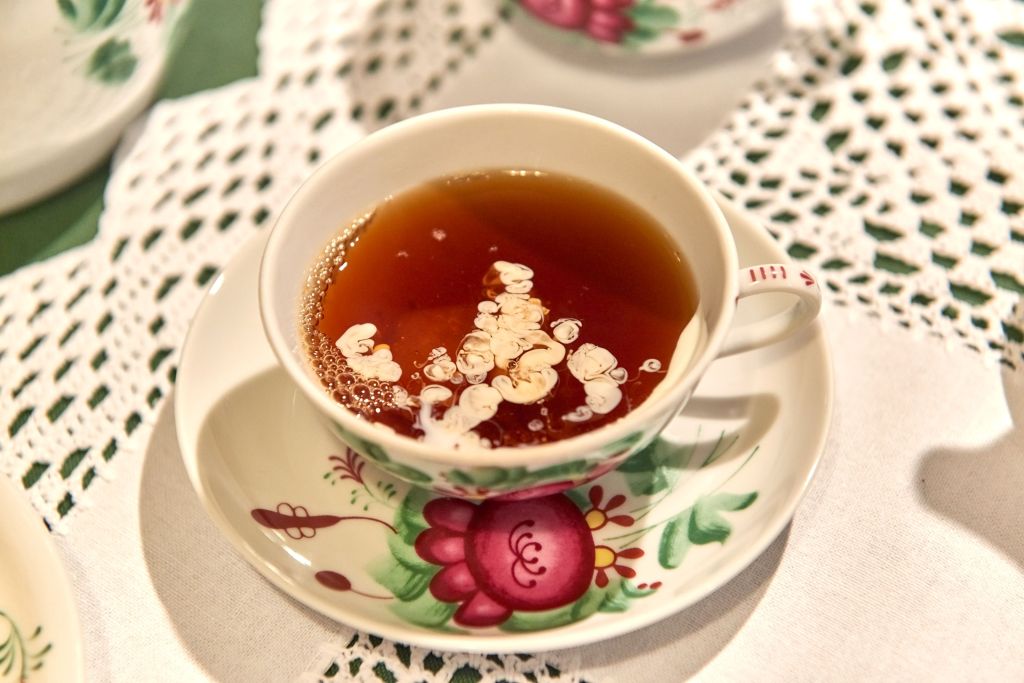
Secondly, the tea is served in a typical East Frisian tea set made of thin porcelain. The cups, saucers, round-bellied teapot, cream jug, and Kluntjepott (sugar bowl) are all decorated with the rose motif — the ostfriesische Rose or Friesenrose. They are usually painted in either old rose or blue. Traditionally, the rose represents homeliness. From the beginning of the eighteenth century much of the rose-motif porcelain used in Ostfriesland was produced way upstream the River Elbe in the town of Meissen in the State of Saxony.
Thirdly, the tea is poured into the cup over a Kluntje. A Kluntje is Platt for rock sugar, also known as candy sugar, or simply candy (kandij in Dutch). Next, a small splash of cream is added along the side of the cup. The cream first sinks to the bottom and then rises again. In the Platt language this is called a Wulkje, which translates as ‘little cloud.’ In principle, the cream is not stirred. As a result, each sip offers a slightly different composition of tea and cream, gradually giving way to the sweetness of the rock sugar.
And Teetied is in the morning, late afternoon, and in the evening. In other words, as long as an Ostfries is awake, it is tea time. Furthermore, when welcoming a guest into the home, the tea ceremony is also brought out. Similar as is costumery in Morocco and Turkey. If it is not, one might start wondering whether it is time to leave. And if you have just broken up with the farmer’s daughter, then one and one makes two.
In the province of Friesland, pancakes were often eaten on Sundays. These could be served with or without bacon. If, as a new boyfriend of the daughter of the house, you were sitting at the table and no bacon was served with the pancakes, you knew you still did not belong in the parents’ eyes. If the plain version remained unchanged over several Sundays, the boy knew it was not going to work out — at least not with the parents.
The Teezeremonie of Ostrfriesland was officially recognised in 2016 as part of Germany’s National Inventory of Intangible Cultural Heritage, within the UNESCO framework for safeguarding living traditions. The Japanese tea ceremony was inscribed in 2015 on the UNESCO Representative List of the Intangible Cultural Heritage of Humanity.
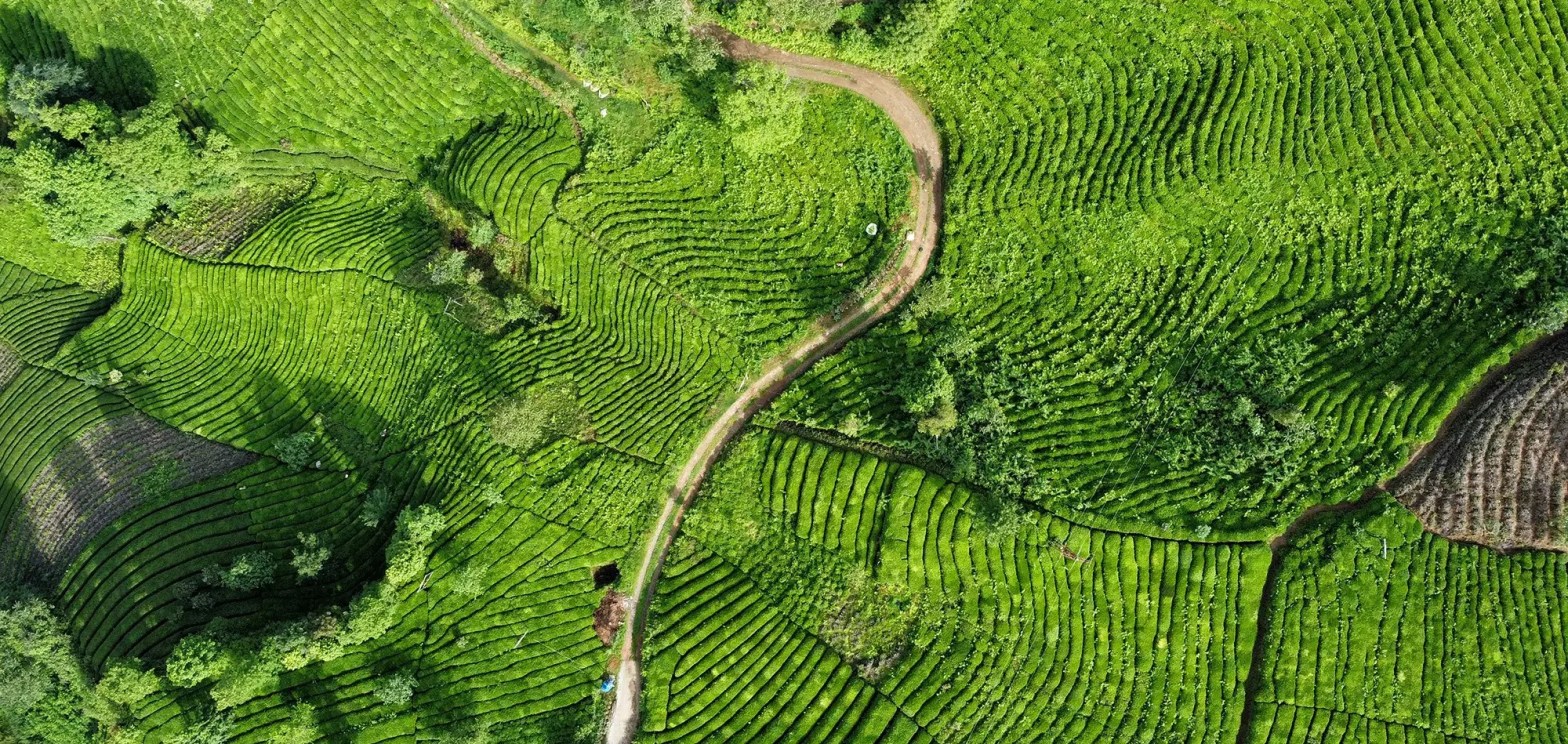
And now, the news (May 2026) that threatens to tip the Ostfriesen off balance: “Bitter times ahead for tea drinkers” (Bowman 2026). The reason is climate change, which is causing increasingly erratic weather. Tea, much like the Ostfriesen, depends on stable conditions. As temperatures and precipitation begin to fluctuate too much for the tea plant, its quality declines: leaves become smaller, and the balance of compounds such as catechins, amino acids, and polyphenols is disrupted.
So, if you have the chance, travel to Ostfriesland to experience the Teezeremonie while it lasts. Enjoy! Or, as the Ostfriesen say: “Laat di dat schmecken!”
Note 1 — In the town of Norden in Ostfriesland visit the Ostfriesisches Teemuseum (East Frisian Tea Museum). It is housed the historical council house. In the same building you can also find the Theel-Acht, which is the world’s oldest cooperative, since they had driven out the Vikings. See our blog post A Theel-Acht. What a Great Idea! for more.
Note 2 — More on trait of the Ostfriesen in our blog post Lodging Etiquette in Ostfriesland. Land of the First Legally Blondes.
Note 3 — In this blog post, the word Wulkje appeared. It is a nice example of small-form suffixes in the Germanic languages Dutch, Low Saxon (Grunnings and Platt), Mid Frisian, North Frisian (Ferring), and German. These are, more or less, respectively -je, -tje, -pje, -kje, -kie, -ie, -tien, -ke, -tsje, -ken, -kin, -chen, and -lein. English and the Scandinavian languages do not have this option and have to resort to local variations of the adjective ‘little.’
And while we are at it, the word for tea in the coastal speeches along the Frisia Coast Trail are: thee (Dutch), tee (German, Low Saxon, Mid Frisian, Saterland Frisian), tii (North Frisian), and te (Danish).
Suggested hiking
- In Northumberland in England, one can walk the 58-kilometre Isaac’s Tea Trail. It is named after the tea seller Isaac Holden. Isaac was a lead miner, tea pedlar, and community fund raiser, who walked from village to village in the North Pennines.
Suggested music
- Iggy Pop, Candy (1990)
- The Police, Tea in the Sahara (1983)
- Cat Stevens, Tea for the Tillerman (1970)
Further reading
- Bowman, L., Bitter times ahead for tea drinkers (2026)
- Britannica, History of the tea trade (website)
- Christian Aid, The Bitter Taste of Climate Change. How extreme weather is ruining our tea (2026)
- Food and Agriculture Organization of the United Nations (FAO), Report of the Working Group on Climate Change of the FAO Intergovernmental Group on Tea (2016)
- Kamiso, W., The Dutch East India Company and the Chinese Tea Trade Before 1757 (2017)
- Niederbühl, S., Die ostfriesische Teekultur — Geschichte und Besonderheiten (2025)
- Ostfriesche Landschaft, Die Teekultur in Osfriesland (2021)
- Rekord-Institut für Deutschland (RID), Und was ist mit Tee? (2021)
- Tea Trade (eds.), The Legend of Shennong: How Was Tea Really Discovered? (2026)
- UK Tea & Infusions Association, The History of Tea (website)


Indeed, I remember those bowls of tea with more than a cloud of “molke” and so many “sûkerklontsjes” that my teeth still hurt… with a Frisian grandmother (born somewhere in the late 19th century) in a flowered apron and worn-out checkered slippers. Thanking politely was not an option
Nostalgia makes the tea even more fragrant and sweeter than it already was….
LikeLiked by 1 person
beautifully spoken!
LikeLiked by 1 person
Enjoy this a lot!
When I first lived in the South of Germany on the Bodensee I remember coming across Ostfriesentee in the supermarket and thinking it wonderfully exotic.
Thanks also for sharing Isaac’s Tea Trail — I had no idea about that, despite growing up a stone’s throw from it and having wandered those moors many times!
LikeLiked by 1 person
Thanks! It quite exotic in a way. And I haven’t either walked the Isaac’s Tea Trail, so let me know once you did!
LikeLiked by 1 person