
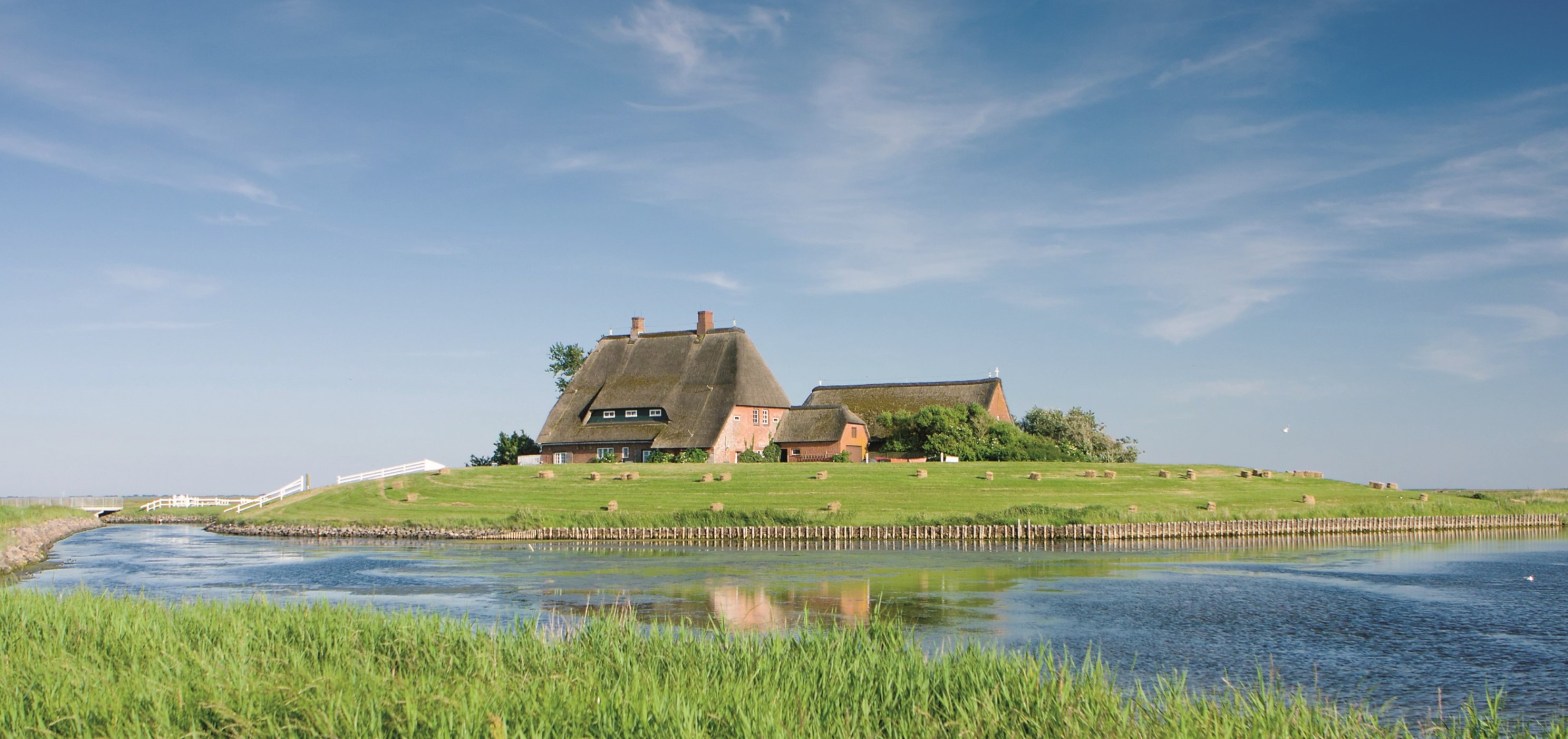
This is your DIY manual for enlarging or creating your own terp — an artificial settlement mound or house platform designed to protect against sea or river floods, depending on where it is built. Although terps have been constructed on the tidal marshlands of the Wadden Sea for over 2,600 years, this manual is the first of its kind. We sincerely hope it is not too little, too late, now that terp-building is on the rise again. Too often we see these projects carried out in an amateurish manner, with unnecessary safety risks being taken.
Although most terps were built between 650 BC and AD 1050, they remain a relevant solution even today. Take, for example, the terp constructed near the town of Wieringerwerf, located in the reclaimed land of the Wieringermeer Polder in the province of Noord Holland. Both the town and the terp were founded in the 1930s. The terp even proved its worth at the end of the Second World War, when the dykes of the Wieringermeer Polder were destroyed. See our blog post Refuge on a Terp 2.0. Waiting to Be Liberated for more about this event.
The most recent terps were built about a decade ago, in 2015, in the Overdiepse Polder in the province of Noord Brabant. These were constructed as part of the Room for the River programme, following severe flooding along the major rivers Rhine and Meuse two decades earlier. Finally, at the time of writing (2017), the inhabitants of the village of Blije, in the province of Friesland, have come up with a cunning plan to build a terp of their own. Construction of the Terp fan de Takomst (‘terp of the future’) was completed in 2022.
However, the fact that the inhabitants of the regions of Nordfriesland and Ostfriesland in north-western Germany, and the Frisians of the Dutch province of Friesland — the traditional builders and guardians of the terps — had noticed that the residents of the province of Noord Brabant, and, before them, those of the province of Noord Holland, were failing to observe all the necessary rituals and procedures deeply troubled them. In time, such negligence might have very serious consequences for the safety and health of the people dwelling upon these terps. The Frisian bastards therefore felt an urgent need to produce a manual, in the hope of preventing similarly irresponsible behaviour in the future.
Be warned: children should construct terps only under the direct supervision of an adult. Adults are advised to read these instructions carefully, paying particular attention to all warnings. Needless to say, we accept no responsibility whatsoever for any unfortunate consequences resulting from the construction or use of a poorly executed terp.
Let’s begin. Brace yourself — what follows is, quite literally, a substantial amount of bullshit.
A: Location, Location, Location
If you want to know where in the landscape it might be opportune to erect a terp, consult the Dutch government’s website overstroomik.nl (literally, ‘Will I be submerged?’). Despite its somewhat alarming name, the site is not intended to frighten people, but to show them how high the water could rise around their home if a dyke were to fail, and how best to prepare for such an event. These, of course, are precisely the places where this manual may come in handy.
The website is available only in Dutch and is therefore inaccessible to the many expats living in the Netherlands. At the time of writing (2017), their number is estimated at somewhere between 40,000 and 75,000, many of them living in the low-lying coastal provinces of Noord Holland and Zuid Holland. Who’s counting? Or are foreigners considered to be more resilient by the Dutch government than its own citizens?
B: Tools & Materials
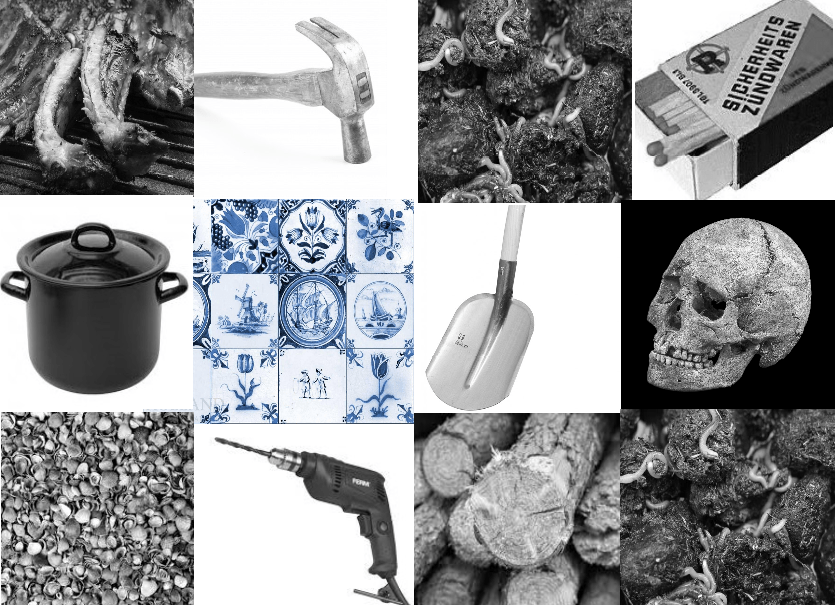
- eight (or more) skulls of ancestors
- ten kilogram cattle meat with bones
- one heirloom piece
- three cooking pans (not too small)
- drill
- ten kilogram pottery
- hammer
- eight hundred cubic meter cow dung (depending on your ambitions)
- shovel
- stack of firewood
- box fire matches
- sea shells (enough to cover the terp surface)
C: Instructions & Warnings

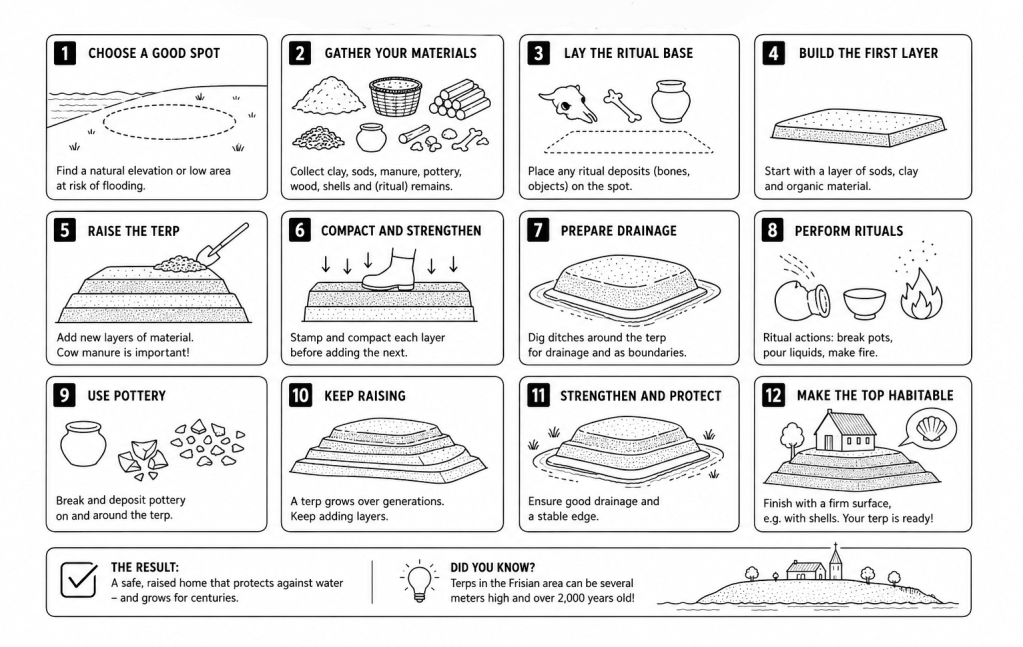
The best time to erect a terp is in early summer. You really do not want to be working with dung during the heavy rains of spring, autumn, and winter. For one thing, the containers would take ages to drain (see Step 7 below). For another, making fires (see Steps 8 and 9 below) in such weather is next to impossible. Most importantly, however, nobody wants to spend an entire day standing knee-deep in wet, smelly dung.
- Place your ancestral skulls on the spot where you want the terp to be erected, or an existing terp enlarged. WARNING 1 — Do not hurry off to kill some of your (close) family members. No! You need to collect remains of your already deceased family members. The terp is to protect you and your family, and the remains will call upon your ancestors for extra protection. Instead, there are many Grave Registration Services on the internet that can help you to locate graves of your ancestors. Some traditions recommend to add a dog skull. This manual considers it optional, as this practice of dog skulls is more related to the maintenance and protection of a house, and not that of a terp.
- Place the meat with bones near the human skulls. Make a little pile of it. The traditional way was that several cows were slaughtered for the occasion. You can go to a local butcher but spare ribs from the supermarket will suffice, too. Argentinian matured T-bone steaks are unnecessary expensive, and do not give a better result. Of course, we stimulate to use biological products. An option of last resort is to use jelly sweets, since they consist partly of cattle bone. As a rule of thumb: ten kilogram jelly sweet for every kilogram of meat.
- Place the heirloom piece near the skulls, too. Taking a piece from your in-laws is acceptable as long as it has serious sentimental value for your in-law family. Up to you whether or not you ask permission from your loved in-laws.
- Now the hard work begins. Think of Heracles cleaning the Augean stables. Using the shovel, gently dump the cow dung over the skulls and all the other items. There is no alternative: you will need to use predominantly cow dung, because of its excellent insulating properties. No human dung, please. Sorry, you will have to keep using toilets. WARNING 2 — No horse dung either. It is highly infectious. Mixing in some sheep dung, however, is not a serious problem. The bottom line is that you are going to need loads and loads of dung. In this respect, not much has changed over the past 2,600 years: cow dung has always been plentiful in the salt marshes. In the old days, it was used as fuel and, of course, for building terps. Later, after the great dykes were built and the sea was effectively banished some 1,000 years ago, dung suddenly acquired a new and important function: fertilizer. And now, in a final twist of irony, its excellent insulating properties have become a threat to the climate.
- Dig ditches around the terp. About a meter wide, but not much broader. For a man of average weight and strength, it must be possible to fierljep (‘to far-leap’) over the ditch with a four-meter-long leaping pole. The ditches have multiple purposes. Firstly, they are for draining purposes. Secondly, they mark your territory. Thirdly, they have a spiritual meaning, namely fencing of the inner world form the outer (scary) world. Check the Indiculus superstitionum et paganiarum, the eighth-century list of heathen practices of the Frisians and the Saxons.
- Wait until dusk.
- At dusk, take the cooking pans and drill a small hole in the bottom. Similar as the Mayas later did, too, with the pottery they buried with the dead. The traditional way of the Frisians was to grab used cooking pots of clay. Essence is that you need containers. Then and now. So, modern pans are perfectly okay to use. Mark the pans from the outside with some of your own blood. No specific patterns prescribed. Fill the pans with a sticky substance that slowly drips through the hole into the dung. Place these containers on the spot above the skulls, meat, and heirloom piece.
- Make a few small piles of wood and light the piles. Again, above the spot where the skulls are buried. WARNING 3 — Make sure the cow dung is not too dry, to prevent the whole terp from catching fire. Dried dung is flammable. And we are not in the region of Nordfriesland in February during the yearly biikin celebrations.
- Wait until the liquid in the cooking pans has fully been drained into the dung. You will have enough time to have dinner in the meantime. Important to keep the fires burning.
- Collect the pottery once the liquid has drained. Almost any kind will do. Tired of those Delft Blue wall tiles? Use them. Roof tiles, your neighbour’s porcelain, or whatever else happens to be available will work just as well. Smash the pottery with a hammer and bury the fragments together with the now-empty perforated cooking pans in a pit somewhere inside the newly created terp. Smash or deliberately deform the pans as well. Frisians were remarkably enthusiastic about breaking pottery, carefully collecting significant fragments over decades. If this seems strange, think of a Greek wedding.
- Dump some of the pottery pieces in the ditches surrounding your terp too. If you have some spare bones of your ancestors left, put it there together with the pottery pieces. It stresses the mark of your territory like a dog pisses against a tree. Additionally, the water in the ditches will protect your house or inner-world against the spiritual, angry outer-world as well.
- Lastly, cover the surface of the new terp with a thick layer of sea shells to have a solid and less smelling floor.
Congratulations! And have a safe and pleasant stay on your terp!
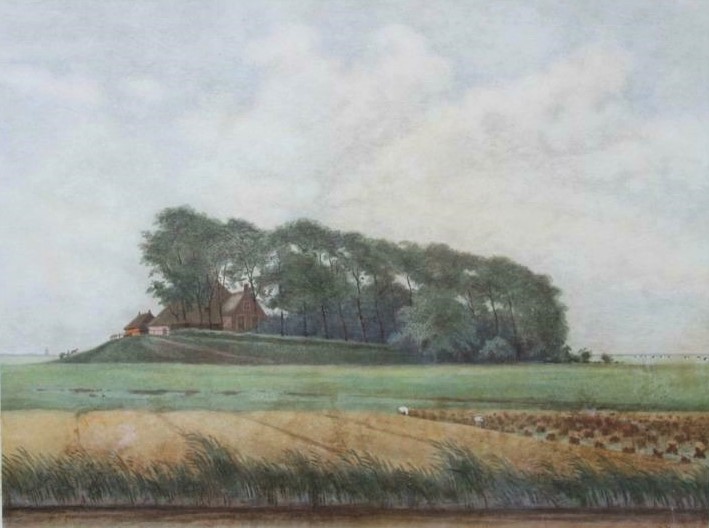
Note 1 — The ritual practices in the Manual have been confirmed by archaeologists; Nieuwhof, A., Eight human skulls in a dung heap and more. Ritual practice in the terp region of northern Netherlands 600 BC-AD 300 (2015).
You may giggle at the practice of digging ditches and marking your territory with pottery and the bones of your ancestors, but it was, in fact, one of the foundations of modern Western society. Ditches, banks, walls, hedges, and similar boundaries embodied control over resources through agricultural property rights. They also gave tangible expression to social relationships, status, and communal identity. Yes, identity was originally determined by the land a group possessed, rather than by genes or ancestry (Oosthuizen 2019).
Note 2 — On behalf of all the Frisians we do apologize for the global warming effects of their dung culture. Even today, heavy debates are ongoing between government and (Frisian) farmers concerning nitrogen emission from, among other, cow dung (Remkes 2022).
Note 3 — Two more terps have been built in the Netherlands recently, and both in the municipality of The Hague. Both as monuments, and not meant for a settlement platform. These are the Terp of Vink, and the terp at the town of Leidschenveen. See our blog post The One Terp That Should Have Been Named a Wierde? Even more exotic, in 1930s the dairy farm Friesche Terp was set up in Pengalengan near the city of Bandung in the Dutch-Indies, present-day Indonesia.
Note 4 — For an overview of the phenomenon of terp earthworks, flip through our blog post Between Leffinge and Misthusum — Understanding the Basics of Terps.
Note 5 — If you have become fascinated by all things cow dung after reading this blog post, you might enjoy the Bullshit Bingos held in the Nordfriesland region. Check the Instagram accounts of Deichdeern_com and Kloenstedt for dates and locations.
Suggested music
- Reboelje, Eilân yn de see (1999)
Further reading
- Baudewig, K., Alltag auf der Hallig (2025)
- Beek, R. van., Veel meer terpen in Nederland dan gedacht (2026)
- Betten, E., Terpen- en wierdenland (2018)
- Frankfurt, H.G., On Bullshit (1986)
- Halbertsma, H., Terpen tussen Vlie en Eems. Een geografisch-historische benadering (1963)
- Knol, E., Friese terpen doorgesneden (2023)
- Knol, E., Hogebeintum aan snee (2019)
- Knol, E., et al, The medieval cemetery of Oosterbeintum (Friesland) (1996)
- Kuipers, J.J.B., Jensma, G. & Vries, O., Nederland in de Middeleeuwen. De canon van ons middeleeuws verleden (2011)
- Meier, D., Die Halligen. In Vergangenheit und Gegenwart (2020)
- Nicolay, J. & Langen, de G. (eds.), Friese terpen in doorsnede. Landschap, bewoning en exploitatie. Deel I: het onderzoek in woord en beeld (2023)
- Nicolay, J. & Langen, de G. (eds.), Friese terpen in doorsnede. Landschap, bewoning en exploitatie. Deel II: profiel- en vlaktekeningen (2023)
- Nicolay, J. & Langen, de G. (eds.), Graven aan de voet van de Achlumer dorpsterp (2015)
- Nieuwhof, A., 650 Terpen langs de Noordzee (2018)
- Nieuwhof, A., Eight human skulls in a dung heap and more. Ritual practice in the terp region of northern Netherlands 600 BC-AD 300 (2015)
- Nieuwhof, A., Ezinge Revisited. The Ancient Roots of a Terp Settlement. Volume 1: Excavation — Environment and Economy — Catalogue of Plans and Finds (2020)
- Nieuwhof, A., Scherven brengen geluk. Aanwijzingen voor opzettelijk gebroken aardewerk (2018)
- Nieuwhof, A., Bakker, M., Knol, E., Langen, de G.J., Nicolay, J.A.W., Postma, D., Schepers, M., Varwijk, T.W., Vos, P.C., Adapting to the sea: Human habitation in the coastal area of the northern Netherlands before medieval dike building (2019)
- Oosthuizen, S., The emergence of the English (2019)
- Renswoude, van O., Leeuwarden en andere warden (2022)
- Teetied & Rosinenbrot (podcast), Warften? Komm wir schütten einen Hügel auf! (2023)
- Versloot, A., De herbewoning van de Friese kwelders en terpnamen. Een onderzoek naar mogelijke verbanden (2021)
- Westerink, B., Wierdenlandschap (2022)
- Wiersma, J.P. (ed.), Bruorren Halbertsma, Rimen en teltsjes; De Terp (1969)
credit featured image Nordsee Tourismus


One thought on “DIY Manual — Making a Terp in Only 12 Steps”