
Temperatures
WATER
The North Sea moderates the climate, though its water temperature varies significantly by region. Around the Shetland Islands in the north, sea temperatures hover close to 10 °C throughout the year. Further south, nearer the European mainland, seasonal contrasts are much greater. Along the southern coast, the North Sea reaches its lowest temperatures in February, averaging about 5 °C, and its highest in August, averaging around 17 °C.
The Wadden Sea shows even wider temperature swings. Because its shallow waters heat up and cool down quickly, they can become markedly colder or warmer than the open sea. In Germany, Wadden Sea temperatures can dip to around −1.5 °C in February and climb to as high as 23 °C in August.
So, when you are on one of the roughly fifty Wadden Sea barrier islands, it can make a noticeable difference whether you go swimming on the North Sea side or on the Wadden Sea side.
LAND
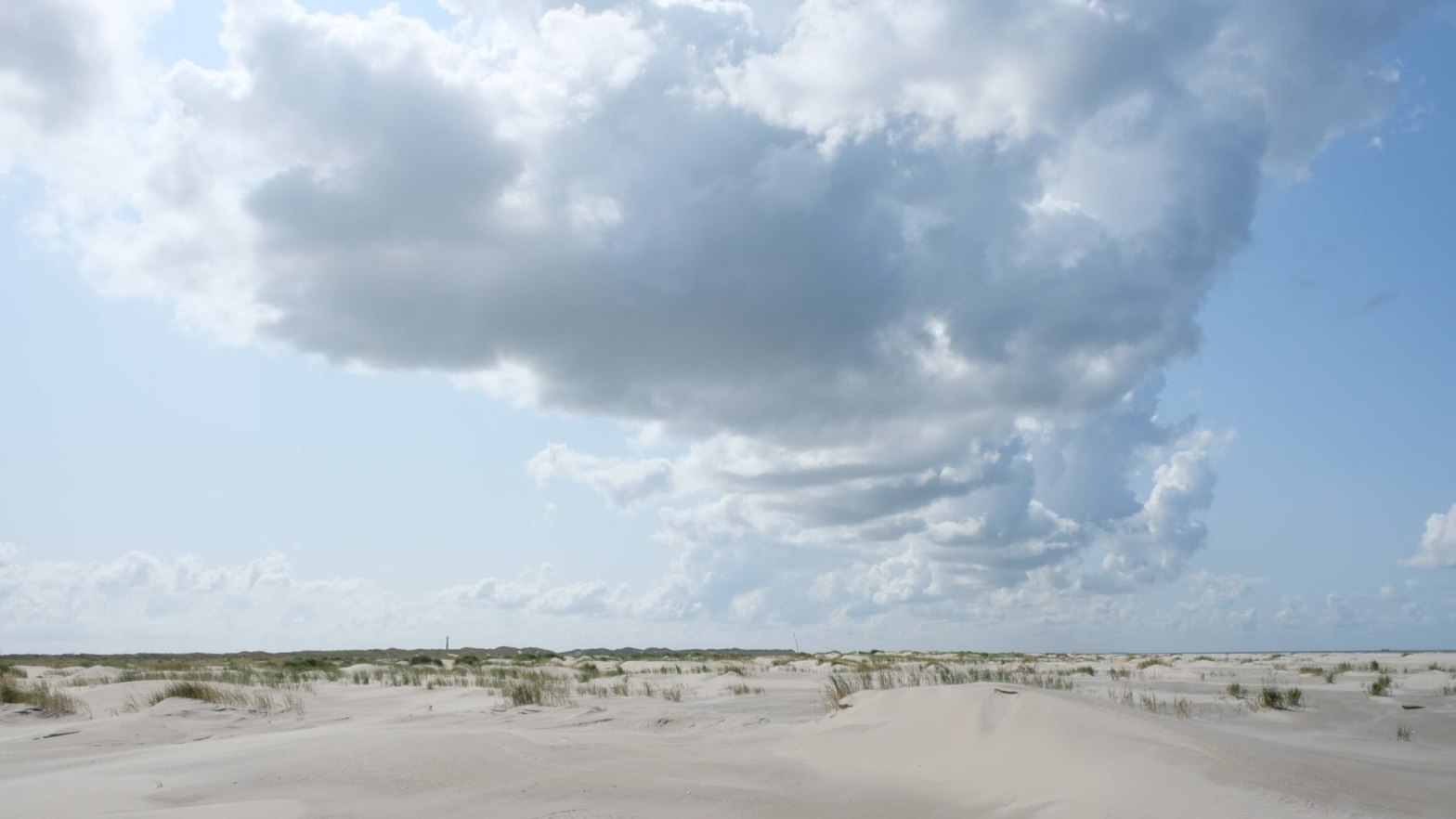
It will not come as a surprise that the landscape of the Frisia Coast Trail lies in a maritime climate. Temperatures are moderate year-round, with the North Sea keeping coastal areas relatively mild.
Along the North Sea coast of Belgium and the Netherlands — from the Zwin estuary in Flanders up to the province of Noord Holland, roughly the area of former West Frisia — average daytime temperatures are lowest in January and February at around 6 to 7 °C, and highest in July and August at around 22 to 23 °C.
Daytime temperatures along the Wadden Sea coasts of southwest Denmark, northwest Germany, and the north of the Netherlands are at their coldest in January and February, at about 5 °C, and at their warmest in July and August, at about 22 °C. Differences along the Wadden Sea are small — perhaps 1 °C cooler on average in Landkreis Nordfriesland (Germany) compared to the province of Friesland and the region of Ommelanden in the province of Groningen (Netherlands).
Because of this maritime climate, harsh winters are rare. If, exceptionally, a deep freeze does occur while you are on the trail, forget walking: buy skates and join the crowds on the ice. It is a unique sight to see thousands of people skating on canals and rivers. If conditions get cold enough, the Elfstedentocht (Eleven Cities Tour) will be held in the province of Friesland — a roughly 200-kilometre skating tour across the province. When it happens, millions follow the event worldwide and accommodation in the entire small province sells out. The region goes into what feels like a complete lockdown. Do not worry, though: the last Elfstedentocht took place in 1997.
Wind
Winds along the coast can be very strong, especially in December and January. The dunes, the terps (also called wierde, Warft, Wurt, etc.), and the dykes of the Frisian coast form the first, albeit low, barrier to these winds — although offshore wind farms increasingly act as braking structures as well. Wind direction is predominantly southwest or west during autumn, winter, and early spring, when Atlantic low-pressure systems frequently move in. For hikers, this means that travelling east or northeast is generally the most pleasant option during these seasons.
Winter and spring are also the main seasons for storms, floods, and occasionally major floods. During this time, the tidal marshes of the Wadden Sea coast and the Hallig islands of Landkreis Nordfriesland are regularly inundated. The clay and mud become so saturated that one sinks to the knees — making crossings not only impractical, but also potentially dangerous.
Hiking through tidal marshlands is indeed extremely difficult and can be dangerous. Most historic North Sea flood disasters occurred during these dark winter months — see also our blog post Half a million deaths. A forgotten North Sea disaster…. In summer, by contrast, high-pressure systems gain influence over the Continent and winds more often come from the south or east, bringing warmer conditions to your (tidal) plate.
Rain (precipitation)
Always be prepared for rain, and do not economize on rain gear when walking this trail. Carry your Friesennerz oilskin jacket and sou’wester at all times. Atlantic low-pressure systems shed much of their rain over the British Isles, but not all. In the Netherlands, August is the wettest month with roughly 180 mm of rain, while February is the driest with around 45 mm. Counterintuitive, isn’t it? In the region of Ostfriesland, northwest Germany, it rains on average 16–17 days per month, with the wettest period between November and January.
Given these statistics — rarely freezing, and the lowest precipitation in winter — it becomes clear why coastal dwellers laugh at the idea of a ‘white Christmas.’ It has happened only eleven times in the past century. Winter hiking will normally not confront you with snow, and if it does, it is seldom enough to be any obstacle. What you will have to deal with is rain and wind, and the Frisia Coast Trail is flat and exposed: no cliffs, almost no forest, and no natural or manmade shelters. There is, quite literally, nowhere to hide from the elements.
But — and this is the compensation — the combination of sea climate and low, flat land produces spectacular skies. The constantly shifting cloudscapes, the clear, sharp light, the famous ‘low sky’: they can be breath-taking, especially when the weather is rough rather than conventionally ‘good.’ When crossing the Wadden Sea flats, the experience can be otherworldly: a landscape without horizon, where sea floor and sky merge into one vast, luminous nothing.
Do hike under the clouds!
Note 1 — With all this damp weather, salty sea winds, and (former) peat lands, we do not understand why whisky distilleries have not become a big hit.
Note 2 — Featured image, the Wadden Sea island of Ameland by Hans Faber.
Suggested music
- The Cult, Rain (1985)
- Jimi Hendrix, Rainy Day, Dream Away (1968)
 Frisia Coast Trail