
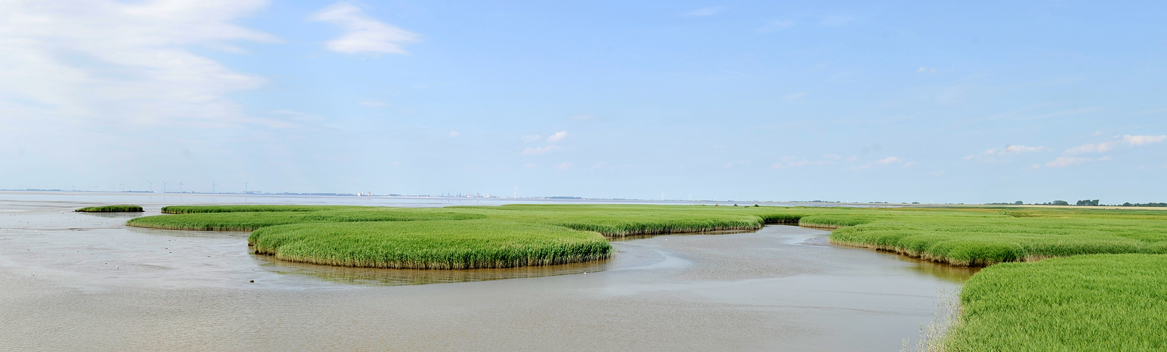
River Ems (DE) to River Jade (DE)
- Length: 280 km (175 miles) in 14 sections
- Terrain: flat
- Region: East Frisia
From the River Ems to the River Jade, marking the end of the region of Ostfriesland, or East Frisia, in Germany. The coast of stage 6 was know for its pirates in the Late Middle Ages. Still the trail means hiking along the Wadden Sea, but the track also leads more inland to the town of Aurich where in the High Middle Ages the so-called ‘Seven Sealands’ of tota Frisia gathered at the thing called the Upstalboom. As you hike east, look out for the last Angles, Jutes, and Saxons migrating west, a migration that started 1,700 years ago.
Trail Sections
- section 6.1: Nieuweschans — Soltburg
- section 6.2: Soltburg — Oldersum
- section 6.3: Oldersum — Aurich
- section 6.4: Aurich — Loppersum
- section 6.5: Loppersum — Krummhörn
- section 6.6: Krummhörn — Greetsiel
- section 6.7: Greetsiel — Norden
- section 6.10: Norden — Neßmersiel
- section 6.11: Neßmersiel — Dornumersiel
- section 6.12: Dornumersiel — Harlesiel
- section 6.13: Harlesiel — Hooksiel
- section 6.14: Hooksiel — Willemshaven/Eckwarderhörne
Description
During Roman Period this was the territory of the Chauci minores ‘minor Chauci’. A probably with the Frisii maiores (Frisians) related people or vice versa, and of which we know from the Romans in the first century AD they lived on terps, i.e., artificial dwelling mounds, as well. In German a terp is called a Wurt, and in Lower-German Warft, Warf or — just like in the province of Groningen in the Netherlands — wierde).
After the fall of the Roman Empire, the Chauci disappeared and over the course of fifth and sixth centuries, the (new) Frisians extended their influence into this area, from then on East Frisia, the present-day region of Ostfriesland. The law code Lex Frisionum ‘law of the Frisians’ of ca. AD 780 described this area as inter Laubachi et Wisaram, meaning ‘between the River Lauwers and the River Weser’.
From this region a rich Old Frisian law corpes of the High Middle Ages has been kept. Of course, the region of Ostfriesland is, as said, also where the town of Aurich is and where the thing of the Upstalsboom was. Here delegates of the Seven Sealands would meet every year on the first Tuesday after Pentecost. Check our blog post Upstalsboom: why solidarity is not the core of a collective. East Frisia encompassed the Sixth and Seventh Sealand. The medieval shires of East Frisia are: Overledigerland, Saterland, Moormerland, Lengenerland, Emsigerland, Brokmerland, Auricherland, Norderland, Harlingerland, Wangerland, Östringen, and Rüstringen. Sometimes the Saxon region of Dithmarschen is included, although it has no Frisian history.
And later, in the fourteenth and fifteenth centuries, this was the coast of pirates, a.o. the Vitalienbrüder, the Victual Brothers. Ports like Greetsiel and Norden were important hide-outs of pirates like Klaus Störtebeker and Godeke Michels. Their fleets were a serious threat for the Hanseatic League trade interests.
With the rise of the Hauptinge or Hoventlinge, slowly the farmers republics fell apart. The Frisian language has disappeared here, too, just like in the province of Groningen, and has been replaced by Oostfreesk, a speech of the Low-Saxon language and closely related to the Low-Saxon dialect spoken in the region of Ommelanden in the province of Groningen in the Netherlands, former Mid Frisia.
Photo’s
For a first, visual impression of this stage, click here.
 Frisia Coast Trail