
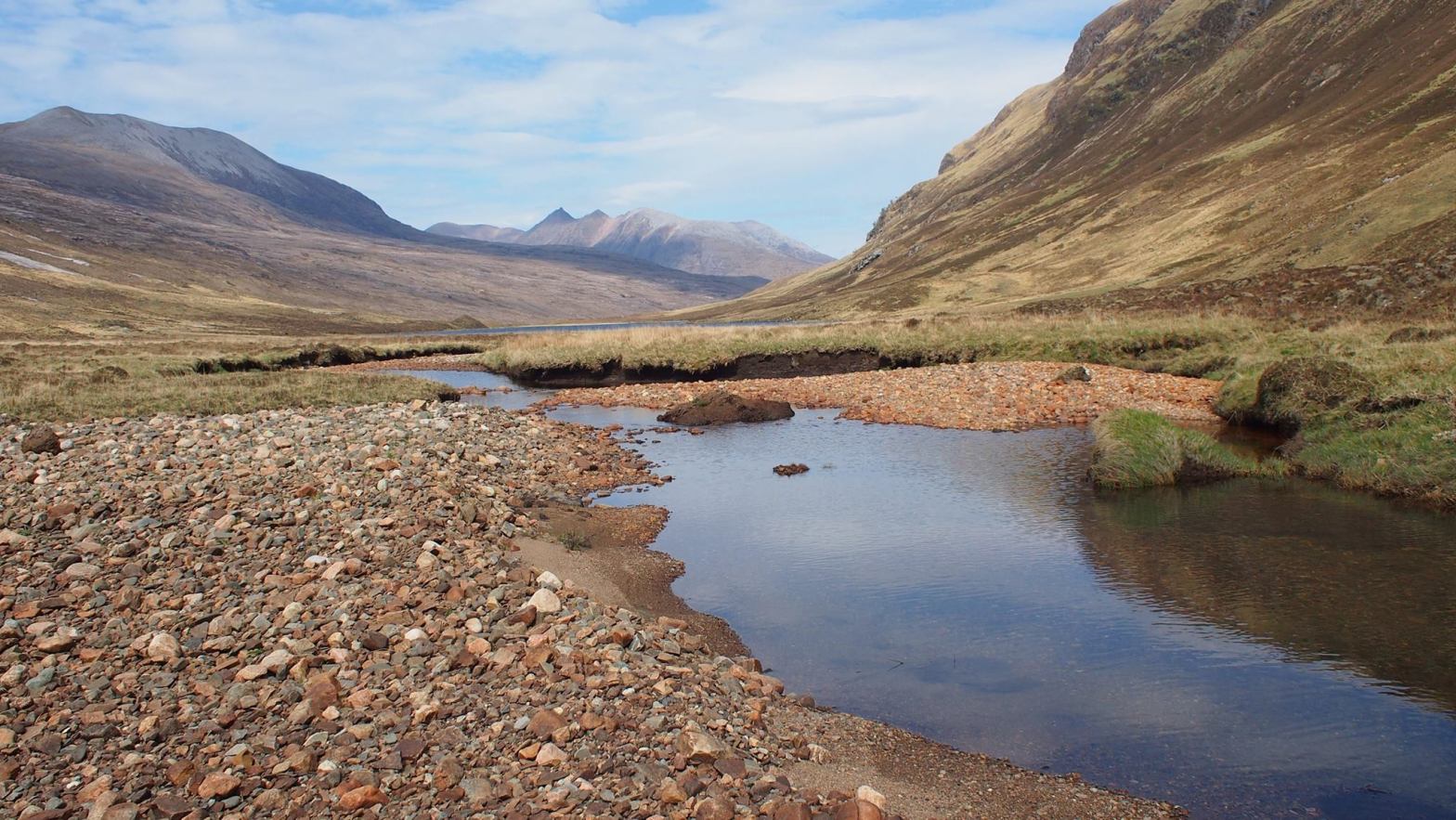
The essence of the Frisia Coast Trail is hiking through the heartland of (former) Frisia: to experience the landscape, its history and culture, and to meet its people. Every now and then, ‘Frisian bastards‘ venture onto trails that pass through the heartlands of other minority cultures. Hiking the illustrious Cape Wrath Trail in the far northeast of Scotland was one such adventure. It was a two-week, fairly challenging trek with no fixed route — and, consequently, no path directions. Often there weren’t even paths to follow, just open glens stretching into emptiness. The only requirement was to start at Fort William and finish at the isolated Cape Wrath lighthouse. This particular bastard completed the journey in fourteen days, including one rest day — at KLB.
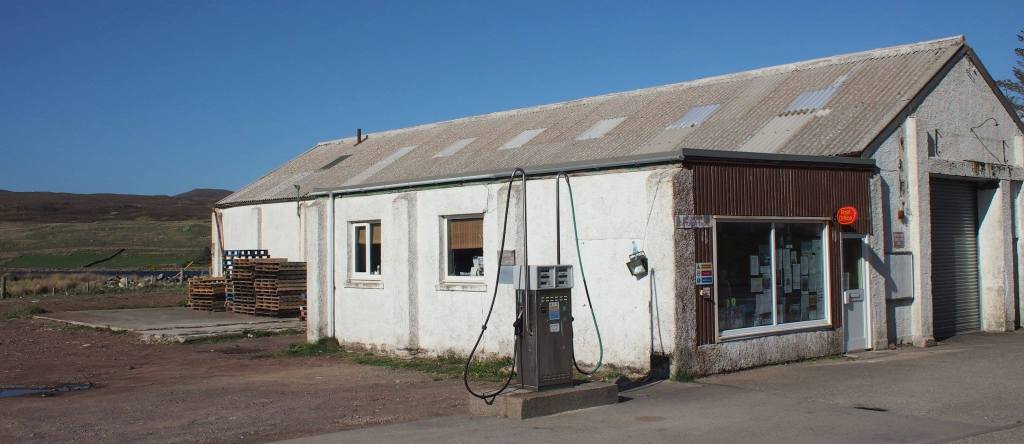
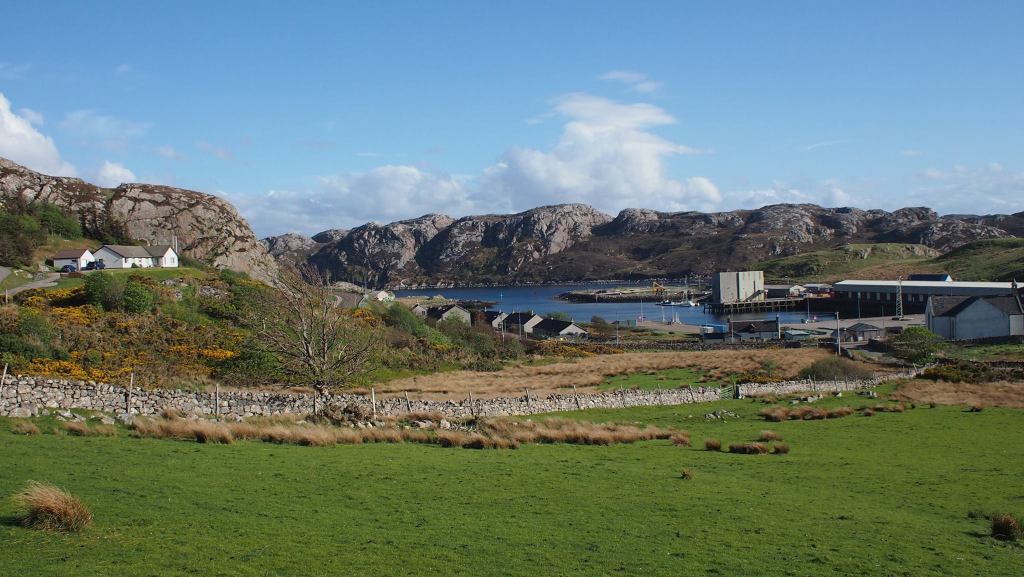
Ceann Loch Biorbhaidh, or Kinlochbervie in English — and KLB to locals — has that unmistakable frontier feeling. It is a harbour tucked into the far northwest of Scotland, almost at the edge of the map. The look and feel can be harsh: strong winds and horizontal rain sweeping straight in from the Atlantic. The town has no clear structure; houses appear scattered at random. There’s a store that doubles as a post office, and a SPAR supermarket housed in a converted hangar on the quays. A gas station stands with a single rusted pump, offering no other facilities. Nearby, a half-rusted purple abri carries a bus-stop sign. Here and there, houses have fallen into ruins, and an old church sits abandoned.
At the port, small-scale industry persists amid rusted chains and pale crates, the air thick with the smell of fish and diesel. A large sign announces that the port’s expansion was made possible by the European Union — though for how much longer, now that the UK has left? KLB sits at the frontier, where beauty is not sought, and yet, perhaps because of that, it is beautiful.
It was a tough day to reach KLB. The bastard started early, setting off from the town of Kylesku at 5:00 a.m. Waking up was not difficult — birds were already singing — or quarrelling — around 4:30 a.m. The weather was dry, allowing breakfast outdoors and the packing of bag and tent without any dampness. Slugs were everywhere, so he carefully folded his tent to make sure not to squash a single one in the folds of the fabric.
Crossing the massive Kylesku Bridge, which separates Loch Gleann Dubh from Loch a’Chàirn Bhàin, the path gradually climbed Ben Strome. A reasonable ascent, steady but persistent. On the east side of Ben Strome lies Loch an Leathiad Bhuain. After summiting, the path descended toward Loch More and the tiny village of Achfary — just a handful of houses and a church. The narrow secondary road through Achfary winds past the stunning Loch Stack, and it is hard not to imagine that the creators of Game of Thrones borrowed heavily from the mystically resonant names of this region.
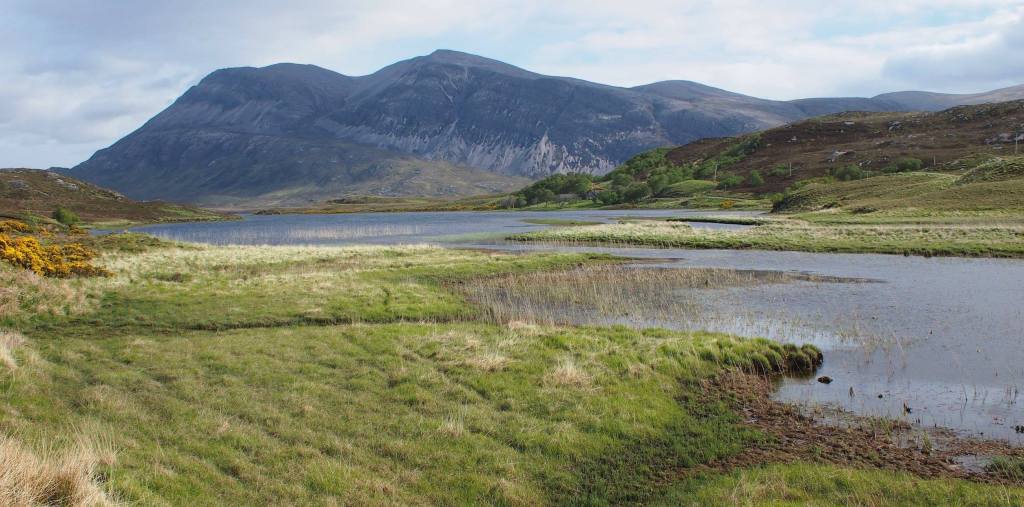
After walking along the southern shores of Loch Stack westward in the rain, the path turned north again into the mountains, heading toward Ben Arkle, which rises to almost eight hundred meters. At the foot of Ben Arkle, the trail veers northwest and leads to the narrow but long Loch a’ Garbh-bhaid. What follows is about seven challenging kilometres without a path, through the usual bog, swamp, and peatland. Navigating the first section — from the end of the path to the loch — is particularly tricky: a 1.5 km stretch of pure swamp. Somehow, the bastard managed to get through it without getting stuck and lived to tell the tale.
Beyond the swamp, it becomes an endless struggle through bog and tall, grassy vegetation along the north bank of the loch. Of course, there is still no path. This might be one of the most exhausting sections of the entire CWT. Halfway through, you reach the River Garbh, which must be crossed. You have to walk quite a way upstream to find a ford. With heavy rain, this river could easily become an impassable obstacle. Shoes and socks off, you step into the cold, refreshing water, taking care with each move, as the current is strong and the algae-covered stones are dangerously slippery.
Loch a’ Garbh-bhaid empties into a short river — or, more accurately, a stream — called the Rhiconich. This stream, in turn, ends abruptly near the hamlet of Rhiconich. The road is hidden from the river, and vice versa, thanks to a small forest. So when you arrive at Rhiconich, it feels as if you have stepped out from the wings and suddenly find yourself on the stage of civilization — a bit of a Steppenwolf moment.
It was 2:00 p.m. Nine hours of constant walking, and not a single break yet. Hotel Rhiconich was closed, not opening until 3:00 p.m. The place looked a bit shabby, and the mood was low. In the distance, at the end of Loch Inchard, KLB could be seen — a magnet for the bastard. A seaport. The ocean. But his feet hurt, and doubt crept in. After some cold instant coffee, a few cigarettes, and a bit of chocolate, energy returned to his mind. Inevitably, he decided to finish ‘the bitch’ and move on to KLB — a two-day stretch in a single day. The last stretch, however, would be on asphalt, and therefore brutal on his feet.
But it went well. The skies cleared, the sun shone brightly, and it grew hot as he walked — which helped. A blister was the only thing bothering the bastard, nothing more. After an hour and a half, he arrived at the London Store, a famous spot according to the guides. The owner, an old man likely over seventy, sat outside in the sun.
“You’re doin’ well,” he called out in a thick, hard-to-understand Scottish accent. “Saw ye comin’.”
“Thanks,” said the bastard, setting down his walking poles and backpack. The store was packed to the ceiling with everything imaginable. He bought an apple, two packs of cigarettes, a bottle of Coke, and some candy. Another half hour later, he reached KLB. Around 4:00 p.m. — ten hours of hiking, about thirty-five kilometres, through mountains and bog, with a full pack. Not bad.
The bastard tried the only hotel in town near the harbour: Hotel Kinlochbervie. An original name, though the place was in a decaying state — and a bit smudgy to boot. The aquarium in the hall was coated with algae, though the fish were still alive.
The large woman behind the desk barked without making eye contact: “No, we are full.”
“Oh, that’s a pity. But can I make a reservation for dinner tonight?” the bastard asked.
“No, full too,” she barked again. No progress in the conversation.
The bastard resorted to the desperate-hiker routine: “Sigh — no food either — sigh — Do you know where I can get food now? Until what time is that store open? Closed already, too? Sigh — etc.”
The bastard remained friendly and cheerful — his only chance. And yes, she finally heaved herself up, walked slowly to the back, and returned. If he came early tonight, around 6:00 p.m., he could still get a meal. He thanked her profusely, promised to eat quickly, and asked where he could pitch his tent in a sheltered spot — or if she might have any addresses for nearby bed & breakfasts.
She actually started making calls. After the fourth one, she got a hit. Abruptly, she handed over the wired phone to the bastard with a curt: “You make the deal.” It was £35. The bastard told the owner of B&B Buzzy Bee — that was the name of the place — that he would come right away.
The bastard opened the hotel door, ready to rush off to Buzzy Bee, when standing in front of him was the Manchester Man. Incomprehensible! The bastard had last seen this fellow hiker — whose name he had long forgotten — two days ago in the village of Inchnadamph. He could not imagine that the Manchester Man had covered the same distance on foot.
The Manchester Man, realizing his deception was obvious, immediately launched into a story: he could not have reached the village of Durness in time, so he had taken the bus from the village of Kylesku to that of KLB. The bastard silently wondered how many times public transport had featured in his journey. In any case, the Manchester Man needed accommodation and, without asking if it was alright, followed the bastard to Buzzy Bee.
When he opened the squeaky fence, Moira, the owner, was already outside. “Gosh, it’s two of you!” she shouted from a distance.
The bastard explained who the Manchester Man was, and eventually, he too got a bed. Owner Moira moved from her own bedroom to the little house in the garden to make space.
Moira was pleasant and energetic — end of her fifties, very talkative, with a hint of hippie spirit. Just like her house: full of frills and character, and she grew her own vegetables. It was a typical old Scottish home, door in the middle, a window on each side, painted white. Very cosy.
Moira explained that she never took reservations. “I’m too chaotic for that,” she said, clearly proud of what she had achieved. Originally, she came from Manchester, and after her divorce, she moved here with her little, barking dog. Her children studied elsewhere in the UK.
The bastard had to cut the conversation short and freshen up quickly — he did not dare arrive a single minute late for dinner at the hotel. Moira had made that perfectly clear. The ‘big lady’ at the desk turned out to be the owner, and Moira was surprised that she — Mrs. Bell, as she was called—had gone to the trouble of phoning ahead to arrange accommodation.
The restaurant was huge. Almost nobody was there. In total ten guests. Big windows. Very surreal almost. Thinking this must be like dining in the Restaurant at the End of the Universe (Adams 1979). The bastard had two entrees: pea soup and salmon salad. Main course a steak, and for desert an apple pie with custard. And, the necessary alcohol, of course. Beer and Laphroaig whisky.
Next to the bastard sat two tall, strong men. At first, he thought they were soldiers. When he ordered a Laphroaig whisky from the Irish waitress, both of them burst out laughing.
“Why?” he asked.
“You only drink Laphroaig as punishment when you lose a round in a card game,” they replied.
The bastard immediately called after the waitress: “Make it a double!” That sent them into laughter again, and just like that, a conversation began.
The men turned out to be anglers, though at the ocean rather than a river. The bastard commented that they looked ‘different’ from the river-trout fishers he had dined with at the fancy Oykel Bridge Hotel a week earlier.
They laughed again. “Aye, you mean the traditional ones,” they said. Trout fishers are wealthy men, driving big cars, wearing stockings, and speaking like British nobility. Posh. You would not associate them with soldiers.
The food was average, but not bad. Mrs. Bell served it, breathing heavily and in near-silence, while the cheerful Irish woman, speaking in a thick accent, took the orders. She addressed the Frisian bastard emphatically as “Mister Faber” (pronounced Mistè Faybu) and always added the informal “love.” At the same time, the Irishwoman tended the bar in the pub next door. “I’m a bit too old for this now,” she explained. But since her years in Switzerland, she said, she had not been able to pursue any other profession.
The view from the big windows while eating was grandiose. The hotel is high above the fishing port and the weather was beautiful. Especially in the evening sun. After dinner the bastard made a detour through the village and across the port area especially.
Back at B&B Buzzy Bee, the bastard drank coffee with Moira and met the third guest, Joshua. Joshua was a Kenyan in his mid-thirties, and had been in Scotland for just three months. He was a math teacher at the local secondary school. After two years of bureaucracy, he and the school had finally succeeded in securing visas for him to come to the UK and take up the post of math teacher in KLB. For the past two years, the school had been without a math teacher — no Brit, or any other European, was interested in such an isolated northern post.
“Great how Western immigration procedures prioritize the future of children in already empty and aging countrysides,” the bastard could not help thinking. Now Joshua was waiting for better, more private accommodation, probably a residential caravan. Predictably for a Kenyan, he ran fast each morning — a sight that must have seemed remarkable in this remote fishing port in the northern Scottish Highlands.
But more people from afar were coming to KLB. Tourists, especially, according to Moira. Sometimes even tour buses, instead of the usual campers. Recently, a coach full of Germans had arrived. They entered the tiny SPAR supermarket on a Thursday and bought all the bread. Panic swept through the village.
“My God, the Germans bought all the bread!” Moira exclaimed. KLB, after all, is only supplied with fresh bread once a week — every Thursday. With the departure of the German tour bus, the village had suddenly run out of bread for almost a week.
After some more gossip about the locals, the bastard smoked a cigarette outside and went to bed. Tired from a very full, long day, but extremely satisfied. Moreover, no tent to sleep in. A wonderfully soft bed, instead, with duvet. For two nights even!
The bastard made the following comparison between Scots and Frisians — things they have in common and things they do not:
Scots and Frisians have in common:
Scots and Frisians have not in common:
- both suffer from predominant western winds and lots of rain;
- both have lots of sheep;
- both still carry the original tribe name after more than 2,000 years: Scoti and Frisii;
- both distillate whisky (yes, Frisians too);
- both excessively use their national flags;
- both have no real independent country;
- both value the concept freedom highly;
- both are capable of self-reflection;
- both favourite pastime is building things (Frisians terps, Scots castles);
- both have the skill to recognize beauty.
- both engage in invented traditions, the kilt and the battle cry ‘Leaver dea as slaef’
- Scots wear skirts, Frisians do not;
- Scots distillate good whisky, Frisians do not;
- Frisians distillate Beerenburg, Scots do not;
- Scotland has 5,3 mln inhabitants, Friesland 0,6 mln;
- 60,000 Scots speak Gaelic, 400,000 Frisians speak Frisian;
- Frisians are scattered over countries and areas, Scots are not (both diasporas not included);
- consensus about Scottish identity, about Frisian identity not;
- Frisians remember battles they won, Scots the ones they lost;
- Scots have wet bog, Frisians have wet clay;
- many Scots strive for independence, only few Frisians do.
And then, of course, Frisians and Scots stand at the foundation of airwave transmissions in the world in the first quarter of the twentieth century; the Frisians with radio, the Scots with television. See our blog post What Killed the Radio Star? The Frisian Claim to Radio Fame.
Note 1 — Moira, also known as the Moirae or the Fates, is the Antique goddess with three manifestations, namely Clotho, Lachesis, and Atropos. This were subsequently the spinster that spun the woollen thread of life, the allotter that directed the fate or destiny of people, and the unturner (or death) that cut the thread of life. Spinning wool by woman and the turning of the wheel, is a very old and widespread theme of Western believes, religions, myths and sagas. See also our blog post Come to Rescue ‘The Rolling Sheep‘.
Note 2 — See our blog post Frisian Support for the Corsican Cause in Jeopardy—Hiking the GR20, and our blog post Croeso i Gerddwyr—Hiking the Pembrokeshire Coast Path in Wales.
Note 3 — If interested in the complete blog post of the author about his solo hike of the Cape Wrath Trail, check this link (in Dutch), and here for more pictures of the Cape Wrath Trail.
Note 4 — SPAR supermarkets are a Dutch invention founded in 1932. A multinational franchise that manages independently owned and operated food retail stores. Originally the name was DESPAR (The Spar) which stands for Door Eendrachtig Samenwerken Profiteren Allen Regelmatig, which freely translates as ‘By Unitedly Working-together Profit All Regularly’.
Further reading
- Adams, D. The Hitchhiker’s Guide to the Galaxy (1979)
- Allan, G., The Scottish Bothy Bible. The complete guide to Scotland’s bothies and how to reach them (2017)
- Atkinson, T., The Northern Highlands. The Empty Lands (1986)
- Harper, I., Walking the Cape Wrath Trail. Through the Scottish Highlands from Fort William to Cape Wrath (2015)
- Knottnerus, O., Liever dood dan Fries? De ongemakkelijke geschiedenis van een vermeend spreekwoord (2024)
- Murphy, A., Schotland Highlands & Islands, Footprint (2011)
- Page, O. et al, Schotland, Trotter (2009)
- Renswoude, van O., Noch jimmer de simmer (2022)
- Wilson, N., Scotland’s Highlands & Islands, Lonely Planet (2012)
- Wright, P., Walking with Wildness. Experiencing the Watershed of Scotland (2012)
 Frisia Coast Trail